Skip to content
1/7
Collective bargaining for an inclusive, sustainable and resilient recovery

Collective bargaining for an inclusive, sustainable and resilient recovery

Collective bargaining plays an important role in many countries in securing decent work and guaranteeing equality of opportunity and treatment.

The COVID-19 crisis made this importance even more evident. During the pandemic, collective bargaining was critical to protecting workers and reinforcing the resilience of enterprises and labour markets.

Explore this InfoStory to learn more.

Full report

The key to inclusive and effective governance of work

Collective bargaining is a fundamental principle and right at work. The effective recognition of this right enables voluntary negotiations between employers (or employers’ organizations) and workers’ organizations, which can result in a collective agreement.

How does collective bargaining contribute to the inclusive and effective governance of work?

Collective bargaining offers a unique model of co-regulation, one enacted by the parties themselves. Some of the features of this form of governance include:

Responsive regulation

It enables parties to tailor rules to their particular circumstances and to adapt them when circumstances change. It provides for “regulated flexibility” in respect of wages, working time and other conditions of work.

Inclusive labour protection

It facilitates inclusive labour protection, both in the coverage of enterprises and workers (e.g. workers on temporary contracts, migrant workers) by collective agreements and the manner in which such agreements address issues such as wages, social protection and terms of employment.

Enables sustainable enterprises

It helps create an enabling environment for sustainable enterprises, by promoting trust, cooperation and stability, the retention of firm-specific skills, and the pooled financing of social protection.

Strengthens compliance

It strengthens compliance with statutory or negotiated labour standards, reducing statutory resources needed to monitor and enforce labour standards.

Institutional resilience

It forges resilience, by facilitating the trade-offs required to ensure business continuity and save jobs and earnings during a crisis, while transforming labour practices for a future with decent work.

1/4

What shapes collective bargaining coverage?

Over 1/3 of employees in 98 countries have their pay and other working conditions set by one or more collective agreements

The collective bargaining coverage rate ranges from 98% in Austria, France and Italy to around 1% in Ethiopia, Malaysia and Thailand.

Strong and representative employers’ and workers’ organizations are crucial for the effective representation of interests...

...in collective bargaining and the legitimacy of the outcomes and agreements reached.

Collective bargaining during the COVID-19 pandemic

Ensuring safe workplaces during the COVID-19 pandemic

The tailoring of public health measures and joint oversight of occupational safety and health (OSH) in the workplace, together with the paid sick leave and healthcare benefits provided for in many collective agreements protected millions of workers, sustained key services and enabled businesses to continue operating during the pandemic.

Of the 512 collective agreements and practices examined by the ILO across 80 countries:

  • 69% of agreements include measures ensuring safe workplaces 
  • 71% of agreements provide healthcare benefits and sick pay

Jobs and earnings: How collective bargaining mitigated the impacts of the COVID-19 crisis

Collective bargaining played an important role during the COVID-19 crisis in forging resilience, saving jobs, protecting earnings and safeguarding business continuity. Negotiated solutions also helped to cushion the pandemic’s effects on inequality.

A future with decent digital work practices

Stay-at-home measures and lockdowns throughout 2020 and 2021 accelerated the digitalization of work.

Agreements negotiated in response to the COVID-19-induced telework and hybrid working practices are now transforming into more durable frameworks.

The experimentation underway in the gig economy with collective bargaining is paving the way a future with decent digital work.

Negotiating for an inclusive, resilient and sustainable recovery

To realize the potential of collective bargaining to contributie to an inclusive, sustainable and resilient recovery, a number of priorities must be addressed. 

Revitalizing employers’ and workers’ organizations

The representative function of employer and business member organizations (EBMOs) and trade unions – both in terms of membership strength and capacity to integrate diverse interests – is the bedrock of effective social dialogue, including collective bargaining.

Investment in membership recruitment and retention strategies is vital, as is the development of the necessary expertise to engage in inclusive and effective evidence-based policy dialogue and collective bargaining going forward.

Effective recognition of the right to collective bargaining for all workers

The ILO has repeatedly affirmed the universal nature of principles and rights enshrined in the fundamental Freedom of Association and Protection of the Right to Organise Convention, 1948 (No. 87) and the Right to Organise and Collective Bargaining Convention, 1949 (No. 98).

Realizing these principles and rights is only possible under a broader regulatory framework that encourages and promotes the full development of voluntary negotiations conducted in good faith.

Given the proliferation of diverse work arrangements in recent years, there is a need to review regulatory frameworks at the national level to ensure legal clarity, so that those needing protection are covered by labour laws and other laws and regulations.

Promoting collective bargaining

Collective bargaining needs to take place within an enabling regulatory framework established by the State – or in some countries, by the parties themselves.

Such a framework should promote the full development of voluntary negotiations, including through the provision and sharing of information, the training of negotiators and facilitation and dispute resolution services to support collective bargaining.

Investing in bipartite and tripartite social dialogue

Effective and inclusive social dialogue requires continued engagement on social and economic policy with and between peak-level employers’ and workers’ organizations, as well as with governments.

Investment in bipartite and tripartite social dialogue can provide the institutional means to ensure a human-centred recovery.

Reinforcing social dialogue for the achievement of the Sustainable Development Goals

Social dialogue, including collective bargaining, can contribute to the implementation of the 2030 Agenda for Sustainable Development.

While social dialogue is clearly vital for attaining Sustainable Development Goal 8 (on decent work and economic growth), it can also support other Goals through its unique contribution to the inclusive and effective governance of work.

1/4

Find out more

To learn more about collective bargaining and its role in mitigating the impact of the COVID-19 crisis, explore the first edition of the new ILO flagship report, Social Dialogue Report 2022: Collective bargaining for an inclusive, sustainable and resilient recovery.
Discover the proportion of workers covered by collective agreements in each country

What factors are shaping the regulatory coverage of collective bargaining?

The effective recognition of the right to collective bargaining, including:

  • The ratification and implementation of the ILO Convention No. 98 on the Right to Organise and Collective Bargaining, and related ILO Conventions.
  • Legislation and institutional steps to promote collective bargaining in respect of workers in the public sector, as well as among domestic workers, migrant workers, agricultural workers, workers in the informal economy and workers in export processing zones.
  • Ensuring all workers, irrespective of their contractual status, are afforded freedom of association and collective bargaining rights, including temporary employment, dependent self-employment and, most recently, platform work performed under various work and employment relationships.

Strong and representative workers’ and employers’ organizations.

The institutional setting for collective bargaining, including whether collective bargaining is carried out on a single or multi-employer basis, the coordination of collective bargaining and the manner in which collective agreements are applied.  

Alternate text

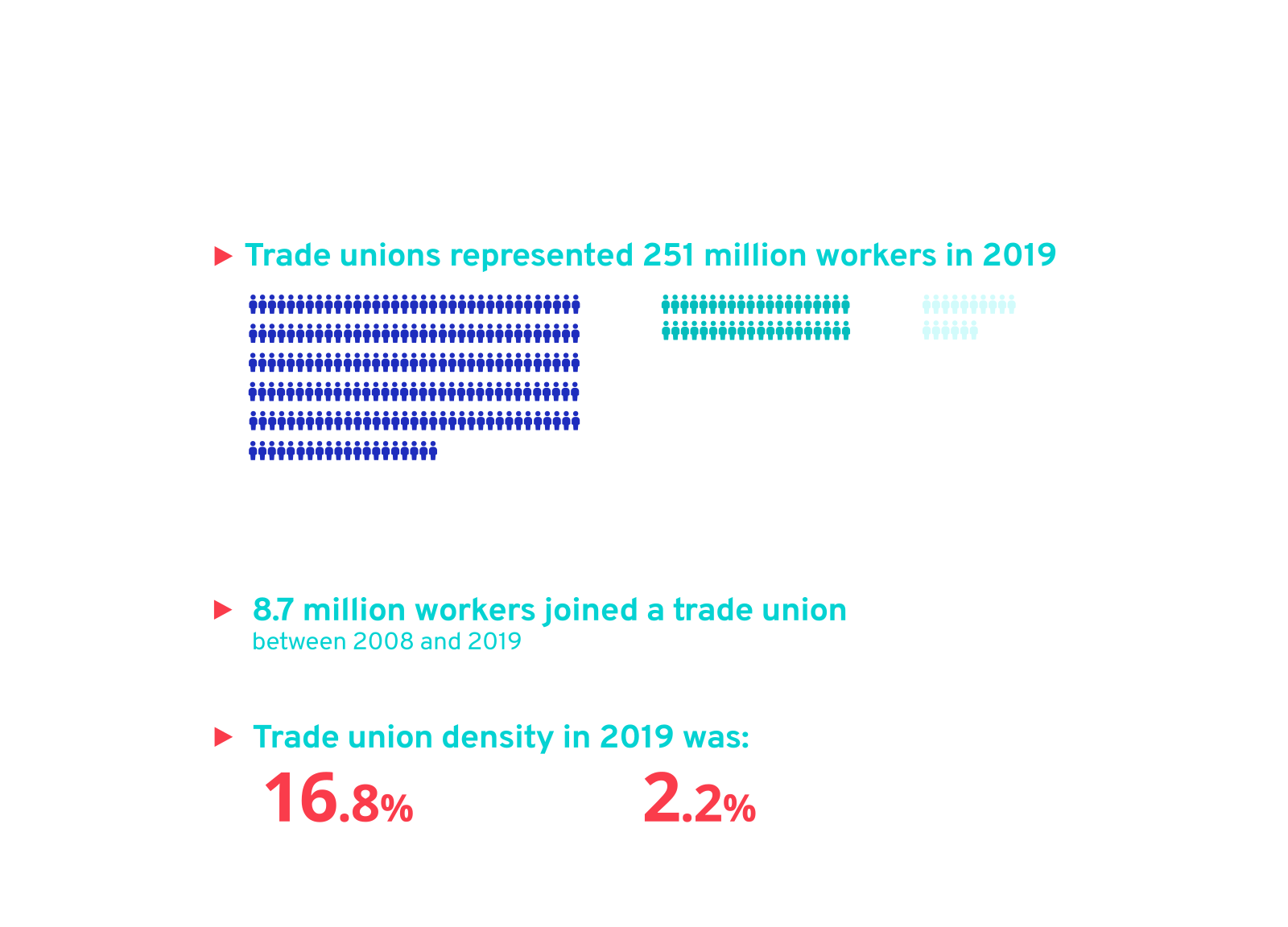
How many workers are members of a trade union?

What role do employers’ organizations play in collective bargaining?

The ILO conducted a survey in April and May 2021 among employers’ and business organizations on their involvement in collective bargaining. Here are some of the key findings.

Occupational safety and health clauses in collective agreements

Protecting frontline workers

  • Make appropriate personal protective equipment available, ensure staff use it correctly and have the necessary rest breaks from the equipment.
  • Vaccination and testing
  • Workplace safety measures ( e.g. installation of physical barriers and cash-free payments).
  • Protection of at-risk workers (e.g. redeployment).
  • Improved sick leave entitlements and leave for self-isolation. 
  • Psychosocial support for workers (healthcare and social care).
  • Improved health and life insurance.
  • Protection against violence and harassment at the workplace.

Participation in COVID-19 workplace safety

  • Expansion of mandates of OSH committees to include risk assessment, reporting and implementation of COVID-19 measures.
  • Establishment of dedicated crisis response committees to address and monitor crises.

Hierarchy of controls in OSH risk management: Substitution

  • Maximum use of telework and/or suspension of activities in departments not essential to production.
  • Mandatory telework for workers with pre-existing conditions and over the age of 65 years.
  • Right of workers to refuse to return to work if a substantial threat exists to their health and safety.

Hierarchy of controls in OSH risk management: Engineering controls

  • Increased ventilation of workplaces.
  • Setting up of partitions between workers (e.g. in manufacturing).

Hierarchy of controls in OSH risk management: Organizational and administrative measures

  • Temperature checks at the workplace.
  • Limited occupancy and movement within workplaces, restricted access to common spaces and adequate distancing.
  • Provision of individual sanitation kits (e.g. alcohol gel) and longer breaks for personal hygiene.
  • Increased sanitation of workplace.
  • Paid sick leave for COVID-19 and paid leave for self-isolation periods and vaccination.
  • Vaccination roll-out at the workplace or costs covered by employer.

Hierarchy of controls in OSH risk management: Personal protective equipment

  • Provision of adequate personal protective equipment.
  • Correct use and rest from personal protective equipment.
1/4

Safe banana plantations in Colombia

In Colombia, the banana growers’ association (AUGURA) and the trade union (SINTRAINAGRO) in the Urabá region negotiate a general collective agreement every two years. The general agreement covers 80 companies that own 320 farms and employ around 20,000 workers, and forms the basis for further negotiations between individual plantation owners and their respective trade unions.

Following a work stoppage in early 2020 over dissatisfaction with health and safety conditions in the pandemic, the AUGURA and SINTRAINAGRO negotiated a Bio-Safety Protocol. The protocol contains provisions on safe distancing at the workplace and in transport, hand washing guidelines, regular cleaning and disinfection of equipment, and the provision of personal protective equipment. It also provides for verification of suppliers and customers’ health status as well as the quarantining of persons with symptoms.

Workers over 65 or with comorbidities were not required to work during the peak of the pandemic. Once the paid sick leave of these and other workers required to isolate was exhausted, they received the minimum wage plus an 8% supplement.

Joint union-management OSH committees monitored the protocol’s implementation. As a result, incidence of COVID-19 was reported to be lower than in other regions in the country.

Collective agreements create safer workplaces

Data from the Better Work programme from 393 garment factories in Cambodia, Jordan and Viet Nam during the pandemic shows that compliance with OSH standards is better in factories with a collective agreement.

Clauses in collective agreements safeguarding employment, earnings, and business continuity

Implementing state-sponsored employment retention measures

  • Workers on short-time and furlough schemes not to be made redundant.
  • Fixed-term contracts to be renewed to give temporary workers access to state-sponsored income replacement schemes.
  • Agreement to supplement statutory replacement rates.
  • Creation of solidarity funds to ensure higher supplements for low-wage workers through, for example, the contribution of accrued leave entitlements or wage contributions by higher paid workers and managers.
  • Preserve leave and social protection entitlements during furlough periods.

Negotiating short-order flexibility to save jobs and safeguard business continuity

  • Wage moderation or postponement of wage negotiations in exchange for employment guarantee.
  • Suspension or conversion of variable pay and bonuses.
  • Reductions in working time and work-sharing.
  • Use of working-time credits and banked hours to maintain jobs and earnings.
  • Use of paid annual leave entitlements during shutdowns.
  • Functional and geographic mobility.
  • Commitment to prevent redundancies or mitigate effects.
1/4

Partnering for business continuity and employment in South Africa

In South Africa, COVID-19 lockdowns and border closures significantly affected the clothing manufacturing sector. This included the temporary halt of fabric imports and the closure of factories and retail shops.

In March 2020, the Minister of Employment and Labour issued an emergency directive to create a COVID-19 Temporary Employee/Employer Relief Scheme (TERS) under the Unemployment Insurance Fund. The scheme replaced lost income resulting from temporary lay‑offs or reductions in working hours.

The National Bargaining Council for the Clothing Manufacturing Industry (NBCCMI) negotiated four COVID-19-related agreements. All were extended by the Minister to the entire sector.

March 2020: Compensation for lost earnings

The first COVID-19 Collective Agreement (23 March 2020) committed the NBCCMI to obtain statutory funds to partially compensate workers for lost earnings due to the impending lockdown.

The NBCCMI entered into an agreement with the TERS to receive and administer the funds for the sector on the basis of a sectoral agreement. Employers agreed to pay three out of six weeks during the first lockdown, with the remaining three weeks being paid from TERS funds received by the NBCCMI.

The agreement established a Rapid Response Team to implement the agreement.

May 2020: Adjustment of working time

The second COVID-19 Collective Agreement (12 May 2020) extended the first agreement, continuing the statutory TERS scheme.

As “essential service providers”, a number of clothing firms began producing personal protective equipment and operating at 50% capacity on a rotating basis, so that workers were protected and all workers had the opportunity to work and earn wages.

June 2020: Production of personal and protective equipment and other essential products

The third COVID-19 Collective Agreement (2 June 2020) provided the sector with the full backing of organized business and labour in the production of personal protective equipment (PPE) and other essential products.

The agreement set a production target for the industry (100 million fabric face masks per month). A PPE Rapid Response Task Team was established to implement the agreement. The agreement also established a register of PPE Manufacturing Qualifying Companies, accredited by the NBCCMI.

April 2021: Vaccination campaign

The fourth COVID-19 Collective Agreement (6 April 2021) encouraged all employees in the sector to get vaccinated, with a view to achieving an 80% immunity target.

The Clothing and Textile Workers’ Union’s Worker Health Programme and workplace medical facilities were made available to support the vaccination campaign.

1/4

Balancing work and additional care responsibilities

In 2020 and 2021, the need to balance work with care responsibilities emerged as a key issue on the bargaining agendas in several countries. Discover how collective agreements helped to reduce the burden of care work during the pandemic.

Germany

A sectoral agreement for transport service providers (2021) established special time-off of up to 50 days in 2021 for additional childcare responsibilities as a result of COVID-19 pandemic.

Argentina

A sectoral agreement in the banking sector introduced a day-care centre allowance.

Australia

An enterprise agreement in the healthcare sector (2021) enabled workers to refuse to work overtime due to their personal circumstances, including family responsibilities.

Bangladesh

A plant-level enterprise agreement in a textile manufacturing company (2020) established a day-care centre for children under the age of six.

Cambodia

An enterprise agreement in garment manufacturing (2020) reconfirmed the statutory requirement to provide a day-care allowance.  For infants from 18 months to 3 years old, the factory should either establish a day-care centre or pay the cost of childcare.

Costa Rica

An analysis of 12 collective agreements shows that during the pandemic public sector agreements included measures such as the guarantee of paternity leave and breastfeeding leave, surpassing statutory standards.

Denmark

A sectoral agreement in retail (2021) increased paid leave for care responsibilities of dependents from 2 days to 2.66 days, between May 2020 and August 2021.

United States

An enterprise agreement in a phone services company (2020) included paid childcare leave and paid family leave to care for persons diagnosed with COVID-19.

France

An enterprise agreement in a multinational electricity utility company (2020) provided for a supplementary payment to cover any shortfall in social security childcare benefits for parents whose presence was needed on site and whose child/children could not be placed in a crèche or school.

Norway

Several collective agreements in Norway adopted flexible working-time arrangements to address the burden of increased care responsibilities during the pandemic.

For example, a framework sectoral collective agreement for kindergartens (2020) expanded overtime limits for workers to facilitate increased demand for care services by healthcare and social care professionals.

Portugal

An enterprise agreement (2020) established an exceptional transitional allocation of one month’s salary to workers confined to taking care of children, where schools, nurseries and other social care services were not available due to COVID-19.

Republic of Korea

An enterprise agreement in healthcare (2020) established workplace childcare facilities in healthcare centres.

Senegal

A sectoral agreement for the bakery sector (2021) provides that after six months of service, workers are granted teo days of paid leave in the event of the hospitalization of the worker’s spouse or child.

1/4

Clauses shaping future telework practices

Facilitating transitions in work organization

  • Joint assessment of experimental hybrid telework during the pandemic.
  • Consultation rights on the introduction of permanent hybrid telework models.
  • New employees and apprentices / trainees to complete minimum period before teleworking.
  • Minimum period of onsite work to maintain culture of teamwork.
  • Implementation of surveillance proportional to needs and in compliance with legislation.
  • Right to privacy.
  • Protection of company data.
  • Employers to cover costs related to telework and workers to ensure infrastructure (electricity, bandwidth) compliant with company needs.

Ensuring decent teleworking conditions

  • Workers granted conditional control over working time, employers determine core periods during which employees can be reached.
  • Preference to continuous work periods with appropriate breaks to prevent over-connection.
  • Right to disconnect.
  • OSH standards for telework established and respected
  • Supervisors to monitor psychosocial risks and teleworkers to receive support and counselling.
  • Telework-related OSH training.
  • Full consultation and representation rights for teleworkers.
  • Equal opportunity and treatment.

Skills development

  • Workers to acquire digital skills including in respect of cybersecurity.
  • Certification of frameworks for digital skills.
  • Equal access of teleworkers to training.
1/4

Negotiating telework framework agreements: The experience from Belgium

Rudi Delarue, Chair of the National Labour Council, shares the experience of Belgian social partners

Experimenting with collective bargaining in the gig economy

Germany

An enterprise agreement with food delivery platform (2018) establishes a European Works Council with a provision to have employee representatives on the supervisory board.

Austria

A sectoral agreement covering bicycle couriers (2020) provides for monthly wage, overtime premium, bonus structure, limits on daily working hours, rest and vacation allowance.

It also covers personal protective equipment, a mileage allowance and an allowance for a mobile phone. Provisions for social protection, paternity and maternity leave reflect statutory standards.

Denmark

  • An enterprise agreement with cleaning platform (2018) covers conversion to employee status, hourly wages, social protection and data protection and processing. 
  • An enterprise agreement for platform translation workers (2018) sets tariffs and provides for annual adjustments for wage freelancers, data protection and full transparency of rating parameters and algorithms as well as dispute resolution procedures.
  • A sectoral agreement for food delivery riders (2021) provides for hourly wages, weekly working time, minimum periods for shifts, overtime and night work premiums, parental leave, mileage reimbursement, social protection, personal protective equipment, data protection, protections against dismissal, and severance pay.

Spain

  • An amendment to the sectoral agreement for hotels and catering sector (2019) specifies that it also applies to the food delivery workers working for digital labour platforms. It regulates wages and working conditions.
  • An enterprise agreement with a food delivery platform (2021) includes provisions on wages, working time, OSH training, personal protective equipment, health checks, accident insurance, and gender equality, including equal pay and equality of opportunity and treatment, and digital rights (right to disconnect, to privacy, to information on algorithms and data protection).

Italy

An enterprise agreement with food delivery platform (2021) provides for the minimum hourly rate and bonus structure. Riders receive mileage reimbursement, breaks and overtime banking and premiums. It includes training, personal protective equipment and access to accident and life insurance.

Norway

An enterprise agreement with food delivery platform (2019) establishes minimum wage rates, a winter bonus, reimbursement for equipment and includes a pension.

Republic of Korea

An enterprise agreement covering food delivery service platform (2020) stipulates that workers no longer need to pay a fee for being on the platform. It also regulates weekly payments, bonuses, health check-ups, safety training and the right to stop deliveries in the event of bad weather.

United Kingdom

  • An enterprise agreement with platform courier services company (2019) includes standard working time, bonus payments and holiday pay for “self-employed plus”. A follow-up agreement in 2021 updates the prior agreement with respect to pay rates.
  • An enterprise framework recognition agreement (2021) with a ride-hailing labour platform sets out procedures for consultation, collective bargaining and union facilities.

Switzerland

A sectoral agreement for bicycle couriers (2019) introduces a minimum hourly wage, overtime, a night work and weekend work premium, vacation days, mileage reimbursement, social protection and data protection.

1/4

We use cookies to give you the best experience. By using our website, you consent to the use of cookies. Find out more in our privacy policy.