Skip to content
1/7
The win-win of disability inclusion

The win-win of disability inclusion

Globally, there are over one billion people with disabilities. They are now more active in our society than ever before. Yet employment rates are low and many barriers to work still exist.

Explore this InfoStory to find out why employing people with disabilities makes good business sense for private companies, and how you can help promote inclusion.

Everybody gains from disability inclusion

For the one billion women and men with disabilities, inclusion in the labour market, and in society in general, requires the breaking down of existing barriers.

Companies have greater opportunities than ever before to bring in people with disabilities, as customers and clients, but also as employees and managers. By including people with disabilities, companies, individuals and society at large all win.

How does your brain think about disability?

The benefits of inclusive workplaces

Access to talent
By focusing on skills rather than stereotypes, you access an untapped pool of talent.

Increased innovation
Employees with diverse experiences have different approaches to problem solving.

Increased engagement and retention
Employees who feel included have higher levels of loyalty and enthusiasm.

Better reputation
Customers value companies that show a real commitment towards inclusion.

Benefits for everyone
Everyone benefits from an inclusive workplace, not just those with a disability.

Employing people with disabilities makes good business sense

Employers speak for themselves

All the company's corporate areas and business units agree that the key to equal opportunities is to make the presence of employees with disabilities a normality at the company.

Verónica Pastor, Deputy Director of Corporate Culture, Repsol

At IBM we recognize people as central to business success. (…) By maximizing the previously untapped potential that people with disabilities bring to the workplace, we walk the talk of embracing people of all different abilities.

Christian Bonnafont, Vice-President Software, IBM France

At Sodexo, we believe with everyone on board, committed to eliminating the misconceptions and biases that hold people with disabilities back, and focused on changing perspectives and raising awareness, everything is possible.

Denis Machuel, CEO Benefits and Rewards Services, Sodexo

Starting your disability inclusion journey

Get commitment from the top

Disability inclusion needs top-level backing if it’s going to become company policy.

A statement from the CEO can be incredibly powerful, so make sure it’s seen by all employees, shareholders and stakeholders. 

Remove recruitment barriers

Analyse every step of your recruitment process to make sure there are no barriers for people with disabilities and that everyone involved is properly trained.

Adverts for jobs and apprenticeships should also make it clear that you’ll provide reasonable adjustments for interviews and the job itself, if needed. 

Make yourself more accessible

An accessibility audit of your company is a good way to start making your premises and services (like your website) more accessible.

Make sure any new construction work complies with accessibility standards and is part of your occupational health and safety plans.

Think flexibly about individual needs

You should be prepared to make reasonable adjustments to the workplace. These could include modifying machinery and equipment, or the content of the job itself. You might also need to adjust working hours, work organization and the work environment. 

Learn more about reasonable adjustments.


Get support from others

Lots of organizations out there can provide support with job matching, disability awareness training or expertise on accessibility or on-the-job support.

Consider joining national business and disability networks or employers' federations – peer support is very helpful.

Work on being welcoming

Disability awareness training makes employees more confident about communicating with disabled people – and your working environment more welcoming as a result.

Disability awareness should also be included in all diversity training. Bear in mind that persons with disabilities are a heterogeneous group, including with regard to gender identity, ethnic diversity and sexual orientation.

Taking disability inclusion further

Put it in writing

Prove you’re committed to disability inclusion by making it company policy. This can be a specific policy or the inclusion of disability as part of more general policies on anti-discrimination, diversity or human rights.

Equal opportunities for all

Employing disabled workers is just the first step. As for all employees, you need to make sure disabled employees have access to all training and career progression activities.

Confidential staff satisfaction surveys are a good way to check how employees with disabilities are doing compared to non-disabled colleagues. Disaggregation of data by sex will help identify different impacts on women with disabilities as compared to men with disabilities.

Plan for every eventuality

Someone in your business could acquire a disability or mental health condition while working for you. A good disability management/return-to-work programme can reduce absenteeism rates and turnover of staff. There are lots of organizations that can help you establish programmes like this.

Think outside the business

Large companies in particular can contribute to disability inclusion by asking their suppliers to comply with disability legislation. You can also explore buying products and services from businesses that promote the employment of persons with disabilities and have disability inclusion practices in place.

Start networking

Many large companies have employee networks and some have disabled employee networks, including both disabled and non-disabled employees. These networks can be a valuable resource for promoting disability inclusion.

Tell others what you're doing

Make sure everyone knows about your inclusion initiatives. Use your website, newsletters and other channels to shout about your achievements, including your corporate sustainability report if you publish one.

1/4

Get help from around the world

The International Labour Organization (ILO) has been capitalizing on the momentum of disability inclusion through the ILO Global Business and Disability Network (GBDN).

GBDN consists of multinational enterprises, employers’ organizations, national business and disability networks, civil society organizations and academia. Its company members have signed the GBDN Charter and thereby commit to its ten disability inclusion principles

Making it easier for companies to hire people with disabilities

In many countries, companies that are willing to employ persons with disabilities encounter barriers which often make it almost impossible to provide jobs to disabled people.

How can different governments and social partners make it easier for companies to hire disabled people?

Finally, inclusion is everyone's responsibility

There are lots of ways to promote inclusion in the workplace. Smart companies have already started, and are enjoying more successful and sustainable businesses as a result. Many of these share their experiences with other companies, so they too can become more diverse.

At the same time, there is a role for non-business stakeholders to create a more enabling environment for disability inclusion. After all, making the workplace more inclusive is everyone’s responsibility.

Times have changed

And so have perceptions about disability

How does your brain think about disability?

Get the facts right

Ability to work

People with disabilities can and do work across all sectors of the labour market.

Adjustments to the working environment are sometimes needed, but often they cost nothing. 

A big social group

People with disabilities are a large and very heterogeneous part of any society, including in terms of gender identity, ethnic diversity and sexual orientation.

15% of the world’s population has a disability – or 1 in 7 persons.

Productivity

Employers of disabled workers consistently report that people with disabilities perform on par or better than their non-disabled peers in terms of productivity and attendance.

Types of work

A person’s disability does not determine the jobs she or he can do. People with disabilities can perform all types of jobs.

What counts is that they are enabled to use their skills and talents to full capacity.

Workplace adjustments

58% of workplace adjustments for people with disabilities involve no cost at all and 37% only involve a one-off cost, according to the US Job Accommodation Network.

Safety risks

There is no difference between employees with disabilities and those without disabilities when it comes to occupational safety and health concerns.

A multinational’s view on disability inclusion

Map

Our partners around the world

Get to know the Network

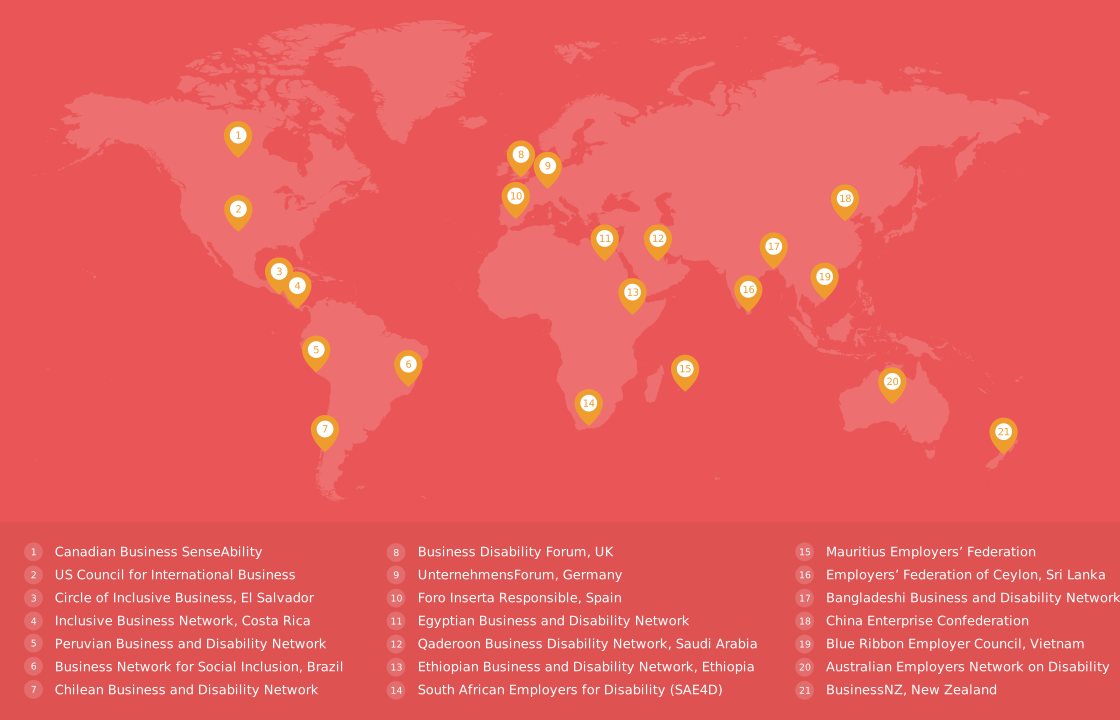
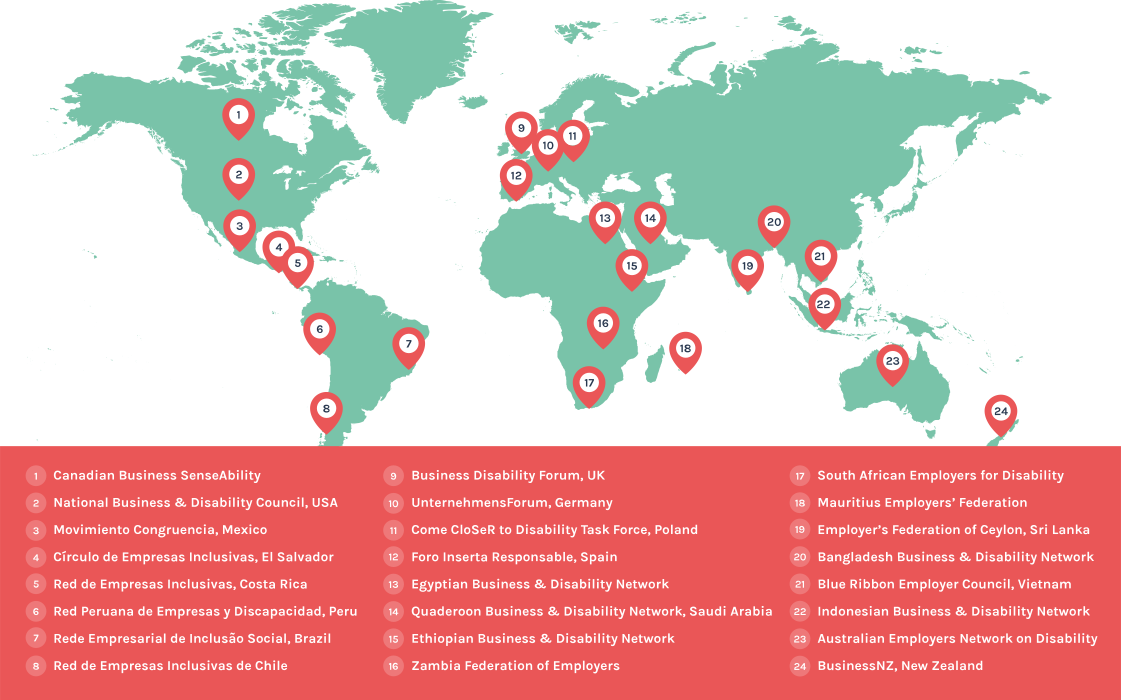
World map showing the location of partners of the ILO Global Business and Disability Network in 24 different countries.

The partners of the ILO Global Business and Disability Network include: Canadian Business SenseAbility; The National Business & Disability Council (NBDC) at the Viscardi Center, USA; Movimiento Congruencia, Mexico; Círculo de Empresas Inclusivas, El Salvador; Red de Empresas Inclusivas, Costa Rica; Red Peruana de Empresas y Discapacidad, Peru; Rede Empresarial de Inclusão Social, Brazil; Red de Empresas Inclusivas de Chile; Business Disability Forum, UK; Unternehmensforum, Germany; Come CloSeR to Disability Task Force, Poland; Foro Inserta Responsable, Spain; Egyptian Business and Disability Network; Quaderoon Business and Disability Network, Saudi Arabia; Zambia Federation for Employers; Ethiopian Business and Disability Network; South African Employers for Disability; Mauritius Employers’ Federation; Employer’s Federation of Ceylon, Sri Lanka; Bangladesh Business and Disability Network; Blue Ribbon Employer Council, Vietnam; Indonesian Business and Disability Network; Australian Employers Network on Disability; BusinessNZ, New Zealand.

Who has a role to play?

Access to education and training

If people with disabilities don’t have access to mainstream formal education, it is less likely that they will acquire the skills needed in the labour market. Institutions for basic and further education need to be made more accessible and inclusive, so girls and boys, women and men have equal opportunities to be prepared for the world of work.

In many countries, the only option for disabled people is still segregated vocational training, which offers a very limited number of skills, usually far from the labour market needs. The goal is to ensure that all mainstream vocational training is made accessible to women and men with disabilities. Apprenticeships, internships and traineeships are good paths to employment, too.

Matching companies and disabled job seekers

Public employment services play a key role in many countries in matching companies and jobseekers. All too often, these services do not effectively cover disabled jobseekers.

Complementing public employment services, in many countries there are special services (usually provided by not-for-profit organizations) that offer job-matching for disabled jobseekers. Some focus on people who require more intensive support, which is often provided through job coaches.

Campaigning for the employment of disabled people

Public authorities play a key role in sensitizing the general public about disability issues and promoting employment for women and men with disabilities.

Not-for-profit organizations, including organizations of persons with disabilities, can use campaigns to challenge stereotypes and the stigmas persons with disabilities experience, thus contributing to a more enabling environment for the employment of persons with disabilities.

Making it the law

Laws need to be adopted or revised with a view to eliminating discrimination based on disability and furthering the rights of people with disabilities. Laws should be in line with ILO international labour standards and the UN Convention on the Rights of Persons with Disabilities. Good examples include explicit prohibition of disability-based discrimination, general anti-discrimination legislation, and integration of disability rights into labour laws.

Legislation related to social protection needs to remove barriers that discourage persons with disabilities from looking for work or staying in a job. Quota legislation for the employment of persons with disabilities can be an important measure of decent work for disabled people.

Public procurers may need to comply with provisions regarding the inclusion of persons with disabilities as employees and/or physical and informational accessibility. Public procurement of goods and services can play an instrumental role in promoting disability inclusion.

1/4

We use cookies to give you the best experience. By using our website, you consent to the use of cookies. Find out more in our privacy policy.