Published in March 2023
How to achieve gender equality in global garment supply chains
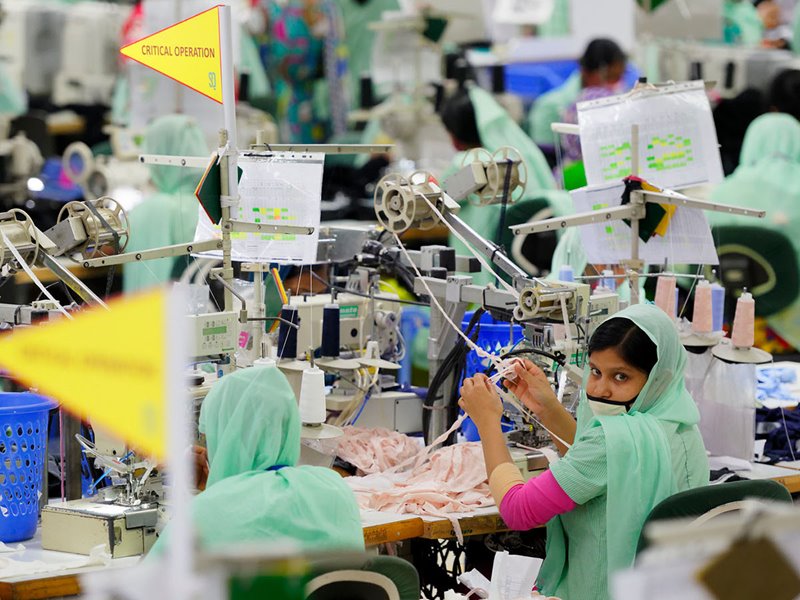
Over the last three decades, global supply chains have been a key entry point for women to enter the formal workforce. This has brought unprecedented opportunities for women to develop and increase their skills, improve their incomes and elevate their living standards.
While global supply chains have enabled women to become more economically empowered, especially in the garment sector, serious decent work deficits remain prevalent (as they are in other segments of the labour market), including discrimination, violence and harassment.
With a more equitable set of policies and actions, the garment industry could lift millions of workers out of poverty and drive inclusive economic growth.
A bird’s eye view of the global garment industry
In 2019, global garment exports amounted to US$1,038 billion. The industry lost an estimated 20% of its value during the COVID-19 pandemic years of 2020 and 2021, but more recent indicators show a promising recovery under way. In 2021, South-East Asia’s value of exported garments, for example, was 22% above its 2019 levels.
The garment industry is also a significant source of employment, providing jobs for around 94 million workers globally. While trends vary by region and country, nearly 60% of garment workers globally are women, reaching nearly 80% in some regions.
Asia is the largest employer of garment sector workers, accounting for 75% of all workers. An estimated 42 million women garment workers are employed in Asia.
Decent work deficits remain prevalent
Partially due to prejudices that place the burden of household and care responsibilities on women, female workers – more often than men – tend to be the ones in home-based production or working for smaller enterprises in the lower tiers of the garment supply chain.
As workers in the informal economy, they usually face highly vulnerable and precarious working conditions, typically without access to social security, labour law coverage, healthcare or minimum wage protections.
These decent work deficits are exacerbated by the dominant “fast fashion” business model in global apparel: the production of inexpensively manufactured apparel that changes quickly according to trends and relies to a large extent on low production costs, including labour costs.
Gender inequality: What are the four biggest challenges faced by female garment workers?
1. Women struggle to make their voices heard
Against a backdrop of generally weak social dialogue at both enterprise and industry level in many countries, working towards the protection of workers’ rights, including those of women, remains a big challenge.
Other challenges include the promotion of women’s participation in committees and bodies that enable social dialogue and collective bargaining, as well as their access to managerial positions.
These challenges are related to misperceptions of women’s goals, preferences and capabilities, as well as the often unequal share of unpaid care work they undertake in the home.
2. Women lag behind men in terms of equal pay for work of equal value
Women workers are disproportionately represented in low-wage jobs in the lower tiers of the sector’s supply chain, and they consistently lag behind men in terms of equal pay for work of equal value.
3. Women's care duties limit their opportunities
Women workers with children – and especially those women with lower education levels – face additional challenges and barriers at the workplace.
4. Women are more exposed to discrimination, violence and harassment
Sexual harassment and violence have been endemic for women in the garment industry, both in the workplace and while commuting. The problem increased during the pandemic due to heightened tensions arising from economic insecurity, as well as women’s decreased earnings and consequent loss of bargaining power at home.
In addition, many migrant workers who are confined to dormitories were unable to escape their abusers.
Success stories: Breaking through gender inequality
Find out how several garment workers contributed to achieve more gender equality in their workplaces.
- Maya Aktar, union organizer
- Better wages and workplaces in Indonesia
- Onsite nurseries to support working mothers
- Reporting sexual harassment
Maya Aktar, union organizer
When Maya Aktar was 19, she was living in Dhaka, Bangladesh, with her family of six. Her parents worked hard, but the family could barely make ends meet.
Maya made the bold decision to move to Irbid, Jordan, where she got a job as a receptionist in a garment factory that employed many migrant workers from Bangladesh. In Jordan, 72% of all workers in the garment sector are women and 76% are migrants.
In addition to Bangla, Maya spoke English and Hindi, and her language skills led her to the opportunity to work with a trade union, liaising between workers and management, translating and assisting in communication.
Not long after, Maya met a union organizer (working for the General Trade Union of Workers in Textile, Garment, and Clothing Industries in Jordan), whose ability to enact change inspired her. He inquired about whether she would be interested in working as a union organizer, too. She began her new position in 2020 and, through talking to workers about their issues, learned of problems ranging from contract violations to late wages to sexual harassment.
Maya’s experience ignited a passion to become a vocal advocate within the context of her work in the trade union for the needs and rights of the most vulnerable workers in the sector – migrants and women.
Better wages and workplaces in Indonesia
Eduard Peea is the Head of Human Resources Development at PT Doosan Busana garment factory in West Java. His factory, much like other factories in Indonesia, has had difficulties fostering dialogue and communication between workers’ representatives and management over wage increases.
In the Indonesia’s garment sector, the minimum wage is the lowest in relation to other sectors, and women earn 6.5% less than men in the same job.
The ILO was able to bring Eduard together with trade union and employer representatives in a training on collective bargaining, which included strategies to build worker–employer trust and to use best practices to formulate workplace policies.
With training, Eduard along with worker and employer representatives were able to communicate and collaborate better. This helped lead to a new collective bargaining agreement for the 1,200 workers between the trade union and the company, which followed an equal pay policy and accommodated the needs of both workers and management.
“Before there was only one-way communication from managers to workers…but now we are able to organize workplace dialogue that have led to higher productivity and openness,” Eduard said.
Onsite nurseries to support working mothers
Sara Samer faced a tough choice: Stay home to tend to her two daughters or face the near-impossible task of finding a workplace with a good kindergarten in Ismailia, Egypt.
“I had lost all my hopes,” the 31-year-old garment worker says. “My previous job didn’t provide employers with a crèche, so I had to send my eldest daughter, Isra’a, to a private kindergarten in my village.” But one problem followed another. Isra’a was often sick or suffering from stomach diseases due to the poor hygiene conditions.
Samer also found that her daughter was not receiving education or proper attention in childcare. In addition, the cost had become unsustainable. “I gave up and stayed home.”
Fortunately, she applied for and got a job with Jade Textile, Egypt’s largest ready-to-wear manufacturer, whose new facility boasted full-service childcare, with education classes, an outdoor play area and an on-site clinic.
Find out more about how childcare at work can lead to higher motivations levels and improved performance, especially among female employees.
Reporting sexual harassment
In 2020, Nguyen Huong Thao, a human resources officer at a factory in Hai Phong province, Viet Nam, decided to take initiative to address the discrimination, in particular sexual harassment, that had become all too familiar in her 16 years of working in an apparel factory.
In Vietnamese garment factories, 79% of workers are female. Sexual harassment has been a historically challenging problem to tackle and address. Evidence in 2020 showed that 19.8% of female workers and 11.9% of male workers in Viet Nam reported experiencing at least one form of violence in the previous six months.
With knowledge and skills gained from a training course on sexual harassment and violence prevention at the workplace, Thao proposed to the factory management to roll out a plan to boost employee awareness. Based on ILO/Better Work training, Thao pioneered a “train the trainer”-style initiative to create mechanisms to report sexual harassment and workplace violence.
A network of focal points in each factory now helps workers identify, monitor and report any sexual harassment cases found. These focal points participate in workshops and receive monthly coaching sessions to refine their skills.
A Just Transition paves the way to gender equality
Achieving a Just Transition throughout the garment sector is becoming increasingly important to achieving gender equality. It’s not only the sector’s heavy environmental footprint that requires urgent action. Climate change is having an evident impact on employment, and women and men are affected differently.
A Just Transition means that societies effectively address women workers’ needs, which can vary from men’s, and that new job opportunities are created for displaced female workers.
How to promote decent work in the garment sector
All garment workers should have access to decent work. Policies and actions by national constituents and global actors must focus on the following critical needs:
- Equal pay for work of equal value, transparently applied and monitored across all aspects of garment sector supply chains.
- Gender equality in leadership, management and decision-making at all levels within supply chains, including in worker and employer organizations. Sectoral strategies are needed to address this gap, as are associated training and skills development programmes.
- Safe and healthy workplaces that are free of discrimination, violence and harassment – including gender-based violence and harassment – and support women’s health and wellbeing, including sexual and reproductive health and rights.
- A reduced unpaid care work burden for women through affordable, accessible and publicly funded childcare services, reduced and/or flexible working hours, and maternity protection as well as paternity and parental leave in line with international labour standards.