


Protecting whistle-blowers in the public service
A global survey of whistle-blowing laws applicable to the public service sector
Abstract
This paper provides an analysis of national laws relevant to whistle-blowers in the public sector across 67 ILO Member States.
It studies each national law through a selection of indicators derived from reference frameworks and guidance by inter-governmental organizations (e.g. UNODC, OECD) and global civil society organizations (e.g. Transparency International, the International Bar Association).
It aims at drawing a picture of each studied member state’s approach to specific questions such as which public sector employees should benefit from a statutory whistle-blower protection, under which conditions and what such protection entails.
The study concludes by observing that although enacting national laws protecting whistle-blowers is a relatively recent trend, such laws present a broad diversity of approaches which contrasts with the relative consistency of institutional recommendations.
Executive Summary
This paper provides a mapping of national laws relevant to whistle-blowers in the public sector across 67 ILO Member States. It studies the provisions of national laws in light of international reference frameworks and guidance by relevant inter-governmental organizations and civil society organizations.
The analysis compares the comprehensiveness of national laws across a selection of 14 key indicators derived from publications by Transparency International, the International Bar Association, the Organization for Economic Co-operation and Development, the United Nations Office on Drugs and Crime, the Council of Europe and the Organization for American States.
Results of the analysis reveal a broad diversity of approaches across the following dimensions:
-
Scope of protection : the diversity of approaches is exemplified by the focus of national laws, with a majority of them specifically designed at protecting whistle-blowers, while a significant number of such laws still address such protection only as part of a broader framework and purpose (Indicator No.1). All national laws studied cover a comprehensive scope of public sector organizations (Indicator No.2). However, some of them do not extensively protect all public sector workers (Indicator No. 4). Even more diversity is observed on the type of reportable irregularities allowing for statutory protection. In many countries, whistle-blowing remains a tool allowing for the reporting of corruption or for the cooperation with witnesses of serious crimes (Indicator No. 3). The scope of the protection also differs based on each individual national law’s approach to the legitimate interests pursued by whistle-blowers by referring to and/or defining “good faith” as key requirement to be recognized as a protected whistle-blower (Indicator No. 5). -
Reporting channels : a majority of national laws studied still require whistle-blowers to report through an official institutional channel to be protected. Some national laws protect individuals reporting internally within their organization and some protect them if they report externally (i.e. to civil society, the public or the press). But only a quarter of the national laws studied protect whistle-blowers across all three channels: official, internal and external (Indicator No. 6). -
Confidentiality and anonymity : almost all national laws studied explicitly protect the identity of whistle-blowers as confidential information (Indicator No. 8). By contrast, provisions allowing for and protecting anonymous reports are much less common, with a large majority of national laws studied either ignoring or explicitly excluding anonymous whistle-blowers from their protection (Indictor No. 7). -
Anti-retaliation provisions : as a matter of principle, a very large proportion of national laws in the study explicitly protect whistle-blowers against retaliation (Indicator No. 9). However, approaches differ again when it comes to defining specific remedies against retaliation (Indicator No. 10) and enacting sanctions against retaliators (Indicator No. 11). -
Institutional set-up : similarly, a significant number of national laws studied designate agencies or jurisdiction to collect whistle-blowers’ claims and enforce their protection (Indicator No. 12), but much fewer include transparency and accountability in such agency or jurisdiction’s mandate (Indicator No. 13). Finally, only a minority of studied laws explicitly prescribe that the whistle-blower be kept informed of the report within a certain timeline (Indicator No. 14).
The study concludes that, while there has been progress in developing whistle-blower protection laws in recent years, as more than half of the national laws studied were enacted within the last decade, many countries still do not meet recognized international guidelines comprehensively.
The observed diversity of approaches contrasts with the consistency of recommendations across sources and questions the need for additional guidance and coordination.
Introduction
Objectives
The ILO held a Technical meeting on the protection of whistle-blowers in the public service sector from 26 to 30 September 2022. In its conclusions, the meeting recommended that the Office should “conduct studies, gather statistics and research, including comparative analysis of national practices, collect data on trends, criteria, developments and case law, concerning the effective protection of whistle-blowers in the public service sector, with a view to offering guidance to ILO Members and informing decisions by the Governing Body of the ILO on the acknowledged need for future action and discussion, without excluding any action within the mandate of the ILO in furthering the protection of whistle-blowers.”1
This study presents an analysis of the laws applicable to whistle-blowers in the public sector, in 67 Member States across all ILO regions. It aims to build on the initial analysis presented in the ILO working paper on “Law and practice on protecting whistle-blowers in the public and financial sectors”2 and the report prepared by the International Labour Office as a basis for discussion at the above-mentioned technical meeting.3
The 347th Session of the ILO Governing Body requested the Director-General to bear in mind the technical meeting’s recommendations for future action by the ILO when drawing up proposals for future work.
Methodology
Scope
The aim of this study is to review the relevant legal texts of a number of countries, bearing in mind balanced geographic coverage reflecting the full diversity of ILO Member States.
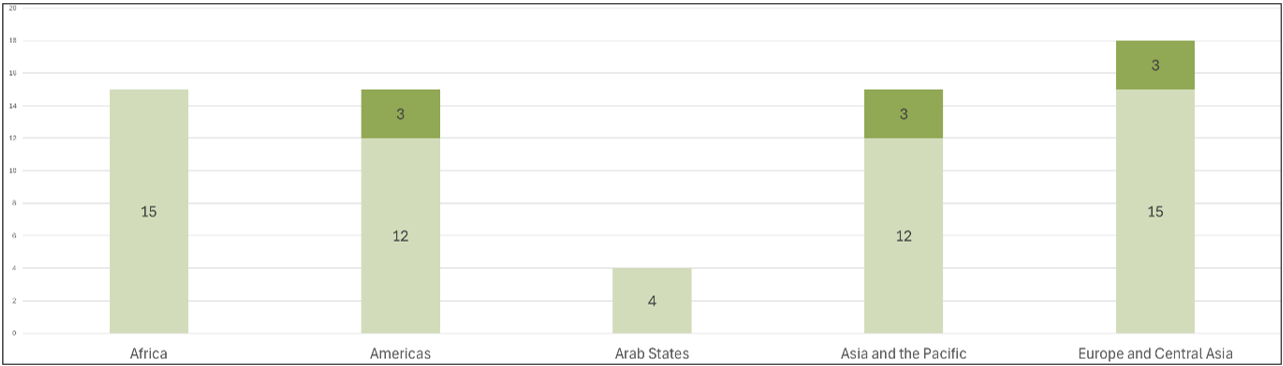
To that end, it covers 15-18 countries from each of the four largest ILO regions (Africa, the Americas, Asia and the Pacific, Europe and Central Asia) and four countries (out of 11 ILO Member States) from the Arab States Region.
On that basis, the study covers only countries with existing legislation on whistle-blower protection applicable to the public sector.
Such legislation (here referred to as “national laws”) must have been enacted by the executive branch or the parliament prior to the start of this research. Bills or draft legislation are thus not included.
The national laws reviewed for each country are presented in Appendix 1. The study draws on original legal texts only. To ensure that the analysis includes the most up-to-date, enforceable version of each national law, only official/institutional sources are used, namely either national governments’ websites or trusted institutional legal databases such as the ILO’s NATLEX4 or the Food and Agriculture Organization (FAO)’s FAOLEX.5
To the extent possible, this study attempts a balanced representation of the countries in terms of their regions, subregions, languages, size and income groups.
Based on the approach described above, the scope of this research may be defined as below:
|
ILO Regions |
Countries in scope |
Countries ISO3 Codes |
|---|---|---|
|
Africa |
15 |
AGO; BWA; CIV; DZA; ETH; GHA; MDG; MUS; NAM; SLE; TUN; TZA; UGA; ZAF; ZMB |
|
Americas |
15 |
BOL; BRA; BRB; CAN; CHL; CRI; ECU; GTM; GUY; HND; JAM; MEX; PER; SUR; USA |
|
Arab States |
4 |
JOR; KWT; LBN; SAU |
|
Asia and the Pacific |
15 |
AUS; BGD; IDN; IND; JPN; KHM; KOR; LKA; MYS; NPL; NZL; PAK; SGP; THA; VNM |
|
Europe and Central Asia |
18 |
BEL; BIH; CHE; DEU; DNK; ESP; EST; FRA; GBR; GEO; ISR; KAZ; KGZ; MLT; NOR; ROU; SRB; UKR |
|
Grand Total |
67 |
Note: countries are identified above and in the “Detailed results…” section by their ISO3 Code. The correspondence between ISO3 Codes and country names is shown in Appendix 1.
As shown in figure 1, most of the national laws reviewed in this study do not specifically cover public sector employees.
Figure 1. National laws reviewed by ILO region
Analysis
The analysis presented here aims to establish criteria for effective whistle-blower laws derived from recognized civil society and intergovernmental organizations.
It expands the analyses presented in the two previous ILO studies published on this topic6, while building on the work of previous studies pursuing similar goals but differing in scope, such as David Banisar’s study entitled “Whistleblowing: International Standards and Developments”7, published in 2011, the report entitled “Whistleblower Protection Laws in G20 Countries, Priorities for Action”8 by Simon Wolfe et al., published in 2014, and the research article titled “Evaluating the effectiveness of whistleblower protection: A new index”, by Shpresa Kaçiku Baljija and Kyoung-sun Min.9
The key study indicators identified in sections 1–14 below draw on the following guidance and recommendations issued by relevant organizations:
-
The United Nations Office on Drugs and Crime (UNODC) Resource Guide on Good Practices in the Protection of Reporting Persons,10 containing guidance on how public officials and other employees who report wrongdoing can best be protected so as to improve the effectiveness of implementation of the United Nations Convention against Corruption (UNCAC);
-
The Council of Europe Recommendation CM/Rec (2014)7 and Explanatory Memorandum11 on the Protection of Whistleblowers, which list and explain 29 Principles intended “to guide member States when reviewing their national laws [on whistle-blowing] or when introducing legislation and regulations or making amendments as may be necessary and appropriate in the context of their legal systems.” The scope of these principles covers both the public and private sectors;
-
The Organization of American States (OAS) “Model Law to facilitate and encourage the reporting of acts of corruption and to protect whistle-blowers and witnesses”,12 presented as part of the “Mechanism for Follow-up on the Implementation of the Inter-American Convention Against Corruption”. This model law aims at protecting “public officials and any person who, in good faith reports or witnesses” acts of corruption;
-
Transparency International’s International Principles for Whistleblower Legislation13 and its supplement entitled Best Practice Guide for Whistleblowing Legislation,14 presenting a set of 30 principles which “serve as guidance for formulating new and improving existing whistle-blower legislation”. This guidance covers both the public and private sectors;
-
The International Bar Association and Government Accountability Project study entitled Are whistleblowing laws working? A global study of whistleblower protection litigation15, which presents a “checklist of 20 requirements for best practice whistle-blower laws”, also applicable across the public and private sectors;
-
The Organisation for Economic Co-operation and Development (OECD) Recommendation of the Council on Public Integrity16 and Public Integrity Handbook17, both focusing on the public sector, as well as its report entitled Committing to Effective Whistleblower Protection18 containing several analyses focused on the public sector. Additionally, the OECD’s “Recommendation of the Council for Further Combating Bribery of Foreign Public Officials in International Business Transactions”19 contains provisions on whistle-blower legislation, applicable across public and private sectors.
The above-listed organizations and publications all share the common goal of promoting features for making whistle-blowing protection legislation more effective.
The “Detailed results …” section below focuses on 14 indicators selected to expand the content of the above-mentioned ILO 2019 and 2022 analyses.
For each selected indicator:
-
three levels of implementation: “Comprehensive”, “Partial” and “Absent or Limited” qualify the extent to which each national law embeds the guidance described above;
-
one of these three levels is allocated to each national law.
Limitations and disclaimer
For each country, the study focuses on one law or regulation applicable to whistle-blowing in the public service sector (as presented in Appendix 1). In some instances, the study looks at one or two laws or regulations that complement the one on which it focuses, such as application decrees referring to the selected act or acts of parliament referred to by the selected decree. The study does not address each country’s entire legal framework applicable to whistle-blowing or to whistle-blower protection in the public sector, but provides an overview of each Member State’s approach to the protection of reporting persons, and how each State assesses its strategy for eliminating irregularities in public service management.
For this reason, the specific case of employees at oversight bodies who have the duty to report irregularities as part of their duties and whose specific protections may be the subject of special laws, is not covered. However, it is assumed that that they will also be protected by the laws studied here.
Owing to the large quantity of information and the diversity of sources from which that is extracted in terms of format and language, this research draws partly on automated searches of key words, natural language-processing search and analysis tools (Large Language Model tools) and artificial intelligence-powered translations of original texts into English.
This document is intended to contribute to the ILO’s knowledge base on the subject, and as a support for discussion among ILO Members, constituents and decision-making bodies. It should not be treated as legal advice.
Detailed results by indicator
Specific legislation for the protection of whistle-blowers
The technical meeting found that “Although there is no uniform definition of whistle-blowing yet, there is nonetheless a growing understanding among ILO Members concerning the concept that constitutes whistle-blowing”, and that “… since reporting irregularities is a duty of public service sector workers and workers of oversight bodies, protecting whistle-blowers is a decent work concern, and is consistent with the mission of the ILO”.
This study covers laws specifically dedicated to empowering and/or protecting whistle-blowers, and also national legislation that contains provisions on whistle-blower protection or creates protections that could apply to them. The focus of a national law, in itself, is not a guarantee that its content will provide optimal protection to whistle-blowers based on international standards. However, as stated in Transparency International’s Principle for Whistleblower Legislation No. 24:
“Dedicated legislation – in order to ensure clarity and seamless application of the whistle-blower framework, stand-alone legislation is preferable to a piecemeal or a sectoral approach”. 20
This principle is further explained in Transparency International’s 2018 publication, A Best Practice Guide for Whistleblowing Legislation.21
The OECD also emphasizes the value of dedicated whistle-blowing legislation in its 2016 document, “Committing to Effective Whistleblower Protection” (chapter 1), notably by stating that “dedicated law(s) […] often provide more clarity and streamline the processes and mechanisms involved in disclosing a wrongdoing”22 and that “…dedicated whistleblower protection laws may be the most effective means of providing comprehensive protection for whistleblowers.”23
On the basis of these considerations, the study classifies national laws according to the extent of their focus on whistle-blower protection, as follows:
1 – Comprehensive: The law is specific to whistle-blower protection either broadly or in the public sector. Its main purpose is to create circumstances that favour the reporting of misconduct.
2 – Partial: The law includes whistle-blower protection provisions in the context of a specifically stated purpose, generally anti-corruption or civil servant status definition.
3 – Absent or limited: The law includes provisions intended to protect witnesses or collaborators in a criminal proceeding that could also apply to whistle-blowers, but without being intended for whistle-blowers.
Indicator No. 1 – Specific legislation for the protection of whistle-blowers
|
Assessment |
Number of countries |
Countries |
|---|---|---|
|
1 – Comprehensive |
46 |
AUS; BEL; BGD; BIH; BOL; BRA; BRB; BWA; CAN; CHL; CRI; DEU; DNK; ESP; EST; ETH; FRA; GBR; GHA; GUY; IND; ISR; JAM; JOR; JPN; KGZ; KOR; LBN; MEX; MLT; MYS; NAM; NOR; NZL; PAK; PER; ROU; SAU; SRB; TUN; TZA; UGA; USA; VNM; ZAF; ZMB; |
|
2 – Partial |
15 |
CHE; GEO; GTM; KAZ; KHM; KWT; LKA; MDG; MUS; NPL; SGP; SLE; SUR; THA; UKR; |
|
3 – Absent or limited |
6 |
AGO; CIV; DZA; ECU; HND; IDN; |
The great majority of national laws reviewed and classified as “comprehensive” above are stand-alone, dedicated acts or executive orders specifically designed to protect whistle-blowers. Some of these national laws pursue a targeted law-enforcement goal such as addressing corruption, but their individual focus remains the protection of whistle-blowers. Many of them present features inspired by international standards such as Transparency International’s Principles for Whistleblower Legislation24 or the Council of Europe’s 2014 Recommendation. More than half of them (25) were enacted in 2015 or later.
The laws assessed as “partial” contain specific provisions on whistle-blower protection, but as part of a much broader piece of legislation. As a result, they are less focused and detailed than dedicated laws. Most of them implement the provisions of the UNCAC or the OECD Recommendation of the Council for Further Combating Bribery of Foreign Public Officials in International Business Transactions.25
The laws classified as “absent or limited” contain protections that could apply to whistle-blower protection while being primarily designed to address participation by witnesses and collaborating defendants in criminal proceedings. They show little or no influence from international standards and conventions.
Coverage of organizations (within the public sector)
By design, the national laws included in this analysis cover public sector entities (see “Scope” section above). In cases where the national law specifically targets other public bodies such as federal agencies, the analysis is limited to the federal level and does not cover subnational government entities such as states, Länder, provinces or cantons.
Nine out of the 67 laws reviewed (13.4 per cent) apply only to public sector entities or employees, while all others apply to both the private and public sectors. Many apply to potential reporting persons without sectoral references and without defining or restricting their scope by reference to specific entities.
The national laws reviewed in this study do not contain provisions excluding significant groups of entities or bodies from their scope, other than specific groups such as intelligence agencies, military personnel or lawyers acting in their professional capacity. Since such exceptions appear to be strictly limited to national security interests or legal privilege, they were deemed not meaningful enough to affect the assessment.26
As a result, all the national laws reviewed under this criterion are “comprehensive” in scope, as presented below:
1 – Comprehensive: The law covers a large section of the public sector or at least a large category of public organizations (e.g. all federal agencies/departments), with no or limited exceptions.
2 – Partial: The law features some restrictions on its application by excluding certain public organizations from whistle-blower protection.
3 – Absent or limited: The law excludes or does not cover most public organizations.
Indicator No. 2 – Coverage of organizations (within the public sector)
|
Assessment |
Number of countries |
Countries |
|---|---|---|
|
1 – Comprehensive |
67 |
All countries in scope |
|
2 – Partial |
0 |
|
|
3 – Absent or limited |
0 |
In Romania, for example, the law details a no-loophole approach to the protection of whistle-blowers and explains to the reader its contents in advance, with clarity.
Romania: Law on the protection of whistle-blowers in the public interest
(1) This law constitutes the general framework for the protection of persons who report violations of the law, which have occurred or are likely to occur, within the authorities, public institutions, other legal persons of public law, as well as within legal persons of private law.
(2) This law regulates the procedure for receiving, examining and resolving reports, the rights and obligations of persons who report or publicly disclose information on violations of the law, the measures to protect them, the obligations of authorities, public institutions, other legal persons under public law, as well as legal persons under private law, the rights of data subjects, as well as the powers of the competent authorities.
(3) The special rules on the reporting of violations of the law contained in the normative acts provided in Annex no. 1 shall continue to apply. The provisions of this law shall apply in situations where the regulations of the normative acts listed in Annex no. 1 do not contain special mandatory rules on the reporting of violations of the law.
(4) This law shall not apply to reports of breaches of public procurement rules in the fields of defense and national security, if they fall within the scope of Article 346 of the Treaty on the Functioning of the European Union.
(5) This law is without prejudice to the provisions regarding:
a) protection of classified information;
b) lawyer's professional secrecy;
c) confidentiality of health information;
d) the secrecy of judicial deliberations;
e) rules of criminal procedure.
(6) This Law shall be without prejudice to the right of workers to consult with their representatives or trade unions, nor to the rules on protection against any harmful measure brought about by such consultations.
(7) This law shall be without prejudice to the rules on the autonomy of the social partners and their right to conclude collective agreements or contracts.
Definition of reportable irregularities
The 2022 ILO Technical meeting found that “Many governments have taken measures in public service employment laws and regulations to allow and encourage public service sector workers and persons working in public sector oversight bodies to report wrongdoing of all kinds, including bribery, fraud, money-laundering, tax evasion, drug trafficking, environmental crimes, safety violations and illicit trade, which hinder social and economic development.”27
The push for improved whistle-blower protection comes initially from civil society and from international organizations with an institutional focus on anti-corruption (Transparency International, UNODC, OECD). However, even for these organizations, whistle-blower protection should not be applied too narrowly to the reporting of specific criminal activities, whether or not qualified as corruption.
The first and third of Transparency International’s Principles for Whistleblower Legislation expressly stipulate that whistle-blowing should extend beyond corruption.28
See, for instance, Principle No. 3:
“Broad definition of whistleblowing – whistleblowing is the disclosure or reporting of wrongdoing, including but not limited to corruption; criminal offences; breaches of legal obligation; miscarriages of justice; specific dangers to public health, safety or the environment; abuse of authority; unauthorized use of public funds or property; gross waste or mismanagement; conflict of interest; and acts to cover up any of these.”
In a footnote to Principle No. 1, Transparency International indicates that reportable activities should include “perceived or potential wrongdoing”, hence going far beyond criminal conduct.29
Similarly, the OECD emphasizes that:
“The legal framework should provide a clear definition of the protected disclosures and specify the acts that constitute violations to any code of conduct, regulations or laws, gross waste or mismanagement, abuse of authority, dangers to the public health or safety, or corrupt acts.” 30
In their joint 2021 publication entitled “Are whistleblowing laws working? A global study of whistleblower protection legislation”, the Government Accountability Project and the International Bar Association list a “Wide subject matter scope with ‘no loopholes’” as a strong feature of effective whistle-blower protection law:
“Whistleblower rights should cover disclosures of any illegality, gross waste, mismanagement, abuse of authority, substantial and specific danger to public health or safety and any other activity that undermines the public welfare or institutional mission to corporate stakeholders, as well as any other information that assists in honouring those duties.” 31
Accordingly, the current analysis attempts to capture the breadth of protection for reporting persons by considering the definition of “reportable irregularities” in national laws.
As with Indicator No. 2, narrow-scope exclusions based on considerations of national security or professional secrecy are not considered.32
The relevant national laws are thus classified as follows:
1 – Comprehensive: The law allows for reporting on a large scope of irregularities, beyond serious crimes or specific categories of issues such as corruption.
The description of reportable irregularities is either very broad or includes a comprehensive list of issues.
2 – Partial: The law only focuses on certain types of irregularities, such as corruption-related issues.
3 – Absent or limited: The law has a narrow focus on specific irregularities or is limited to very serious crimes.
Indicator No. 3 - Definition of reportable irregularities
|
Assessment |
Number of countries |
Countries |
|---|---|---|
|
1 – Comprehensive |
34 |
AUS; BEL; BGD; BRA; BRB; BWA; CAN; CHE; CIV; DEU; DNK; DZA; ESP; FRA; GBR; GHA; GUY; ISR; JAM; JPN; KOR; MLT; NAM; NOR; NZL; PER; ROU; SRB; TUN; TZA; UGA; USA; ZAF; ZMB |
|
2 – Partial |
28 |
BIH; BOL; CHL; CRI; ECU; EST; GEO; GTM; IND; JOR; KAZ; KGZ; KHM; KWT; LBN; LKA; MDG; MEX; MUS; MYS; NPL; PAK; SGP; SLE; SUR; THA; UKR; VNM |
|
3 – Absent or limited |
5 |
AGO; ETH; HND; IDN; SAU |
In Belgium, the law establishes a wide but specific array of the information that, when disclosed, will trigger the protection against retaliation.
Belgium: Law relating to reporting channels and the protection of those reporting breaches of integrity in federal public sector bodies and within the integrated police
§ 1. Any person reporting a breach of integrity in federal public sector bodies is protected by the minimum standards defined in this Act. The following constitute a breach of integrity:
1° an act or omission of an act which constitutes a threat to or an infringement of the general interest and which:
a) constitutes a breach of directly applicable European provisions, laws, decrees, circulars, internal rules and internal procedures which are applicable to federal public sector bodies and their staff members; and/or
b) involves a risk to the life, health or safety of persons or to the environment; and/or
c) is evidence of a serious breach of professional obligations or of the proper management of a federal public sector body;
2° knowingly ordering or advising the commission of a breach of integrity as referred to in 1°.
Given the analytical criteria for this study, the overlap between the first and third indicators is not total.
With one exception, the laws classified as “partial” under the first indicator could not be classified as “comprehensive” under the third indicator. Under those laws, whistle-blowing is merely a means towards the end of fighting corruption, one that, by design, reduces the scope of reportable irregularities to corruption-related ones.
However, some of the “dedicated laws” identified as such under Indicator No. 1 appear to restrict their own scope by setting the bar at what amounts to a reportable irregularity, resulting in a classification of “partial”, or even “limited”, for a few of them.
Lastly, some of the laws classified as “absent or limited” under Indicator No. 1 are classified as “comprehensive” or “partial” under Indicator No. 3 owing to the general nature of the terminology used to define their scope.
Definition of whistle-blowers
This feature addresses the question of who is considered a whistle-blower.
Transparency International’s Principle No. 4 proposes the following broad definition in this regard:
“A whistleblower is any public- or private sector employee or worker who discloses information covered in Principle 3 (above) and who is at risk of retribution. This includes individuals who are outside the traditional employee-employer relationship, such as consultants, contractors, trainees/interns, volunteers, student workers, temporary workers and former employees.” 33
In its Recommendation CM/Rec(2014)7, the Council of Europe defines a whistle-blower as:
“… any person who reports or discloses information on a threat or harm to the public interest in the context of their work-based relationship, whether it be in the public or private sector;” 34
Similarly, the OAS Model Law defines a “good-faith whistleblower” in its Article 2 (c) as:
“Any person who informs the competent authority of the commission of an act which that person considers could be an act of corruption that is liable for administrative and/or criminal investigation.” 35
The December 2023 Resolution of the Conference of the States Parties to the United Nations Convention against Corruption defines whistle-blowers as:
“… reporting persons who report corruption in the context of their professional activity and work-related environment”. 36
The two previously cited ILO publications each explored diverse definitions provided in national legislation. The analysis presented below assesses the extent to which each national law includes or excludes certain categories of public service workers. The more inclusive the scope of the law, the more it is considered to meet the standards set out above.
In most cases, a whistle-blower is defined as a person who reports misconduct by following the procedures described under the law. However, some national laws limit their scope to specific categories of workers.
The current classification also considers whether or not the law stipulates that the whistle-blower’s participation in a criminal proceeding is a factor limiting the breadth of its protection.
In light of these observations, the national laws are classified as follows:
1 – Comprehensive: The law does not only apply to career civil servants but can also grant protection to contractors, interns or volunteers within the public sector.
2 – Partial: The law applies to all civil servants, at least within a certain category (e.g. federal employees), excluding or without including other categories.
3 – Absent or limited: The law applies only restrictively to certain civil servants, within certain functions or ranks, or requires reporters to be involved in criminal proceedings as either a victim, witness or defendant in order to be protected. This includes legislation that limits its protection to that set out under the ILO’s Termination of Employment Convention, 1982 (No. 158), which protects workers against dismissals for “the filing of a complaint or the participation in proceedings against an employer involving alleged violation of laws or regulations or recourse to competent administrative authorities”, or under the Labour Relations (Public Service) Convention, 1978 (No. 151), which protects workers against retaliation for the exercise of civil and political rights with the aim of advancing freedom of association.
Indicator No. 4 – Definition of whistle-blowers
|
Assessment |
Number of countries |
Countries |
|---|---|---|
|
1 – Comprehensive |
61 |
AUS; BEL; BGD; BIH; BOL; BRA; BRB; BWA; CAN; CHL; CIV; CRI; DEU; DNK; ECU; ESP; EST; FRA; GBR; GEO; GHA; GTM; GUY; IND; ISR; JAM; JOR; JPN; KAZ; KGZ; KHM; KOR; KWT; LBN; LKA; MDG; MEX; MLT; MUS; MYS; NAM; NOR; NPL; NZL; PAK; PER; ROU; SAU; SGP; SLE; SRB; SUR; THA; TUN; TZA; UGA; UKR; USA; VNM; ZAF; ZMB |
|
2 – Partial |
1 |
CHE |
|
3 – Absent or limited |
5 |
AGO; DZA; ETH; HND; IDN |
This assessment resulted in very few departures from the “comprehensive” classification as very few laws set limitations as to who can be a whistle-blower.
One law was classified as “partial” as it only applies to employees of a federal agency and does not appear to cover ex-employees or other contributors to the work of such agencies, such as consultants, interns or volunteers.
Five laws were classified as “absent or limited” as they appear to require active participation in a criminal proceeding for an individual to qualify for protection. Here again, there is not a strict overlap with feature No. 1, as the analysis focused on the definition of who might benefit from the protection, rather than on the stated objective of the law.
In Spain, for instance, the Law details the persons who will receive protection according to their status as employees or their representatives, or based on the information they provide.
Spain: Law regulating the protection of persons who report regulatory violations and the fight against corruption
1. This Act shall apply to reporting persons working in the private or public sector who have obtained information on offences in an employment or professional context, including in any event:
(a) persons having the status of public employees or employees;
(b) self-employed persons;
(c) shareholders, members and persons belonging to the administrative, management or supervisory body of an undertaking, including non-executive members;
(d) any person working for or under the supervision and direction of contractors, subcontractors and suppliers.
2. This law shall also apply to whistle-blowers who communicate or publicly disclose information on wrongdoing obtained in the framework of an employment or statutory relationship that has already ended, volunteers, trainees, trainees in training, whether or not they receive remuneration, as well as to those whose employment relationship has not yet begun, in cases where the information on wrongdoing was obtained during the recruitment process or pre-contractual negotiation.
3. The measures for the protection of informants provided for in Title VII shall also apply, where appropriate, specifically to the legal representatives of employees in the exercise of their functions of advising and supporting the informant.
4. The measures for the protection of whistle-blowers provided for in Title VII shall also apply, where appropriate, to:
(a) natural persons who, within the organization in which the whistle-blower provides services, assist the whistle-blower in the process,
(b) natural persons who are related to the reporting person and who may suffer retaliation, such as co-workers or relatives of the reporting person; and
(c) legal persons, for whom he/she works or with whom he/she has any other relationship in an employment context or in which he/she has a significant shareholding. For these purposes, an interest in the capital or in the voting rights attaching to shares or participations is deemed to be significant when, by virtue of its proportion, it enables the person holding it to have the capacity to influence the legal person in which he/she has an interest.
Protection threshold
This indicator addresses the legitimate interest threshold that whistle-blowers are expected to meet in order to benefit from the national law’s protection – the lower the threshold, the more comprehensive the protection.
This threshold is defined in Transparency International’s Principles for Whistleblower Legislation, No. 5, as follows:
“… reasonable belief of wrongdoing” – protection shall be granted for disclosures made with a reasonable belief that the information is true at the time it is disclosed. Protection extends to those who make inaccurate disclosures made in honest error, and should be in effect while the accuracy of a disclosure is being assessed.”
Article 33 of the United Nations Convention Against Corruption refers to the concept of “good faith” to set the protection threshold, while leaving its exact definition to the interpretation of the signatories:
“Each State Party shall consider incorporating into its domestic legal system appropriate measures to provide protection against any unjustified treatment for any person who reports in good faith and on reasonable grounds to the competent authorities any facts concerning offences established in accordance with this Convention.”
Similarly, in its 2017 “Recommendation of the Council on Public Integrity”, the OECD recommends that protection should be granted “against all types of unjustified treatments as a result of reporting in good faith and on reasonable grounds.”37
The concept of “good faith” has been consistently criticized for its potential to restrict protection if interpreted too narrowly38.
In their previously quoted joint paper, the US Government Accountability Project and the International Bar Association advocate against reference to “good faith” as a protection threshold, arguing that the “good faith standard puts the whistleblower’s motives on trial”.39
This concept is therefore not expressly invoked by the Council of Europe in its 2014 Recommendations. According to the Council’s Principle No. 22: “Protection should not be lost solely on the basis that the individual making the report or disclosure was mistaken as to its import or that the perceived threat to the public interest has not materialized, provided he or she had reasonable grounds to believe in its accuracy.”
For the purposes of this study however, the reference to “good faith” does not affect the national law’s rating, so long as it is not defined in a manner that lowers the threshold below reasonable belief in the accuracy of the reported facts. As shown below, a very large majority of the laws reviewed appear to have adopted this “reasonable belief” standard as a protection threshold.
Conversely, conditioning the protection to the absence of a personal interest on the part of the whistle-blower results in a more restrictive application of the protection. For example, the EU Whistleblower Protection Directive states that “… reporting persons should be entitled to protection under this Directive if they have reasonable grounds to believe that the information reported falls within its scope. The motives of the reporting persons in reporting should be irrelevant in deciding whether they should receive protection.”40 Whistle-blowers who report against their supervisors or other colleagues could be denied protection on the ground that they have a vested career interest in sidelining such colleagues, even if they genuinely believe their report to be truthful. This approach is identified in the laws classified as “partial” below.
Further restrictions observed in the countries classified as “absent or limited” below include requiring the reported facts to be accurate or substantiated, which could have a chilling effect on potential whistle-blowers who are not in a position to investigate before reporting.
On the basis of these observations, the national laws are classified as follows:
1 – Comprehensive: The law protects all reporting based on a reasonable belief in the accuracy of the reported facts or based on “good faith”, without further restricting its definition.
2 – Partial: The law sets conditions additional to good faith, for example by excluding whistle-blowers who have a personal interest in reporting, or defines good faith in a way that allows for the exclusion of some reports meeting the "reasonable belief" condition.
3 – Absent or limited: The law sets very restrictive conditions for allowing a report to trigger whistle-blowing protection, such as:
-
requiring the report to be accurate or the whistle-blower to support their report with evidence;
-
requiring reporters to be involved in a criminal proceeding as victim, witness or defendant in need of protection; or
-
requiring a formal request for protection from the whistle-blower which needs to be approved by a specific authority.
Indicator No. 5 – Protection threshold
|
Assessment |
Number of countries |
Countries |
|---|---|---|
|
1 – Comprehensive |
49 |
AUS; BEL; BGD; BIH; BOL; BRA; BRB; BWA; CAN; CHE; CHL; CRI; DEU; DNK; DZA; ECU; ESP; EST; FRA; GHA; GTM; IND; ISR; JAM; JPN; KHM; KOR; LBN; LKA; MEX; MLT; MUS; MYS; NAM; NOR; NPL; NZL; PAK; ROU; SGP; SLE; SUR; THA; TUN; TZA; UGA; UKR; USA; ZAF |
|
2 – Partial |
6 |
GBR; GEO; GUY; KWT; SRB; ZMB |
|
3 – Absent or limited |
12 |
AGO; CIV; ETH; HND; IDN; JOR; KAZ; KGZ; MDG; PER; SAU; VNM |
Brazil has enacted several statutes, ordinances and decrees outlining the thresholds for protection of whistle-blowers at different stages in the process, mostly with a focus on the veracity of the information rather than the intent of the reporting person. Guyana, in turn, defines good faith in very specific but broad terms, also focusing on the information provided rather than the intent. This follows a broad discussion on the good faith requirement, summarized in the statement made in a report from the UK that “[t]he public interest would be served, even in cases where the motives of the messenger might not have been entirely altruistic”.41
Brazil: Law No. 13,608, of January 10, 2018, providing for a telephone hotline to receive complaints and for rewarding information that assists in police investigations
Administrative Council for Economic Defense, Ordinance No. 292, of April 24, 2019, establishing standards for receiving and handling anonymous complaints and establishes guidelines for the confidentiality of the complainant's identity:
Sec. 2º The access restriction established in the caput of this device does not apply if it constitutes a false accusation (art. 339 of Decree-Law no. 2,848/40 – Penal Code) or flagrant bad faith on the part of the complainant.
Decree No. 10,153, of December 3, 2019, providing safeguards to protect the identity of whistle-blowers of illicit acts and irregularities committed against the direct and indirect federal public administration:
Decree No. 11,129, of July 11, 2022, Regulating Law No 12.846, of August 1, 2013, which provides for liability of legal entities for acts against the national or foreign public administration:
Guyana: Protected disclosures Act, 2018
Art. 10 (1). A disclosure is a protected disclosure if -
. . .
(c) it is made in good faith;
(d) it is not made for the purpose of personal gain;
(e) the person making the disclosure reasonably believes, based on the information that person has at that time, that -
(i) the information disclosed and any allegation contained in it are substantially true; and
(ii) the information disclosed tends to show that the person of whom he has made the disclosure has committed, is committing or is likely to commit an improper conduct; and
(f) the disclosure was substantially made in accordance with the procedures for the making of a protected disclosure.
. . . .
(5) A protected disclosure does not cease to be a protected disclosure by reason of any recommendation of the Commission of disciplinary or any other proceedings under section 16.
Diversity of reporting channels
The principles and guidance on effective whistle-blowing legislation consistently recommend adopting a multi-channel approach to whistle-blowing frameworks, so that potential whistle-blowers are presented with options as to how they might best report irregularities while also enjoying institutional protection.
The international bodies consider a three-tier or three-channel model to be the most robust.
Such a model generally involves:
-
An internal channel: the possibility afforded to whistle-blowers to enjoy protection while reporting irregularities within their organization;
-
An official channel: a government agency or judiciary body to which whistle-blowers can address their report;
-
An external (or public) channel: the possibility for the whistle-blower to benefit from protection against retaliation while raising their report to third parties such as the media, civil society organizations or trade unions. Even in the most protective recommendations on whistle-blowing laws, this third channel is generally presented as an exception to be used only in the most serious cases.
Transparency International addresses each of these three channels in its Principles Nos. 15, 16 and 17 respectively.42
The three-channel model is also proposed in Council of Europe Recommendation No. 14:
“14. The channels for reporting and disclosures comprise:
- reports within an organization or enterprise (including to persons designated to receive reports in confidence);
- reports to relevant public regulatory bodies, law enforcement agencies and supervisory bodies;
- disclosures to the public, for example to a journalist or a member of parliament.” 43
In its Public Integrity Handbook, the OECD refers to the three reporting channels as practices, albeit without formally recommending them:
“Reporting channels generally include internal disclosures, external disclosures to a designated body, and external disclosures to the public or to the media.” 44
The UNODC also expresses its support for a diversity of reporting channels in the context of UNCAC implementation45.
Based on the foregoing, this analysis applies the following criteria for the sixth indicator:
1 – Comprehensive: The law explicitly allows for at least three reporting channels:
-
internal: within the employee's organization;
-
official: to one or several dedicated public bodies/agencies;
-
external: to civil society, the press, the public, unions;
with the intention that reporting to all of the above channels will be protected.
2 – Partial: The law only allows for reporting through two reporting channels:
-
internal and official, or
-
official and external;
3 – Absent or limited: The law only protects reporting made through the official channel, and either excludes or remains silent on other channels.
Note that this analysis does not examine the specific threshold associated with each individual channel. Some national laws set additional conditions for whistle-blowers’ use of the “external” channel, for example by limiting it to cases of particular severity or imminent danger, or to those where other channels have already been unsuccessfully addressed. A more granular review of each condition would be necessary to assess the effective availability of this “external” channel.
Indicator No. 6 – Diversity of reporting channels
|
Assessment |
Number of countries |
Countries |
|---|---|---|
|
1 – Comprehensive |
18 |
AUS; BEL; BIH; CAN; DEU; DNK; ESP; EST; FRA; GBR; JPN; MLT; NAM; NOR; ROU; SRB; UKR; ZAF |
|
2 – Partial |
15 |
BOL; BRA; BRB; CHE; CHL; CRI; GEO; IND; JAM; NZL; PAK; PER; TUN; TZA; UGA |
|
3 – Absent or limited |
34 |
AGO; BGD; BWA; CIV; DZA; ECU; ETH; GHA; GTM; GUY; HND; IDN; ISR; JOR; KAZ; KGZ; KHM; KOR; KWT; LBN; LKA; MDG; MEX; MUS; MYS; NPL; SAU; SGP; SLE; SUR; THA; USA; VNM; ZMB |
The “official” channel is the only one associated with some level of protection in all the national laws covered by this part of the study, the majority of these laws being focused solely on the protection of whistle-blowers who use this “official” channel to report irregularities. These laws are generally silent as to other channels and do not provide any protection regarding their use.
The national laws classified as “partial” above generally mandate the creation of an “internal” channel within organizations to allows reporting by workers. A few national laws also ignore the “internal” channel and only open the possibility of reporting “externally” as an alternative to the official channel.
The national laws classified as “comprehensive” explicitly allow for whistle-blowers to report through the three channels while enjoying statutory protection. For example, Bosnia-Herzegovina’s Law explicitly allows public servants to report internally and externally, and includes the public among the available external channels. The use of external channels is only limited by good faith that internal channels have been or will be ineffectual.
Law On Whistle-blower Protection in The Institutions of Bosnia-Herzegovina
Article 4 (Types of protected reporting/disclosure)
The protected reporting (disclosure) may be:
a) Internal, and
b) External.
Article 5 (Internal reporting/disclosure)
(1) Any person employed with the institutions of Bosnia and Herzegovina, referred to in Article 1 of this Law, shall be required to submit a report referred to in Article 3 paragraph (1) of this Law to the following:
a) His/her superior or to any other person, in the institution where he/she is employed who is responsible for the compliance of that institution with the law, or
b) a person or to the institution’s manager who is responsible for compliance of that institution with the law;
c) a person or a body performing supervision or audit in the institutions of Bosnia and Herzegovina, referred to in Article 1 of this Law.
(2) The internal reporting (disclosure) shall be done in the manner as specified by the institution’s internal by-law referred to in Article 3 paragraph (1) of this Law
(3) By way of derogation of paragraphs (1) and (2) of this Article, a report referred to in paragraph (1) of this Article shall be submitted directly to the institution’s manager in the event that:
a) The manager of an institution has not issued the institution’s by-law from paragraph (2) of this Article; or
b) The procedure for internal reporting is not known, namely if the information on the service, body or person responsible for receiving and considering reports referred to in Article 3 paragraph (1) of this Law is not visibly displayed in the institution’s premises and on its web site of the institution; or
c) The whistle-blower has reason to believe that the authorized person, who is designated by the bylaws to receive reports on suspected acts of corruption and whistle-blower protection, participates directly or indirectly in the act of corruption.
(4) Persons addressed in paragraph (1) and (3) of this Article may approach the Agency for Prevention of Corruption and Coordination of the Fight Against Corruption with a request to obtain the status of a whistle-blower in line with Article 7 of this Law.
Article 6 (External reporting/disclosure)
(1) External reporting/disclosure shall imply reporting to the following:
a) authorities responsible to conduct a criminal investigation and prosecution of perpetrators of criminal offences; or
b) The Agency for Prevention of Corruption and Coordination of Fight Against Corruption, and
c) The public, in accordance with article 2, point d) of this Law.
(2) External reporting/disclosure shall be conducted in case that:
a) The procedure based on internal reporting/disclosure referred to in Article 5 of this Law takes longer than 15 days; or
b) The whistle-blower has a reason to believe that the procedure based on internal reporting/disclosure referred to in Article 5 of this Law has been irregular, or
c) The whistle-blower has every reason to believe that the authorized person who is designated by laws to receive the reports referred to in Article 5 of this Law or the manager of an institution, are directly or indirectly associated with the act of corruption.
Provisions and protections for anonymous reports
Making provision for anonymous reporting and treating the identity of the whistle-blower as confidential are two distinct approaches intended to protect the identity of whistle-blowers. Confidentiality requirements are covered under Indicator No. 8 below.
Anonymous reporting of irregularities has always existed and does not require a specific legal framework. But national laws can regulate whether anonymous reports of irregularities will be considered for investigation and whether anonymous whistle-blowers will be protected if their identity is subsequently discovered or disclosed.
By not disclosing their identity, whistle-blowers take their protection against retaliation into their own hands while potentially evading accountability for malicious reports or illegal leaks. For this last reason, the acceptance of anonymous reports has been considered controversial. For instance, the Council of Europe, in the “Explanatory Memorandum” appended to its 2014 Recommendations, mentions that:
“… anonymity raises a host of issues. More often than not, anonymous allegations are assumed to be malicious or are considered to be less credible by those who receive them. Anonymous disclosures can also be much more difficult to investigate and even impossible to remedy. Finally, anonymity is not a guarantee that the source of the information will not be unmasked. Where the person is identified, the fact that they acted anonymously can be seen as a sign of bad faith, further jeopardizing their position.” 46
In its Public Integrity Handbook, the OECD is open to the possibility of accepting anonymous reports as a feature of whistle-blower protection while recognizing its challenges. 47
Transparency International focuses on the protection of whistle-blowers themselves rather than addressing the question of the reliability of anonymous reports, stating in its Principle No. 13:
“Anonymity – full protection shall be granted to whistleblowers who have disclosed information anonymously and who subsequently have been identified without their explicit consent.”
In its 2020 Methodology and Guidelines to Assess Whistleblowing Legislation, Transparency International supports the practice of accepting and following up on anonymous reporting as well as reporting systems that allow for two-way communication with whistle-blowers who do not wish to share their identity with the recipient of their report.48
The UNODC’s 2015 Resource Guide and the OAS model law support anonymous reporting:
-
The UNODC Resource Guide lists the acceptance of anonymous reports as a measure “with a view to encouraging reports and providing protection when the disclosure is made”49 The Guide refers to “anonymous reporting” as a “procedural protective measure to facilitate reporting.”50
-
Article 9 of the OAS model law clearly stipulates: “If for security reasons a whistleblower and/or witness refuses to give his/her identity, the authority shall assess the information received and, in accordance with its competence, rule on the commencement of the relevant investigation.”51
Notwithstanding the controversy about the morality of blowing the whistle anonymously, the sources quoted above consider that making allowance for anonymous reports increases the level of protection for whistle-blowers and maximizes the possibility of identifying and correcting irregularities.
Hence, for the purpose of this analysis, this study applies the following criteria for the seventh indicator:
1 – Comprehensive: The law allows for anonymous reporting by explicitly requiring or allowing anonymous reports be reviewed or investigated by the receiving authority.
2 – Partial: The law refers to anonymous reporting to specify that whistle-blowers who report anonymously can be protected once their identity is known by the receiving authority;
and/or The law allows for anonymous disclosures without clearly setting out a process for accepting them.
3 – Absent or limited: The law ignores or explicitly excludes anonymous reporting.
Indicator No. 7 – Provisions and protections for anonymous reports
|
Assessment |
Number of countries |
Countries |
|---|---|---|
|
1 – Comprehensive |
18 |
AUS; BEL; BOL; BRB; ESP; FRA; GEO; GUY; IND; JOR; MEX; MLT; MUS; NAM; ROU; SRB; UKR; VNM |
|
2 – Partial |
6 |
CRI; DEU; KOR; NZL; SUR; UGA |
|
3 – Absent or limited |
43 |
AGO; BGD; BIH; BRA; BWA; CAN; CHE; CHL; CIV; DNK; DZA; ECU; EST; ETH; GBR; GHA; GTM; HND; IDN; ISR; JAM; JPN; KAZ; KGZ; KHM; KWT; LBN; LKA; MDG; MYS; NOR; NPL; PAK; PER; SAU; SGP; SLE; THA; TUN; TZA; USA; ZAF; ZMB |
A very large majority of the national laws covered by this study either explicitly exclude anonymous whistle-blowers from their protection or do not refer to anonymous whistle-blowing at all. Such an approach results in no or very limited protection for whistle-blowers unwilling to share their identity with the receiving authority.
A quarter of the laws reviewed recognize the value of anonymous whistle-blowing by explicitly accepting anonymous reports.
In between, a few national laws afford some protection to anonymous whistle-blowers without explicitly accepting to review and investigate anonymous reports.
The relevant act in Australia, for example, allows reporting persons to make the disclosure without revealing their identity, without reducing it in writing and without invoking the act. This places the onus on the agency which receives the information of protecting them as well as transmitting the disclosure and identifying the requirement for protection.
Australia: Public Interest Disclosure Act 2013
Art. 28 - How a public interest disclosure may be made
(1) A public interest disclosure may be made orally or in writing.
(2) A public interest disclosure may be made anonymously.
(3) A public interest disclosure may be made without the discloser asserting that the disclosure is made for the purposes of this Act.
(4) This section does not apply to a public interest disclosure that is also a NACC disclosure (see subsection 26(1A)).
Confidentiality of reports
In contrast to anonymity, the protection of confidentiality is a very common feature.
Principle No. 18 of the Council of Europe’s 2014 Recommendation is unambiguous on this point:
“Whistleblowers should be entitled to have the confidentiality of their identity maintained, subject to fair trial guarantees.” 52
Similarly, Transparency International’s Principles clearly emphasize the importance of confidentiality, as stated in Principle No. 7:
“Preservation of confidentiality – the identity of the whistleblower may not be disclosed without the individual’s explicit consent.”
The terms “confidential” and “confidentiality” are also used in Principles 15, 18 and 25 when describing other indicators.
In their joint 2021 study, the Government Accountability Project and the International Bar Association advocate for “reliable identity protection”, whereby the receiving authority treats as confidential not only the whistleblower’s identity but also any “identifying information”, i.e. information that enables the identification of the whistle-blower.53
Confidentiality is listed by the UNODC in its Resource Guide as a “Procedural protective measure to facilitate reporting”54 (alongside anonymous reporting).
Article 11 of the OAS model law also treats the identity of the whistle-blower as confidential.55
In light of these observations, the focus on whistle-blower protection in national laws is classified as follows:
1 – Comprehensive: The law specifically refers to a whistle-blower's identity and/or to the content of their report as confidential, calls for special care on the part of the receiving authority and penalizes the dissemination of the relevant information.
2 – Partial: The law allows for exceptions or places conditions on confidentiality protection.
3 – Absent or limited: The law does not mention whistle-blowers or guarantee them confidentiality protection.
Indicator No. 8 – Protection of confidentiality
|
Assessment |
Number of countries |
Countries |
|---|---|---|
|
1 – Comprehensive |
62 |
AGO; AUS; BEL; BGD; BIH; BOL; BRA; BRB; BWA; CAN; CHL; CIV; CRI; DEU; DNK; ECU; ESP; EST; ETH; FRA; GEO; GHA; GTM; GUY; HND; IDN; IND; ISR; JAM; JOR; JPN; KAZ; KGZ; KOR; KWT; LBN; LKA; MDG; MEX; MLT; MUS; MYS; NAM; NOR; NPL; PAK; PER; ROU; SAU; SGP; SLE; SRB; SUR; THA; TUN; TZA; UGA; UKR; USA; VNM; ZAF; ZMB |
|
2 – Partial |
3 |
CHE; KHM; NZL; |
|
3 – Absent or limited |
2 |
DZA; GBR |
These results suggest that the confidentiality of a whistle-blower’s identity is closely linked to whistle-blower protection, as very few national laws do not explicitly recognize the identity of whistle-blowers as “confidential” information or create significant exceptions to such confidentiality protection. For instance, the relevant Singaporean Act complements the rules of evidence in order to separate the whistle-blower from the process, thus compelling the disputing parties to focus on the evidence provided rather than on those who disclosed the evidence.
Singapore: Prevention of Corruption Act
Art. 36 - Protection of informers
(1) Except as hereinafter provided, no complaints as to an offence under this Act shall be admitted in evidence in any civil or criminal proceeding whatsoever, and no witness shall be obliged or permitted to disclose the name or address of any informer, or state any matter which might lead to his discovery.
(2) If any books, documents or papers which are in evidence or liable to inspection in any civil or criminal proceeding whatsoever contain any entry in which any informer is named or described or which might lead to his discovery, the court before which the proceeding is had shall cause all such passages to be concealed from view or to be obliterated so far as is necessary to protect the informer from discovery, but no further.
(3) If on a trial for any offence under this Act the court, after full inquiry into the case, is of the opinion that the informer wilfully made in his complaint a material statement which he knew or believed to be false or did not believe to be true, or if in any other proceeding the court is of the opinion that justice cannot be fully done between the parties thereto without the discovery of the informer, the court may require the production of the original complaint, if in writing, and permit inquiry and require full disclosure concerning the informer.
Protection against retaliation
The protection of whistle-blowers against retaliation is a key part of whistle-blower legislation. In order to promote whistle-blowing, national laws need to provide potential whistle-blowers with reasonable assurance that they will not suffer adverse consequences from speaking up.
The anti-retaliation effectiveness of national laws is classified here in relation to three indicators:
-
Protection against retaliation: What is the extent of the protection offered against retaliation? What kind of adverse consequences are covered? (see Indicator No. 9)
-
Remedies against retaliation: to what extent does the law create specific paths or a process designed to halt the retaliation and reverse or nullify its adverse effects? (see Indicator No. 10)
-
Sanctions against retaliators: How does the law punish violators of the prohibition on retaliation? (see Indicator No. 11)
A combination of these three indicators allows for robust whistle-blower protection and should therefore improve the law’s effectiveness in encouraging potential reporters to speak up.
The overall need for statutory protection of whistle-blowers is the subject of Transparency International’s Principle No. 6:
“Protection from retribution – individuals shall be protected from all forms of retaliation, disadvantage or discrimination at the workplace linked to or resulting from whistleblowing. This includes all types of harm, including dismissal, probation and other job sanctions; punitive transfers; harassment; reduced duties or hours; withholding of promotions or training; loss of status and benefits; and threats of such actions.” 56
Principle No. 21 of the Council of Europe’s Recommendation is similarly worded:
“Whistleblowers should be protected against retaliation of any form, whether directly or indirectly, by their employer and by persons working for or acting on behalf of the employer. Forms of such retaliation might include dismissal, suspension, demotion, loss of promotion opportunities, punitive transfers and reductions in or deductions of wages, harassment or other punitive or discriminatory treatment.”
Section XXII. ii. of the OECD’s Recommendation of the Council for Further Combating Bribery of Foreign Public Officials in International Business Transactions also endorses a broad spectrum of protection, by recommending that member countries:
“… afford protection to the broadest possible range of reporting persons in a work-related context, including as appropriate to those whose work-based relationship has ended, to persons who acquire information on suspected acts of foreign bribery during advanced stages of the recruitment process or the contractual negotiations, and who could suffer retaliation, for instance in the form of negative employment references or blacklisting, and consider extending protection to third persons connected to the reporting person who could suffer retaliation in a work-related context;” 57
Transparency International’s Principle No. 14 addresses this issue from another angle:
“Personal protection – whistleblowers whose lives or safety are in jeopardy, and their family members, are entitled to receive personal protection measures. Adequate resources should be devoted for such protection.” 58
The UNODC Resource Guide extensively describes the expected features of anti-retaliation protection in its chapter 2, section C.2.59
The OAS model law provides for such protection in its article 16 by focusing on the protection of the whistle-blower’s “physical and psychological integrity”, but also covers workplace-related retaliation in its article 12.60
In light of these observations, this study classifies the national laws under review as follows:
1 – Comprehensive: The law prohibits retaliation, defines it broadly and/or provides an extensive list of adverse measures constituting retaliation which may include vexatious proceedings.
2 – Partial: The law prohibits retaliation without defining it or by defining it restrictively, or
The protection is limited to the safety or well-being of the whistle-blower, without extending to their employment status or economic circumstances.
3 – Absent or limited: The law does not explicitly prohibit retaliation.
Indicator No. 9 – Protection against retaliation
|
Assessment |
Number of countries |
Countries |
|---|---|---|
|
1 – Comprehensive |
56 |
AUS; BEL; BGD; BIH; BOL; BRA; BRB; BWA; CAN; CHL; CRI; DEU; DNK; ECU; ESP; EST; ETH; FRA; GBR; GEO; GHA; GUY; IDN; IND; ISR; JAM; JOR; JPN; KOR; KWT; LBN; LKA; MDG; MEX; MLT; MUS; MYS; NAM; NOR; NZL; PAK; PER; ROU; SAU; SLE; SRB; SUR; THA; TUN; TZA; UGA; UKR; USA; VNM; ZAF; ZMB |
|
2 – Partial |
7 |
AGO; CHE; CIV; HND; KAZ; KGZ; NPL |
|
3 – Absent or limited |
4 |
DZA; GTM; KHM; SGP |
As with Indicator No. 8, few of the laws studied here contained exceptions or limitations to condition the explicit prohibition of retaliation against whistle-blowers. the Barbados Act, for instance, explicitly bars the defenses commonly raised against whistle-blowers like material error, lack of impact of the disclosed conduct or procedural omissions and reverses the burden of proof of retaliation. It also protects whistle-blowers from civil, criminal and disciplinary proceedings, except if they are also perpetrators: in such cases, the Act allows adjudicators to take the disclosure into account when imposing penalties.
Barbados: Whistleblower Protection Act, 2021
Sec. 16.
-
No whistleblower shall be subjected to detrimental action on account of his intending or attempting to make, making or having made, a protected disclosure.
-
Subsection (1) applies notwithstanding any duty of secrecy or confidentiality or other prohibition or restriction on the disclosure of information under any enactment, rule of law, contract, oath or practice.
-
The protection afforded to a whistleblower by this Part shall not be diminished or denied on the basis that
-
the whistleblower was mistaken about the significance of the disclosure;
-
any perceived threat to the public interest on which the disclosure was based has not materialized; or
-
the whistleblower has not fully complied with any applicable disclosure procedures, guidelines or regulations made under this Act.
-
Sec. 17.
Where a whistleblower suffers detrimental action at or around the same time that he makes a protected disclosure, the detrimental action shall be presumed to be a consequence of the protected disclosure unless the person who took, authorized or caused the detrimental action to be taken shows that the act that constitutes the detrimental action is otherwise justified.
Sec. 18.
-
Subject to section 19, a whistleblower shall not be liable in any civil, criminal or disciplinary proceedings on account of his making a protected disclosure.
-
Subsection (1) applies notwithstanding any duty of secrecy or confidentiality or other prohibition or restriction on the disclosure of information under any enactment, rule of law, contract, oath or practice.
-
The protection afforded to a whistleblower by this Part shall not be diminished or denied on the basis that the whistleblower was mistaken about the significance of the disclosure; any perceived threat to the public interest on which the disclosure was based has not materialized; or the whistleblower has not fully complied with any applicable disclosure procedures, guidelines or regulations made under this Act.
Sec. 19.
-
Subject to subsection (3), nothing in this Part shall prevent the institution of criminal proceedings against a whistleblower where the whistleblower was the perpetrator of, or an accomplice in, any improper conduct
-
to which the disclosure relates; and
-
which constitutes an offence.
-
Subject to subsections (5) and (6), nothing in this Part shall prevent the institution of civil or disciplinary proceedings against a whistleblower where the proceedings arise from conduct of the whistleblower, other than the making of a protected disclosure
-
In any criminal proceedings instituted against a whistleblower on the basis that the whistleblower was the perpetrator of, or an accomplice in, the improper conduct disclosed by the whistleblower, the court shall, in giving its judgment or decision, take into due account
-
the fact that the disclosure was made by the whistleblower; and
-
whether the whistleblower has assisted members of the Police Force in apprehending any other person involved in the commission of an offence,
and the punishment of the whistleblower may be mitigated or remitted as the court thinks fit.
-
Where the court acts under subsection (3), the court shall expressly refer to that subsection in its judgment or decision.
-
In any civil proceedings instituted against a whistleblower on the basis that the whistleblower was the perpetrator of, or was an accomplice in, the improper conduct disclosed by the whistleblower, the court may, where it finds that the whistleblower is responsible for the payment of damages, only hold the whistleblower liable for such part of the damage as he may have caused and not hold him liable jointly and severally with others.
-
Where a whistleblower is an employee of a public body and disciplinary proceedings are instituted against him on the basis that he was the perpetrator of, or an accomplice in, the improper conduct disclosed by him, the public body shall
-
endeavour to mitigate the effects of any punishment; and
-
where possible, not seek the dismissal of the whistleblower as punishment.
Remedies against retaliation
The absence of specific legal remedies for retaliation does not mean that whistle-blowers are prevented from taking any possible action against retaliating employers, colleagues or third parties. It means, however, that they must resort to general remedies such as wrongful termination or civil damages lawsuits. This can create a significant hurdle for the whistle-blower in terms of money and/or time, rendering the protection described above less effective.
Accordingly, the provision of specific remedies against retaliation by whistle-blowing protection laws is widely cited as a key indicator.
Transparency International’s Principle No. 20 is particularly prescriptive on this matter:
“Full range of remedies – a full range of remedies must cover all direct, indirect and future consequences of any reprisals, with the aim to make the whistleblower whole. This includes interim and injunctive relief; attorney and mediation fees; transfer to a new department or supervisor; compensation for lost past, present and future earnings and status; and compensation for pain and suffering. A fund to provide assistance for legal procedures and support whistleblowers in serious financial need should be considered.” 61
The Council of Europe’s Principle No. 21 cites the ability of whistle-blowers to submit their claim for retaliation through “civil, criminal or administrative proceedings”, while Principle No. 26 also raises the need for “interim relief”:
“Interim relief pending the outcome of civil proceedings should be available for persons who have been the victim of retaliation for having made a public interest report or disclosure, particularly in cases of loss of employment.” 62
The OAS model law addresses such remedies by proposing fixed calendars for resolving challenges against retaliation made by whistle-blowers, either through administrative (article 37) or judicial (article 38) venues.63
In its “Recommendation of the Council for Further Combating Bribery of Foreign Public Officials in International Business Transactions”, the OECD recommends that its member countries:
“… ensure appropriate remedies are available to reporting persons to compensate direct and indirect consequences of retaliatory action following a report that qualifies for protection, including financial compensation, and interim relief pending the resolution of legal proceedings;” 64
In the conclusion of its Resource Guide, the UNODC also recommends that:
“Measures should be proactive in order to prevent unfair treatment, harm or retaliation against a reporting person and should be retrospective in order to provide a remedy for any damage or harm caused as a result of making a report.” 65
On the basis of these observations, the study classifies the national laws under review as follows:
1 – Comprehensive: The law contains an exhaustive list of measures that whistle-blowers can use to remedy or compensate for any retaliation to which they might be subjected. (Such remedies are distinct from protective measures that are intended only to prevent retaliation from occurring).
2 – Partial: The law mentions remedies without listing them, or lists them restrictively.
3 – Absent or limited: The law does not explicitly allow for remedies.
Indicator No. 10 – Remedies against retaliation
|
Assessment |
Number of countries |
Countries |
|---|---|---|
|
1 – Comprehensive |
42 |
AUS; BEL; BIH; BOL; BRA; BRB; BWA; CRI; DNK; ESP; ETH; FRA; GHA; GUY; IDN; IND; ISR; JPN; KAZ; KOR; KWT; LBN; LKA; MDG; MEX; MLT; MYS; NAM; PAK; PER; ROU; SAU; SRB; SUR; TUN; TZA; UGA; UKR; USA; VNM; ZAF; ZMB |
|
2 – Partial |
14 |
BGD; CAN; CHE; CHL; CIV; DEU; EST; GBR; GEO; HND; JAM; NOR; NPL; NZL |
|
3 – Absent or limited |
11 |
AGO; DZA; ECU; GTM; JOR; KGZ; KHM; MUS; SGP; SLE; THA |
The majority of national laws reviewed prescribe specific anti-retaliation remedies intended to limit the impact on the whistle-blower.
Saudi Arabia: Law for the Protection of Whistleblowers, Witnesses, Experts and Victims, 2024
Art. 14. The protected person shall enjoy as determined by the program administration and the protection procedures require all or some of the following types of protection:
1. Security protection.
2. Concealment of his personal data, and all indications of his identity throughout the period of protection.
3. Transferring him from his place of work – temporarily or permanently – in coordination with his employer.
4. Help him find alternative employment to his job, if necessary to leave his job.
5. Providing legal, psychological and social counselling.
6. Give him the means to immediately report any danger that threatens him or any person close to him.
7. Change his phone numbers.
8. Change his place of residence, temporarily or permanently, and provide suitable alternatives, including transferring him to another region or city within the Kingdom, as the case may be.
9. Take measures to ensure the safety of his movement, including providing him with security escort.
10. Coordinate with the relevant authorities to provide information regarding the crime under protection using electronic media, while changing his voice and hiding his facial features.
11. Protect his dwelling.
12. Assist him financially if his inclusion in the protection hinders his ability to acquire.
13. Any other types of protection that the program administration deems appropriate as determined by the regulations.
Sanctions against retaliators
Sanctions against retaliators also play a critical role in whistle-blower protection by acting as a deterrent against potential retaliators and by clearly providing whistle-blowers with legal protection in the event of retaliation.
Penalties against retaliators are expressly recommended in Transparency International’s Principle No. 29:
“Penalties for retaliation and interference – any act of reprisal for, or interference with, a whistleblower’s disclosure shall be considered misconduct, and perpetrators of retaliation shall be subject to employment/professional sanctions and civil penalties.” 66
In 2020, Transparency International recommended further sanctions in relation to vexatious proceedings against whistle-blowers and breach of the duty to protect their identity.67
The 2014 Council of Europe Recommendation does not address sanctions against retaliators under a specific principle, but does mention them in the introduction to its Explanatory Memorandum:
“A law that provides clear and swift sanctions against those who take detrimental action against whistleblowers means that whistleblowers will have a real alternative to silence or anonymity.” 68
The OAS model law does not explicitly refer to sanctions but describes “Liability for non-performance of duties” in its article 39 as follows:
“Non-compliance and failure to perform duties related to the granting of protective measures shall give rise to administrative, civil, and criminal liability, as applicable. Sanctions shall be imposed following administrative or judicial proceedings as provided in the applicable special regulations.” 69
In its “Recommendation of the Council for Further Combating Bribery of Foreign Public Officials in International Business Transactions”, the OECD recommends that its member countries:
“… provide for effective, proportionate, and dissuasive sanctions for those who retaliate against reporting persons.” 70
The UNODC Resource Guide lists sanctions against retaliators among possible “remedial measures taken once reprisal has occurred.”71
On the basis of these observations, this study classifies the national laws under review as follows:
1 – Comprehensive: The law explicitly makes it a violation to retaliate against a whistle-blower and specifies sanctions or refers to other criminal/administrative provisions containing sanctions.
2 – Partial: The law mentions that retaliators should be sanctioned but without providing any specific details, or is unclear about what kind of retaliation is sanctionable.
3 – Absent or limited: The law does not explicitly allow for sanctions of retaliators.
Indicator No. 11 - Sanctions against retaliators
|
Assessment |
Number of countries |
Countries |
|---|---|---|
|
1 – Comprehensive |
42 |
AUS; BEL; BGD; BOL; BRB; BWA; CAN; CIV; CRI; DEU; DNK; DZA; ESP; EST; FRA; GHA; GUY; IDN; ISR; JAM; KOR; KWT; LBN; LKA; MLT; MUS; MYS; NAM; PAK; PER; ROU; SAU; SLE; SRB; SUR; TUN; TZA; UGA; UKR; USA; VNM; ZMB |
|
2 – Partial |
4 |
BIH; BRA; HND; IND |
|
3 – Absent or limited |
21 |
AGO; CHE; CHL; ECU; ETH; GBR; GEO; GTM; JOR; JPN; KAZ; KGZ; KHM; MDG; MEX; NOR; NPL; NZL; SGP; THA; ZAF |
While the majority of national laws reviewed stipulate sanctions against retaliators, a significant number do not identify such sanctions, leaving it to other civil, criminal or administrative laws to enforce their retaliation prohibitions.
Almost one third of the national laws reviewed do not treat retaliation against whistle-blowers as sanctionable behaviour.
The Bolivian Law, for example, sanctions such retaliation with dismissal. In contrast, the Ivorian Law provides fines and imprisonment for those who retaliate against whistle-blowers.
Bolivia: Law on the Protection of Whistle-blowers and Witnesses, 2013
Art. 10 - Sanction for Reprisals in the Workplace
Any formal or informal act or practice of retaliation in the workplace against a public servant who has carried out or is about to carry out a protected activity shall be punishable by dismissal, following administrative proceedings.
Côte d’Ivoire: Law 2018-570 - protection of witnesses and whistle-blowers
CHAPTER 8 Criminal provisions
Art. 30.- Any person who, by state or profession, is the custodian of information relating to the protection measures and personal data of the protected person and who, except in cases where he is called to testify in court or where the law requires him to make this information known, has nevertheless revealed it, shall be punished by imprisonment of one to five years and a fine of 500,000 to 5,000,000 francs.
The unauthorized disclosure of personal data or protection measures of victims, witnesses, whistle-blowers, experts and other persons concerned shall be punished by the same penalties even if it occurs after the end of the investigations and procedures.
Art. 31.- Anyone who, without authorization, reveals a fact declared secret by law or declared secret by the judge or the authority seized, of which he became aware during a judicial or extrajudicial procedure in which he was present, in particular as a party, witness, interpreter or representative of one of the parties, shall be punished by imprisonment of one to three years and a fine of 100,000 to 1,000,000 francs.
Art. 32. -The depositary mentioned in Article 30 of this law shall be punished by imprisonment of five to ten years if the disclosure facilitated the commission of acts that harmed the physical or mental integrity of the person to be protected, a member of his family, an ally or a close relative, or that caused damage to his assets. The penalty is imprisonment of twenty years if the disclosure of the information facilitated the homicide of the person to be protected.
Art. 33.- Any agent responsible for ensuring protection who, through negligence, imprudence, inattention or failure to comply with the regulations, unintentionally causes harm to the person requiring protection shall be punished by imprisonment of three months to one year and a fine of 100,000 to 1,000,000 francs.
Art. 34.- Any person who does not meet any of the conditions or is in any of the circumstances to benefit from them and has fraudulently obtained the status of person requiring protection in order to obtain the implementation of the protection measures provided for in this law shall be punished by imprisonment of one to five years and a fine of 300,000 to 3,000,000 francs.
The judge shall order the convicted person to reimburse the costs incurred to ensure their protection.
Control authority
Ultimate accountability for the effectiveness of whistle-blowing frameworks lies with national governments. By designating or creating a specific government agency, a Government can dedicate specific resources to ensuring that the national legislation is adequately enforced.
Transparency International addresses this requirement in its Principle No. 28:
“Whistleblower complaints authority – an independent agency shall receive and investigate complaints of retaliation and improper investigations of whistleblower disclosures. The agency may issue binding recommendations and forward relevant information to regulatory, investigative or prosecutorial authorities for follow-up.” 72
Furthermore, in its Best Practice Guide, Transparency International states that:
“… a whistleblowing authority should be competent to receive, investigate and address complaints of unfair treatments and improper investigations of whistleblower disclosures, as well as provide advice and support to whistleblowers.” 73
The UNODC Resource Guide highlights the importance of designating authorities competent to investigate reports and receive complaints against reprisals.74
In its Recommendation of the Council for Further Combating Bribery of Foreign Public Officials in International Business Transactions, the OECD recommends its member states to:
“… ensure that sufficiently-resourced and well-trained competent authorities implement the legal framework for the protection of reporting persons, and receive, investigate or otherwise process complaints of retaliation.” 75
The OAS model law prescribes, in its article 3, a clear division of authority in relation to reporting content:
“When the complaint relates to acts of an administrative nature, the competent authority for receiving protection requests (“receiving authority”) shall be the agency responsible for administrative oversight of the civil service, such as the Office of the Comptroller General.
When the complaint relates to acts of a criminal nature, the receiving authority shall be the Office of the Public Prosecutor.” 76
On the basis of these observations, the study classifies the national laws under review as follows:
1 – Comprehensive: The national law establishes or designates an agency/jurisdiction (or several agencies/jurisdictions) with powers to ensure that reports are investigated.
2 – Partial: The national law establishes or designates agencies or jurisdictions with no specific power when it comes to investigating whistle-blower reports.
3 – Absent or limited: The national law does not specify which agency or jurisdiction will ensure that reports are investigated.
Indicator No. 12 – Control authority
|
Assessment |
Number of countries |
Countries |
|---|---|---|
|
1 – Comprehensive |
55 |
AGO; AUS; BEL; BIH; BOL; BRA; BRB; CAN; CHE; CHL; CIV; CRI; DEU; DNK; DZA; ECU; ESP; EST; ETH; FRA; GEO; GHA; GUY; HND; IDN; IND; JAM; JOR; KAZ; KHM; KOR; KWT; LBN; LKA; MDG; MEX; MLT; MUS; NAM; NPL; NZL; PAK; PER; ROU; SAU; SGP; SLE; SRB; SUR; THA; TUN; UGA; UKR; USA; ZMB |
|
2 – Partial |
3 |
BWA; JPN; NOR |
|
3 – Absent or limited |
9 |
BGD; GBR; GTM; ISR; KGZ; MYS; TZA; VNM; ZAF |
Most national laws clearly define the national authority/authorities tasked with managing whistle-blower reports. One such Law was adopted in Jordan to establish a Commission with policy-making, implementing and prosecuting powers.
Jordan: Law No. 13 of 2016 on Integrity and Anti-Corruption
Art. 3. A body called the Integrity and Anti-Corruption Commission shall be established in the Kingdom with legal personality and financial and administrative independence, and in this capacity, it may carry out all legal actions necessary to achieve its objectives, including the conclusion of contracts and the ownership of movable property.
The headquarters of the Authority shall be in Amman.
The Chairman shall represent the Authority before third parties.
Art. 4. The Authority aims to ensure compliance with the principles of national integrity and anti-corruption through:
(i) activating and apply the set of values and rules of conduct in the public administration and ensure its integration and impartiality and that provides high-quality services to the citizens;
(ii) ensuring that the Executive Authority adheres to transparency when establishing its policies and taking decisions;
(iii) ensuring the citizen’s right to be able to access information;
(iv) ensuring the presence of a legal framework that can hold the public officials and the decisions makers accountable;
(v) receiving the aggrieved persons’ complaints and grievances;
(vi) cooperating in providing and requesting mutual international legal assistant concerning anti-corruption through the official channels;
(vii) detecting all forms of financial and administrative corruption, disclosing violations and infractions, collecting the related pieces of evidence and information;
(viii) prosecuting any person who commits any act of corruption, seize his/her movable and immovable assets, and ban him/her from travel based on an injunction issued by the competent judicial authority, in addition to request the related authority to suspend him/her from his/her official post, and if needed request the suspension of his/ her salary, allowances and all other financial rights; and
(ix) ensuring that the private sector’s control bodies and the civil society institutions do adopt and apply good governance standards and principles.
Transparent use of legislation
Beyond the existence of a designated authority in charge of enforcement, a commonly identified indicator of an effective legal framework for whistle-blowing is the existence of accountability or provisions allowing for transparent reporting.
Under the heading “Publication of data”, Transparency International’s Principle No. 25 states that:
“… the whistleblower complaints authority (below) should collect and regularly publish (at least annually) data and information regarding the functioning of whistleblower laws and frameworks (in compliance with relevant privacy and data protection laws). This information should include the number of cases received; the outcomes of cases (i.e. dismissed, accepted, investigated, validated); compensation and recoveries (maintaining confidentiality if the whistleblower desires); the prevalence of wrongdoing in the public and private sectors; awareness of and trust in whistleblower mechanisms; and time taken to process cases.” 77
The UNODC Practical Guide also advocates for transparency in whistle-blowing activity:
“In order to maintain public confidence in their reporting systems, competent authorities typically have a duty to ensure that a range of information about its reporting system and its operation is reported annually and made publicly available. […] The type of information that can be made available includes the number of reports made, the types of issues reported, the number of reports that led to further investigations and the number that resulted in any action taken, as well as general information and statistics about the type of sanctions.” 78
The Council of Europe is less prescriptive about the need for periodic reporting, but still recommends that “periodic assessments of the effectiveness of the national framework should be undertaken by the national authorities.”79
The OAS model law prescribes an annual review through a “public report to Congress”.80
“Transparency and review” is also a practice highlighted by the International Bar Association and the US Government Accountability Project in their joint document, which states that “every whistleblower law should include a formal review process that tracks how many use the new anti-retaliation rights, whether they have proven effective empirically and what changes should be enacted based on lessons learned.” 81
In its Recommendation of the Council for Further Combating Bribery of Foreign Public Officials in International Business Transactions, the OECD recommends its member states to “periodically review the effectiveness of the legal and institutional frameworks for the protection of reporting persons and consider making publicly available the results of these periodical reviews;”82
On the basis of these observations, the study classifies the national laws under review as follows:
1 – Comprehensive: The above-mentioned agency/jurisdiction reports regularly to the public and/or to the national parliament on its activities.
2 – Partial: The above-mentioned agency/jurisdiction reports to another authority or jurisdiction on its activities; or
The above-mentioned agency/jurisdiction reports regularly to the public and/or parliament, but not under any specific provision mandating that such reporting should cover specific whistle-blowing-related activities.
3 – Absent or limited: No agency/jurisdiction is mentioned by the national law or the national law does not include any specific accountability provision.
Indicator No. 13 – Transparent use of legislation
|
Assessment |
Number of countries |
Countries |
|---|---|---|
|
1 – Comprehensive |
23 |
AUS; BEL; BOL; CAN; DEU; DNK; ESP; FRA; GEO; GHA; GUY; IND; JAM; KWT; LKA; MDG; MEX; MUS; NAM; NZL; PAK; ROU; USA |
|
2 – Partial |
6 |
BRA; NPL; SLE; SUR; THA; UKR |
|
3 – Absent or limited |
38 |
AGO; BGD; BIH; BRB; BWA; CHE; CHL; CIV; CRI; DZA; ECU; EST; ETH; GBR; GTM; HND; IDN; ISR; JOR; JPN; KAZ; KGZ; KHM; KOR; LBN; MLT; MYS; NOR; PER; SAU; SGP; SRB; TUN; TZA; UGA; VNM; ZAF; ZMB |
The United States adopted since 1989 a requirement for the Special Counsel on whistleblower protection to submit annual reports to Congress, which must provide statistical information on their activities, as well as recommendations for future Congressional action.
United States of America: Whistleblower Protection Act of 1989
Art. 1218 - Annual report. The Special Counsel shall submit an annual report to the Congress on the activities of the Special Counsel, including the number, types, and disposition of allegations of prohibited personnel practices filed with it, investigations conducted by it, and actions initiated by it before the Merit Systems Protection Board, as well as a description of the recommendations and reports made by it to other agencies pursuant to this subchapter, and the actions taken by the agencies as a result of the reports or recommendations. The report required by this section shall include whatever recommendations for legislation or other action by Congress the Special Counsel may consider appropriate.
Right of information for whistle-blowers
The last indicator covered by this study focuses on the whistle-blower’s engagement in the review process.
Keeping the whistle-blower informed of the outcome of the investigation is widely recognized as necessary to building a credible framework.
This is recommended by Transparency International’s Principle No. 22.83
According to the UNODC Resource Guide:
“All reports should be assessed on their merits and those who report should be kept informed of decisions made, for example as to whether the matter will be investigated or not, or whether the matter falls within the remit of another body.” 84
The Council of Europe also recommends providing feedback to whistle-blowers, specifically in the context of internal reporting, in its Principle No. 20:
“A whistleblower who makes an internal report should, as a general rule, be informed, by the person to whom the report was made, of the action taken in response to the report.” 85
1 – Comprehensive: The national law mandates that the whistle-blower be kept informed of the outcome of the report within a certain timeline.
2 – Partial: The national law mandates communication with the whistle-blower without specifically prescribing timelines or the substance of the communications (or only mandates an acknowledgement of receipt, and not the communication of status or conclusions).
3 – Absent or limited: The national law is silent on the right of the whistle-blower to be kept informed.
In light of these observations, the study classifies the national laws under review as follows:
Indicator No. 14 – Right of information for whistle-blowers
|
Assessment |
Number of countries |
Countries |
|---|---|---|
|
1 – Comprehensive |
25 |
AUS; BEL; BGD; BIH; BOL; BRB; CAN; DEU; DNK; ESP; EST; FRA; GEO; GUY; IDN; MEX; MLT; NZL; ROU; SRB; SUR; TUN; USA; ZAF; ZMB |
|
2 – Partial |
11 |
BRA; BWA; CIV; ETH; IND; JAM; KAZ; KOR; MYS; UKR; VNM |
|
3 – Absent or limited |
31 |
AGO; CHE; CHL; CRI; DZA; ECU; GBR; GHA; GTM; HND; ISR; JOR; JPN; KGZ; KHM; KWT; LBN; LKA; MDG; MUS; NAM; NOR; NPL; PAK; PER; SAU; SGP; SLE; THA; TZA; UGA |
Malta, where the murder of a blogger triggered the initiatives leading to the EU Directive, adopted in 2013 an Act that requires officers in charge of receiving reports to acknowledge receipt, unless doing so would harm the whistleblower; provide feedback to the whistleblower; and inform them of the outcome of the investigation. It compels the responsible unit to designate officials who will keep the whistleblower informed and request any necessary information.
Malta: Protection of the Whistleblower Act, 2013
Art. 13 (1) The whistleblowing reporting officer shall acknowledge receipt of an internal disclosure within seven (7) days of receipt and provide feedback within a reasonable time, not exceeding three (3) months from the acknowledgment of receipt or, if no acknowledgment was sent to the reporting person, three (3) months from the expiry of the seven (7) day period after the report was made…
Art. 17 17(1) All authorities referred to in the First Schedule shall:
(a) . . .
(b) promptly, and in any event within seven (7) days of receipt of the external disclosure, acknowledge that receipt unless the whistleblower explicitly requested otherwise or the whistleblowing reports Unit reasonably believes that acknowledging receipt of the disclosure shall jeopardize the protection of the reporting person’s identity;
. . . .
(d) provide feedback to the whistleblower within a reasonable time frame not exceeding three (3) months, or six (6) months in duly justified cases;
(e) communicate to the whistleblower the final outcome of investigations triggered by the report, in accordance with procedures provided for under national law;
. . . .
(4) The whistleblowing reports Unit shall designate staff members responsible for handling reports, and in particular for:
(a) providing any interested person with information on the procedures for reporting;
(b) receiving and following up on external disclosures;
(c) maintaining contact with the whistleblower for the purpose of providing feedback and requesting further information where necessary.
(5) The staff members referred to in sub-article (4) shall receive specific training for the purposes of handling reports:
(a) providing any interested person with information on the procedures for reporting;
(b) receiving and following up on external disclosures;
(c) maintaining contact with the whistleblower for the purpose of providing feedback and requesting further information where necessary.
Summary of findings
Figure 2 demonstrates how the enactment of national laws protecting whistle-blowers is a relatively recent trend, at least where the scope of this study is concerned:
-
Only 4 out of 67 national laws were enacted for the first time before 2000;
-
More than half (36) of the national laws were enacted within the past decade (2015 or later);
-
More than three quarters of the laws enacted since 2010 are dedicated to whistle-blower protection (rated as “1” under Indicator No. 1 above).
Figure 2. Number of national laws reviewed by period of enactment
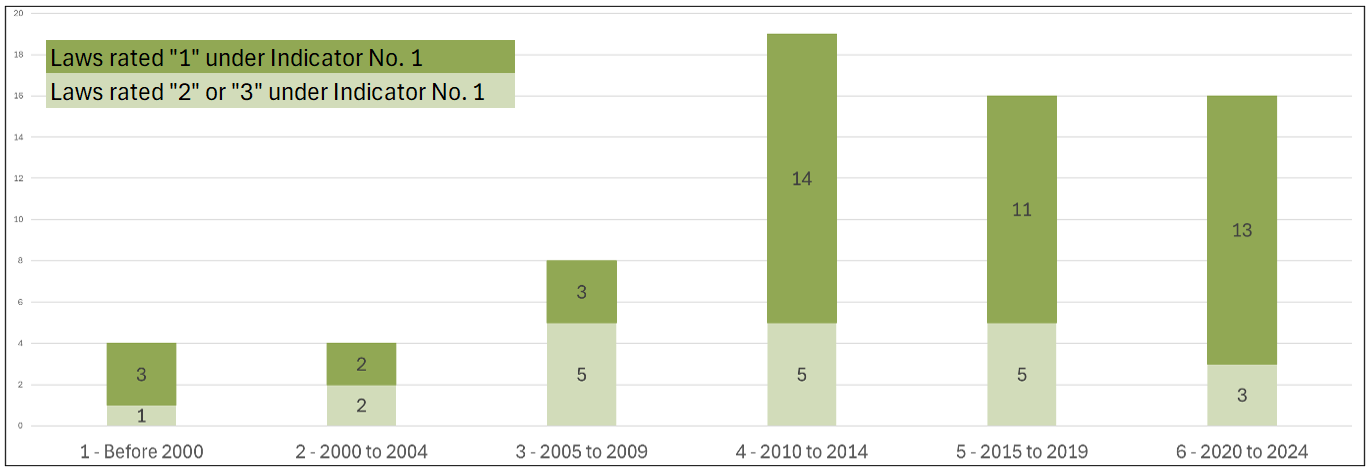
Despite a deliberate focus on laws covering the protection of potential whistle-blowers, this study reveals a broad diversity among the national approaches to building such a framework.
Out of the 67 national laws covered by this study, only five are considered to be “comprehensive” across all 14 indicators. Four of these were enacted during the two years preceding the release of this report (between 2022 and 2024).
Eighteen national laws were found to be “absent or limited” across five or more indicators.
Results of the analysis reveal a broad diversity of approaches across the following dimensions:
-
Scope of protection : the diversity of approaches is exemplified by the focus of national laws, with a majority of them specifically designed at protecting whistle-blowers, while a significant number of such laws still address such protection only as part of a broader framework and purpose (Indicator No.1). All national laws studied cover a comprehensive scope of public sector organizations (Indicator No.2). However, some of them do not extensively protect all public sector workers (Indicator No. 4). Even more diversity is observed on the type of reportable irregularities allowing for statutory protection. In many countries, whistle-blowing remains a tool allowing for the reporting of corruption or for the cooperation with witnesses of serious crimes (Indicator No. 3). The scope of the protection also differs based on each individual national law’s approach to the legitimate interests pursued by whistle-blowers by referring to and/or defining “good faith” as key requirement to be recognized as a protected whistle-blower (Indicator No. 5). -
Reporting channels : a majority of national laws studied still require whistle-blowers to report through an official institutional channel to be protected. Some national laws protect individuals reporting internally within their organization and some protect them if they report externally (i.e. to civil society, the public or the press). But only a quarter of the national laws studied protect whistle-blowers across all three channels: official, internal and external (Indicator No. 6). -
Confidentiality and anonymity : almost all national laws studied explicitly protect the identity of whistle-blowers as confidential information (Indicator No. 8). By contrast, provisions allowing for and protecting anonymous reports are much less common, with a large majority of national laws studied either ignoring or explicitly excluding anonymous whistle-blowers from their protection (Indictor No. 7). -
Anti-retaliation provisions : as a matter of principle, a very large proportion of national laws in the study explicitly protect whistle-blowers against retaliation (Indicator No. 9). However, approaches differ again when it comes to defining specific remedies against retaliation (Indicator No. 10) and enacting sanctions against retaliators (Indicator No. 11). -
Institutional set-up : similarly, a significant number of national laws studied designate agencies or jurisdiction to collect whistle-blowers’ claims and enforce their protection (Indicator No. 12), but much fewer include transparency and accountability in such agency or jurisdiction’s mandate (Indicator No. 13). Finally, only a minority of studied laws explicitly prescribe that the whistle-blower be kept informed of the report within a certain timeline (Indicator No. 14).
The 2022 ILO Technical meeting concluded that “whistle-blower protection should be considered within the national context and circumstances of each country”, recognizing that some level of diversity between national law is to be expected. However, this study observed some significant departures from consistent institutional recommendations which raises questions on the need for additional guidance or coordination.
Finally, the approach adopted for this study focuses solely on analysis of the apparent intent of national legislators, without seeking insight into the actual application or efficiency of the national laws reviewed. Such insight might be gathered from a survey of ILO Member States’ practices with regard to whistle-blower protection in the public sector, or by mining the results from relevant review mechanisms such as the country monitoring reports under the OECD Anti-bribery Convention or the UNCAC Implementation Review Mechanism.
At the 2022 Technical meeting on the protection of whistleblowers in the public service sector, ILO constituents agreed that an efficient, transparent and high-quality public service is essential for sustainable social and economic development and is of common interest to governments, employers and workers. Corruption and other forms of wrongdoing impact public administration because they lead to the inefficient provision of public services, reduce public investment and slow economic growth. They undermine the trust in public institutions which is necessary for decent work, an enabling environment for sustainable enterprises and social justice. Corruption distorts fair competition and creates inequality in the distribution of socio-economic benefits. The protection of whistle-blowers in the public service sector is therefore an important strategy in fighting corruption and wrongdoing in this sector.
As countries continue to develop their laws and practice on the protection of whistle-blowers in the public service, it is hoped that the present study can serve as a guide to benchmark their standards against those of relevant international institutions. Moreover, they can refer to the Conclusions of the ILO Technical meeting on the protection of whistleblowers in the public service sector, which noted that to be effective, whistle-blower protection should be considered within the national context and circumstances of each country. Accordingly, there are diverse approaches to effective whistle-blower protection, established in laws, codes of ethics, and policies across countries. Among others, these include:
-
training and awareness raising;
-
definition of how the burden of proof works in a case of retaliation;
-
clear and protected reporting channels;
-
protected avenues for whistle-blowers to receive independent and trusted advice and support from appropriate bodies, including workers’ organizations;
-
internal and external legal support;
-
interim relief measures;
-
sanctions and remedies;
-
provision or prohibition of incentives and rewards;
-
confidentiality clauses that protect the identity of whistle-blowers;
-
the establishment of independent enforcement agencies and oversight bodies such as national whistle-blower protection authorities, or a strengthened mandate for existing national institutions in this field;
-
clear criteria and a minimum threshold for accessing and managing protection.
Appendix: List of laws included in the research, by country
|
ISO3 Code |
Country |
ILO Region |
National law reviewed |
Year of enactment |
|---|---|---|---|---|
|
|
Angola |
Africa |
Law 1/20 on the Protection of Victims, Witnesses and Collaborating Defendants in Criminal Proceedings |
2020 |
|
|
Australia |
Asia and the Pacific |
Federal Public Interest Disclosure Act, 2013 |
2023 |
|
|
Belgium |
Europe and Central Asia |
Law on reporting channels and protection of those who report breaches of integrity in federal public sector bodies and within the integrated police force |
2022 |
|
|
Bangladesh |
Asia and the Pacific |
Disclosure of Information in Public Interest Act |
2011 |
|
|
Bosnia and Herzegovina |
Europe and Central Asia |
Law on the Protection of Persons Who Report Corruption in Bosnia and Herzegovina institutions |
2023 |
|
|
Bolivia (Plurinational State of) |
Americas |
Law No.458 on the protection of whistleblower and witnesses |
2013 |
|
|
Brazil |
Americas |
Presidential DecreeNo.10.153 (Provides for safeguards to protect the identity of whistleblowers of illicit acts and irregularities committed against the direct and indirect federal public administration) |
2019 |
|
|
Barbados |
Americas |
Whistleblower Protection Act, 2021 |
2021 |
|
|
Botswana |
Africa |
Whistleblowing Act, 2016 |
2016 |
|
|
Canada |
Americas |
Public Servants Disclosure Protection Act |
2005 |
|
|
Switzerland |
Europe and Central Asia |
Provisions of the law on federal staff (articles 22a et seq.) |
2010 |
|
|
Chile |
Americas |
Law No.21952 establishing a protective status in favor of whistleblowers |
2023 |
|
|
Côte d'Ivoire |
Africa |
Law 2018-570 on the protection of witnesses, victims, relators, experts and other related persons |
2018 |
|
|
Costa Rica |
Americas |
Law on the protection of whistleblowers and witnesses of acts of corruption against workplace retaliation |
2024 |
|
|
Germany |
Europe and Central Asia |
Whistleblower Protection Act |
2023 |
|
|
Denmark |
Europe and Central Asia |
Whistleblower Protection Act |
2021 |
|
|
Algeria |
Africa |
Law No. 06-01 on prevention and fight against corruption |
2006 |
|
|
Ecuador |
Americas |
Organic law on Amendments to the Comprehensive Organic Criminal Code in relation to Anti-corruption |
2021 |
|
|
Spain |
Europe and Central Asia |
Law regulating the protection of persons who report regulatory violations and the fight against corruption. |
2023 |
|
|
Estonia |
Europe and Central Asia |
Act on the Protection of Whistleblowers from Violations of European Law at Work |
2024 |
|
|
Ethiopia |
Africa |
Proclamation 699/2010 to Provide for the Protection of Witnesses and Whistleblowers of Criminal Offences |
2011 |
|
|
France |
Europe and Central Asia |
Act on the improvement of whistleblower protection |
2022 |
|
|
United Kingdom of Great Britain and Northern Ireland |
Europe and Central Asia |
Public Interest Disclosure Act, 1998 |
1998 |
|
|
Georgia |
Europe and Central Asia |
Law of Georgia on the Fight Against Corruption |
2015 |
|
|
Ghana |
Africa |
Whistleblower Act, 2006 |
2006 |
|
|
Guatemala |
Americas |
Decree 31-2012 — Anti-Corruption Law |
2012 |
|
|
Guyana |
Americas |
Protected Disclosures Act |
2018 |
|
|
Honduras |
Americas |
Witness protection law in criminal procedure |
2007 |
|
|
Indonesia |
Asia and the Pacific |
Protection of witnesses and victims |
2014 |
|
|
India |
Asia and the Pacific |
Whistle Blowers Protection Act, 2014 |
2014 |
|
|
Israel |
Europe and Central Asia |
The Protection of Employees Law (Exposure of Offences of Unethical Conduct and Improper Administration) |
1997 |
|
|
Jamaica |
Americas |
Protected Disclosures Act, 2011 |
2011 |
|
|
Jordan |
Arab States |
Law No. (62) of 2014 on the Protection of Whistleblowers, Witnesses, Informants and Experts in Corruption Cases, Their Relatives and Persons Closely Related to Them |
2014 |
|
|
Japan |
Asia and the Pacific |
Whistleblower Protection Act |
2004 |
|
|
Kazakhstan |
Europe and Central Asia |
Law on combatting Corruption |
2015 |
|
|
Kyrgyzstan |
Europe and Central Asia |
Law "On the Protection of Persons Reporting Corruption Offences" |
2019 |
|
|
Cambodia |
Asia and the Pacific |
Law on Anti-corruption |
2010 |
|
|
Republic of Korea |
Asia and the Pacific |
Public Interest Whistleblower Protection Act |
2023 |
|
|
Kuwait |
Arab States |
Law No. 2 of 2016 establishing the Kuwait Anti-Corruption Authority |
2016 |
|
|
Lebanon |
Arab States |
Law No. 83 relating to the protection of whistleblowers |
2018 |
|
|
Sri Lanka |
Asia and the Pacific |
Anti-Corruption Act No.9 of 2023 |
2023 |
|
|
Madagascar |
Africa |
Law 2004-30 on fighting corruption |
2004 |
|
|
Mexico |
Americas |
Guidelines for the Promotion and Operation of the Internal and External Citizen Corruption Whistleblower System |
2019 |
|
|
Malta |
Europe and Central Asia |
Protection of the Whistleblower Act |
2013 |
|
|
Mauritius |
Africa |
Prevention of Corruption Act, 2002 |
2002 |
|
|
Malaysia |
Asia and the Pacific |
Whistleblower Protection Act, 2010 |
2010 |
|
|
Namibia |
Africa |
Whistleblower Protection Act 10 of 2017 |
2017 |
|
|
Norway |
Europe and Central Asia |
Working Environment Act (chapter 2A) |
2005 |
|
|
Nepal |
Asia and the Pacific |
Right to Information Act, 2007 |
2007 |
|
|
New Zealand |
Asia and the Pacific |
Protected Disclosures Act 2022 |
2022 |
|
|
Pakistan |
Asia and the Pacific |
Public Interest Disclosure Act, 2017 |
2017 |
|
|
Peru |
Americas |
Law No. 29542 on the Protection of Whistleblowers in the Administrative Field and Effective Collaboration in the Criminal Field |
2010 |
|
|
Romania |
Europe and Central Asia |
Law No. 361 on the Protection of Whistleblowers in the Public Interest |
2022 |
|
|
Saudi Arabia |
Arab States |
Law on the Whistleblower, Witness, Expert and Victim Protection System |
2024 |
|
|
Singapore |
Asia and the Pacific |
Prevention of Corruption Act, 1960 |
1960 |
|
|
Sierra Leone |
Africa |
Anti-corruption Act, 2008 |
2008 |
|
|
Serbia |
Europe and Central Asia |
Law on the Protection of Whistleblowers |
2014 |
|
|
Suriname |
Americas |
Anti-corruption Act |
2017 |
|
|
Thailand |
Asia and the Pacific |
Executive Measures in Anti-corruption Act |
2009 |
|
|
Tunisia |
Africa |
Organic Law on the Reporting of Corruption and the Protection of Whistleblowers |
2017 |
|
|
Tanzania, United Republic of |
Africa |
Whistleblower and Witness Protection Act |
2015 |
|
|
Uganda |
Africa |
Whistleblower Protection Act, 2010 |
2010 |
|
|
Ukraine |
Europe and Central Asia |
Law on the Prevention of Corruption |
2014 |
|
|
United States of America |
Americas |
Whistleblower Protection Act of 1989 |
1989 |
|
|
Viet Nam |
Asia and the Pacific |
Law No. 25/2018/QH14 on Denunciation |
2018 |
|
|
South Africa |
Africa |
Protected Disclosures Act 26 of 2000 |
2000 |
|
|
Zambia |
Africa |
Public Interest Disclosure Act |
2010 |
References
Banisar, David. 2011. “Whistleblowing: International Standards and Developments” in Corruption and Transparency: Debating the Frontiers between State, Market and Society, ed. I. Sandova. Washington DC: World Bank-Institute for Social Research, UNAM.
Council of Europe. 2014. Protection of Whistleblowers: Recommendation CM/Rec (2014)7 and Explanatory Memorandum.
International Bar Association and Government Accountability Project. 2021. Are whistleblowing laws working? A global study of whistleblower protection litigation.
Chalouat, Iheb, Carlos Carrión-Crespo and Margherita Licata. 2019. “Law and Practice on Protecting Whistle-blowers in the Public and Financial Services Sectors”, ILO Sectoral Policies Working Paper No. 328.
ILO. 2022a. Sectoral Policy Department, The protection of whistle-blowers in the public sector, ref: TMWBPS/2022.
ILO. 2022b. Conclusions of the Technical meeting on the protection of whistle-blowers in the public service sector, 2022.
OAS (Organization of American States). 2013. Model Law to facilitate and encourage the reporting of acts of corruption and to protect whistleblowers and witnesses.
OECD (Organisation for Economic Cooperation and Development). 2009. Recommendation of the Council for Further Combating Bribery of Foreign Public Officials in International Business Transactions (amended in 2021), OECD/LEGAL/0378.
–––. 2016. Committing to Effective Whistleblower Protection, Paris: OECD Publishing.
–––. 2017. Recommendation of the Council on Public Integrity, OECD/LEGAL/0435.
–––. 2018. Terracol, Marie. A Best Practice Guide for Whistleblowing Legislation.
–––. 2020. OECD Public Integrity Handbook, Paris: OECD Publishing.
Transparency International. 2013. International Principles for Whistleblower Legislation.
–––. 2020. Methodology and Guidelines to assess
UNODC (United Nations Office on Drugs and Crime). 2015. The United Nations Convention against Corruption: Resource Guide on Good Practices in the Protection of Reporting Persons.
–––. 2021. Speak Up for Health: Guidelines to enable whistle-blower protection in the health-care sector.
–––. 2023. “Protection of reporting persons”, Resolution No. 10/8 of the Conference of the States Parties to the United Nations Convention against Corruption, CAC/COSP/2023/L.12.
Shpresa Kaçiku Baljija and Kyoung-sun Min. 2023, Evaluating the effectiveness of whistleblower protection: A new index. in Data & Policy (2023), 5: e28. doi:10.1017/dap.2023.20.
Wolfe, Simon et al. 2014. Whistleblower Protection Laws in G20 Countries: Priorities for Action. Transparency International Australia.