


Demographic change in Europe and Central Asia
Addressing the issue of a shrinking and ageing labour force
Abstract
This paper identifies existing labour market challenges associated with ageing in Europe and Central Asia. It presents a general overview and provides ideas to stimulate social dialogue. In 2024, there were 28 persons aged 65 years and above per 100 persons aged 15 to 64 years and this ratio is projected to rise to 43 by 2050. The proportion of older workers (55 years and above) will increase, while the prime-age workforce (25 to 54 years) will decline. This demographic transition is expected to result in a net loss of 10 million workers in the region by 2050. As pension systems increasingly have to rely on a diminishing pool of younger workers, sustaining current living standards will become more challenging. Productivity growth in Europe and Central Asia has been falling since 1991. New sources of productivity have to be unlocked if current standards of living are to be maintained. Increasing the labour force participation of inadequately represented groups, including women, persons with disabilities, the youth, migrants and refugees may only partially improve the situation. However, it would be a step forward in improving the outlook for the challenges that the region is experiencing.
Introduction
Europe and Central Asia,1 like the rest of the world, is undergoing a rapid demographic transformation. Particularly in Europe, the prime working-age population (25 to 54 years) is shrinking due to low fertility rates, with some European countries, and mainly in Eastern Europe, also suffering from talent emigration. Although total fertility in Central Asia and Israel remains above the replacement level, lower birth rates and higher longevity have caused significant shifts in the population structure. The ensuing rising economic dependency of the non-employed on workers and shrinking labour force threatens economic wealth – both at the aggregate level due to the risk of hampering economic development, but also at the individual level, by straining the capacity of existing social protection systems to provide adequate old-age pensions. Section 1 of this paper addresses the issue of a shrinking and ageing working population in Europe and Central Asia as well as the challenges that may arise from demographic shifts. It offers a snapshot of the current demographic and labour market trends in the region. Issues stemming from an ageing labour force and rising dependency ratios are described.
Societies need to define and strategize how to react to the challenges posed by demographic change and rising dependency ratios. To mitigate the impact of such challenges, the participation in the labour force of specific categories of people who are presently not fully engaged can be expanded, in particular women, older workers and young people, persons with disabilities, and migrant workers and refugees. Section 2 of this paper investigates the labour market characteristics of those groups and highlights some challenges which hinder greater participation by them. The analysis raises several questions critical for securing an adequate share of the economically active population with decent work, supporting the young and elderly, national healthcare systems and social protection schemes.
The share of older workers will also keep rising on account of longer and healthier lives. Older workers may have age-specific characteristics in terms of physical and mental fitness, skills and experience acquired, and levels of productivity. How can the potential of older workers be tapped? How can their active status in the labour market be supported in productive and well-paying economic activities?
The persistent inequality in the distribution of unpaid care work, disproportionately borne by women, and the inadequacy of childcare, elderly care, long-term care and related care leave policies and infrastructure significantly hinder women’s labour market participation, their ability to balance both unpaid care and paid work, as well as their broader economic security, health and well-being. How can policies foster women’s participation in the labour market and their right to decent work?
Persons with disabilities are inactive or unemployed in higher shares than the rest of the working-age population. Recent developments including digitalization, artificial intelligence (AI) and telework can make it easier for persons with disabilities to be employed in productive, decent jobs. How can the employment of persons with disabilities be supported and their active participation in the labour market be boosted?
The level of youth who are not in employment, education or training (NEET) in Europe and Central Asia stands at rather high levels. How can youth employment be increased jointly with rising levels of participation of older people in the labour force?
Talented and skilled youth are leaving some areas in Europe and Central Asia, such as the Western Balkans, to emigrate to other countries in the region which have started programmes to attract foreign, qualified labour force. How can development policies encourage the return of skilled emigrated youth?
Certain migration movements are quite constant in some areas, and conflicts in the region have generated flows of refugees that have the potential to support the shrinking labour force of host countries. How can countries ensure the inclusion of migrant workers and refugees in their labour markets to better support shrinking labour forces in the region? Which policies facilitate the integration of refugees in national labour markets? How can decent working conditions be secured for all workers, including migrants, especially in those sectors offering jobs of low quality, where local qualified candidates refuse employment?
Productivity is fundamental for economic development and higher wages. It is also a key component for sustained, sustainable and inclusive development. Yet, recent productivity growth has been low, which is extremely problematic given the rising dependency ratio in the region – which is the number of persons below the age of 15 years and 65 years and older compared to those aged 15 to 64 years. Furthermore, with rapid technological shifts and rising pressures brought on by climate change, boosting productivity may not benefit everyone equally. How can productivity gains be fostered and equally distributed among all individuals, including those who are vulnerable, who are socially excluded or who face discrimination?
This paper identifies existing labour market challenges associated with ageing. Social dialogue often plays an important role in the identification and implementation of solutions, and such instances are highlighted. It is for social partners and policymakers to choose the most appropriate mechanisms to mitigate the labour market challenges associated with their ageing societies. This paper presents a general overview and provides ideas to stimulate social dialogue with the guiding questions above.
Population and labour force trends
Population trends
The global phenomenon of population ageing affects Southern Europe more than other subregions in Europe and Central Asia; while Central Asia is projected to maintain a low dependency ratio until 2050, with proportionally more working-age adults to support the young and the elderly (see figure 1). In Europe and Central Asia as a whole, the old-age ratio – the number of persons aged 65 years and above per 100 persons aged 15 to 64 years – is projected to rise from 28 in 2024 to 43 in 2050 – a change very similar to that expected for high-income countries globally. Yet, demographic trends differ widely across subregions. Southern Europe is expected to experience the largest change in the old-age ratio, by 30 persons, reaching 66 per 100 by 2050. Western Asia is also expected to see a large increase in the old-age ratio. However, on account of its relatively young population in 2024, the old-age ratio is projected to rise to only 34 persons per 100 by 2050. Northern Europe is expected to see a relatively small rise in the old-age ratio by 11 to 42 persons per 100 in 2050. Central Asia’s old-age ratio hardly rises and is projected to stand at 17 persons per 100 in 2050. Furthermore, the total population is projected to rise between 2024 and 2050 in Northern Europe and in both Central and Western Asia as well, while it is projected to fall in the other European subregions.2
Figure 1. Old-age ratios in Europe and Central Asia, 2024 and 2050 projections
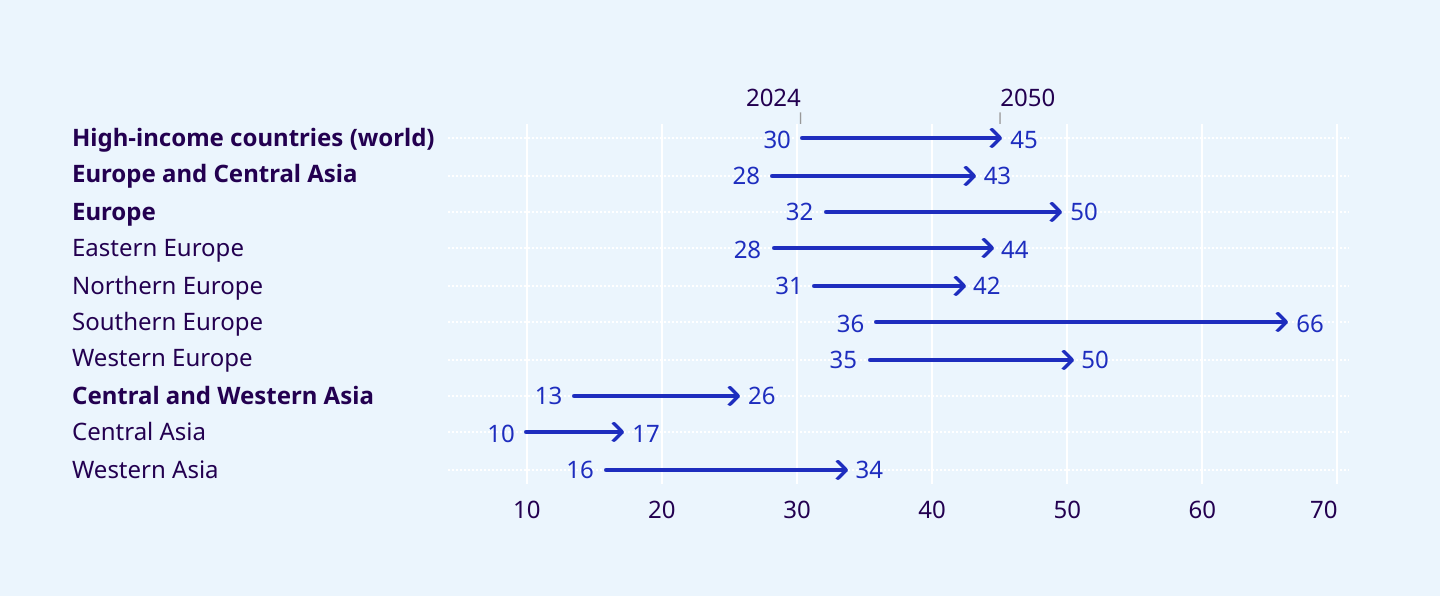
Note: The old-age ratio is the population aged 65 years and above per 100 persons aged 15 to 64 years. The old-age ratios of men and women are projected to change very similarly, with women exhibiting a higher level due to longer life expectancy.
Source: DESA (2024).
Even though population projections are subject to uncertainty related to the evolution of birth rates and migration flows, all scenarios for Europe project a major rise in the old-age ratio (see figure 2). Advances in longevity and the ageing of the baby-boomer generation mean that even if birth rates in Europe were to instantly rise to replacement level, the number of persons aged 65 years and above per 100 persons aged 15 to 64 years would only rise to 46 by 2050 – an improvement of a mere 4 persons compared to the median projection for Europe. The absence of inward migration into Europe would raise the old-age ratio by around three persons – an impact that is notable but that nevertheless pales in comparison to the overall increase in the old-age ratio due to demographic change. Indeed, 90 per cent of all scenarios estimated for Europe by the UN World Population Prospects 2024 project an old-age ratio in the range between 47 and 52 by 2050.
Figure 2. Scenario projections for old-age rations in Europe’s in 2050, with and without migration
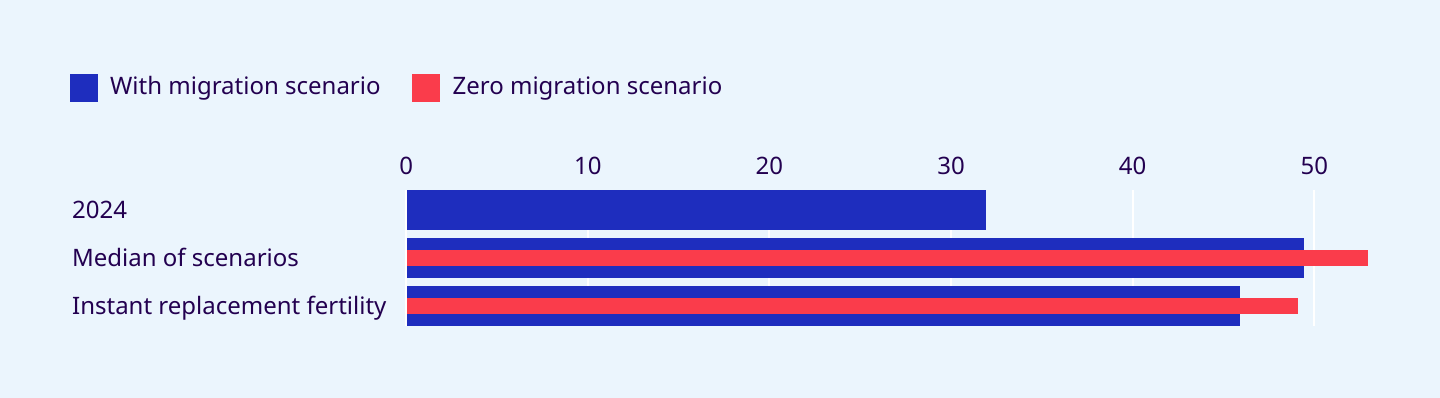
Note: Old-age ratio is the population aged 65 years and above per 100 persons aged 15 to 64 years.
Source: DESA (2024).
Labour force trends
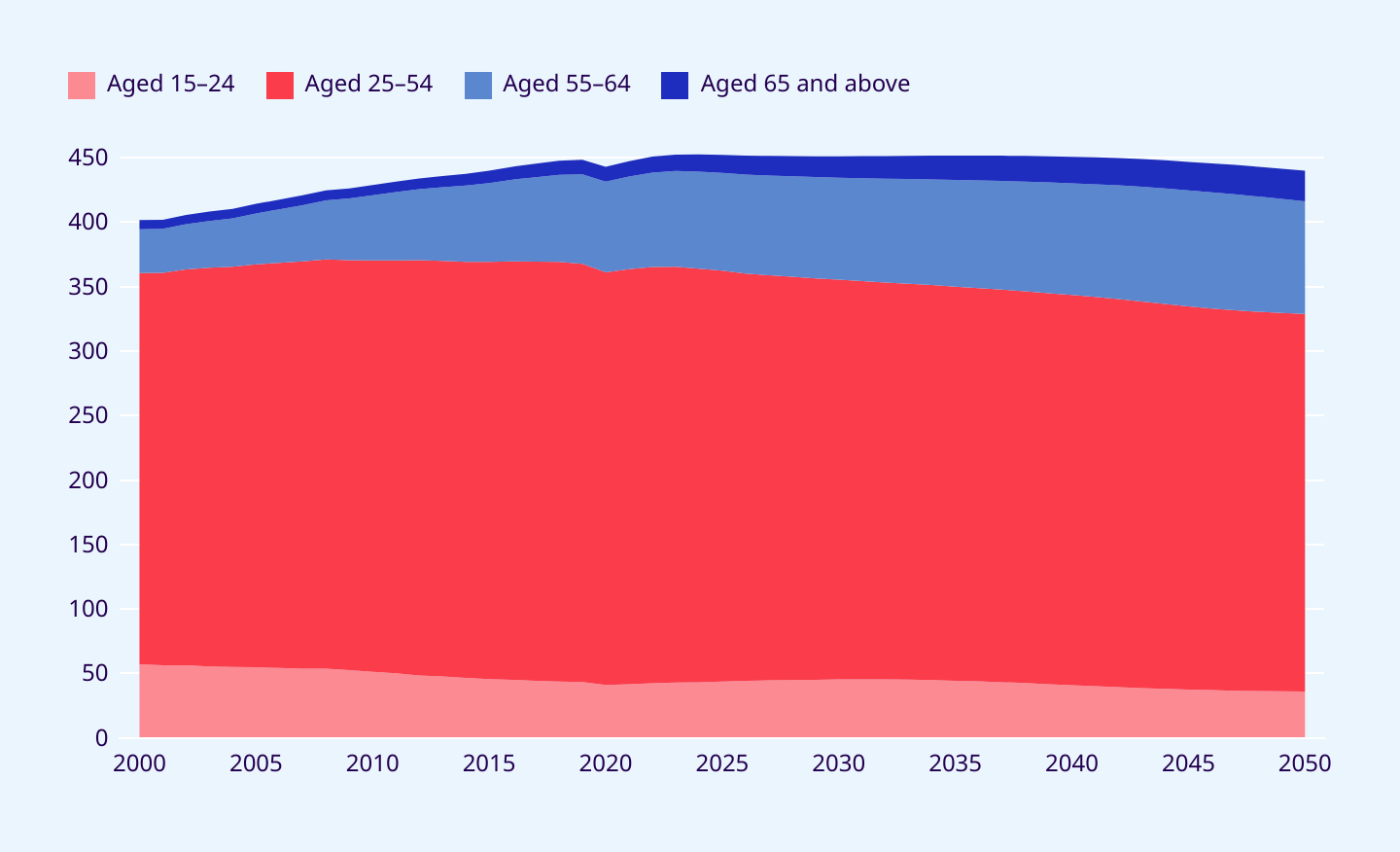
As populations in Europe and Central Asia age, the composition of the population and the labour force will change significantly (see figure 3). While the number of persons aged 55 years and above in the labour force is projected to rise to 25 million by 2050 in Europe and Central Asia, the labour force aged 15 to 54 years is projected to decline from 365 million in 2023 to 330 million by 2050, resulting in a net loss of 10 million. Although changes in the population structure are the primary drivers of changes in the composition of the labour force, distinct trends in labour force participation rates (LFPRs) among various demographic groups can also have an impact on that composition.
Figure 3. Composition of the labour force in Europe and Central Asia, by age group, 2000–50, (million)
Source: ILO estimates.
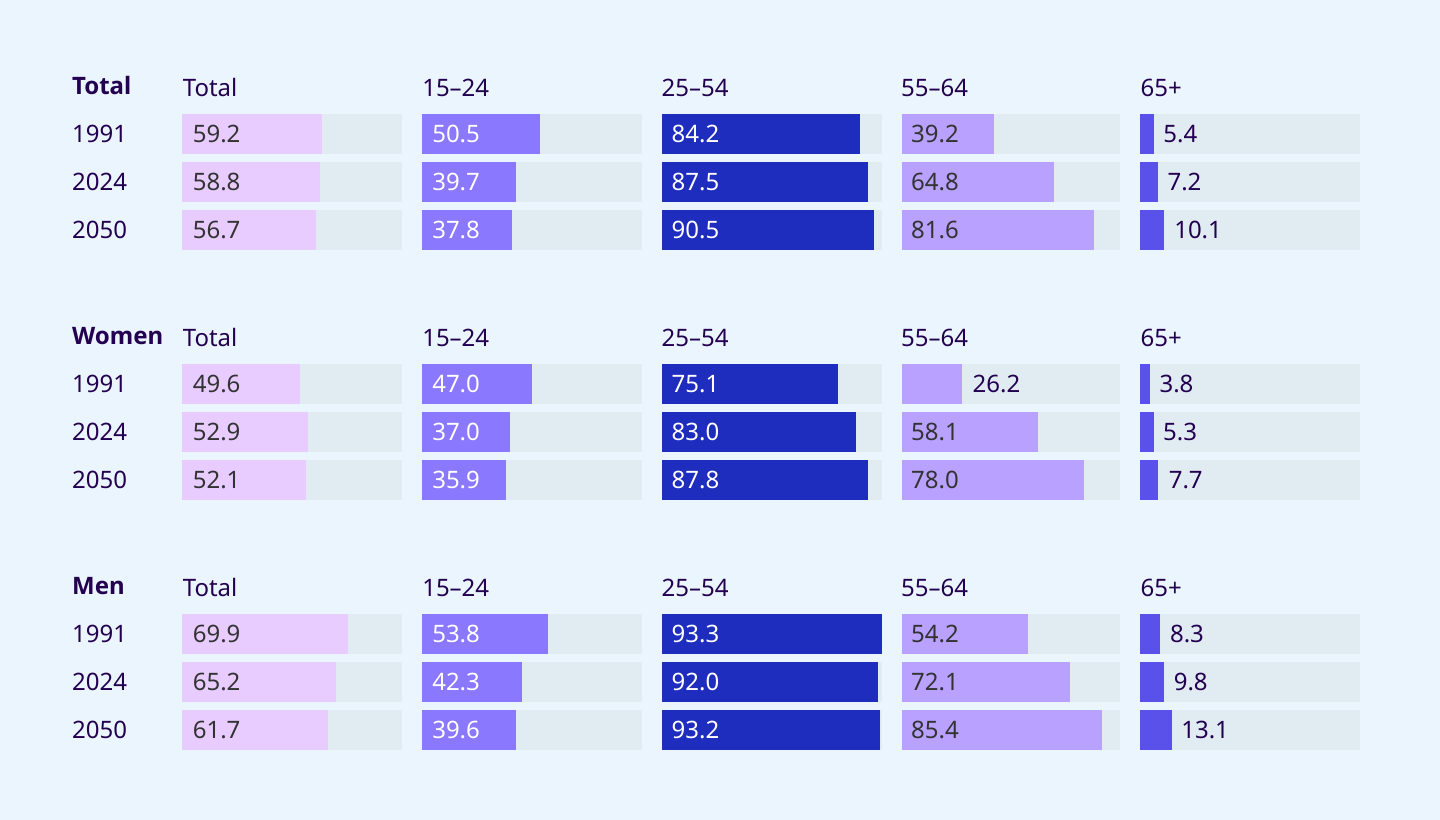
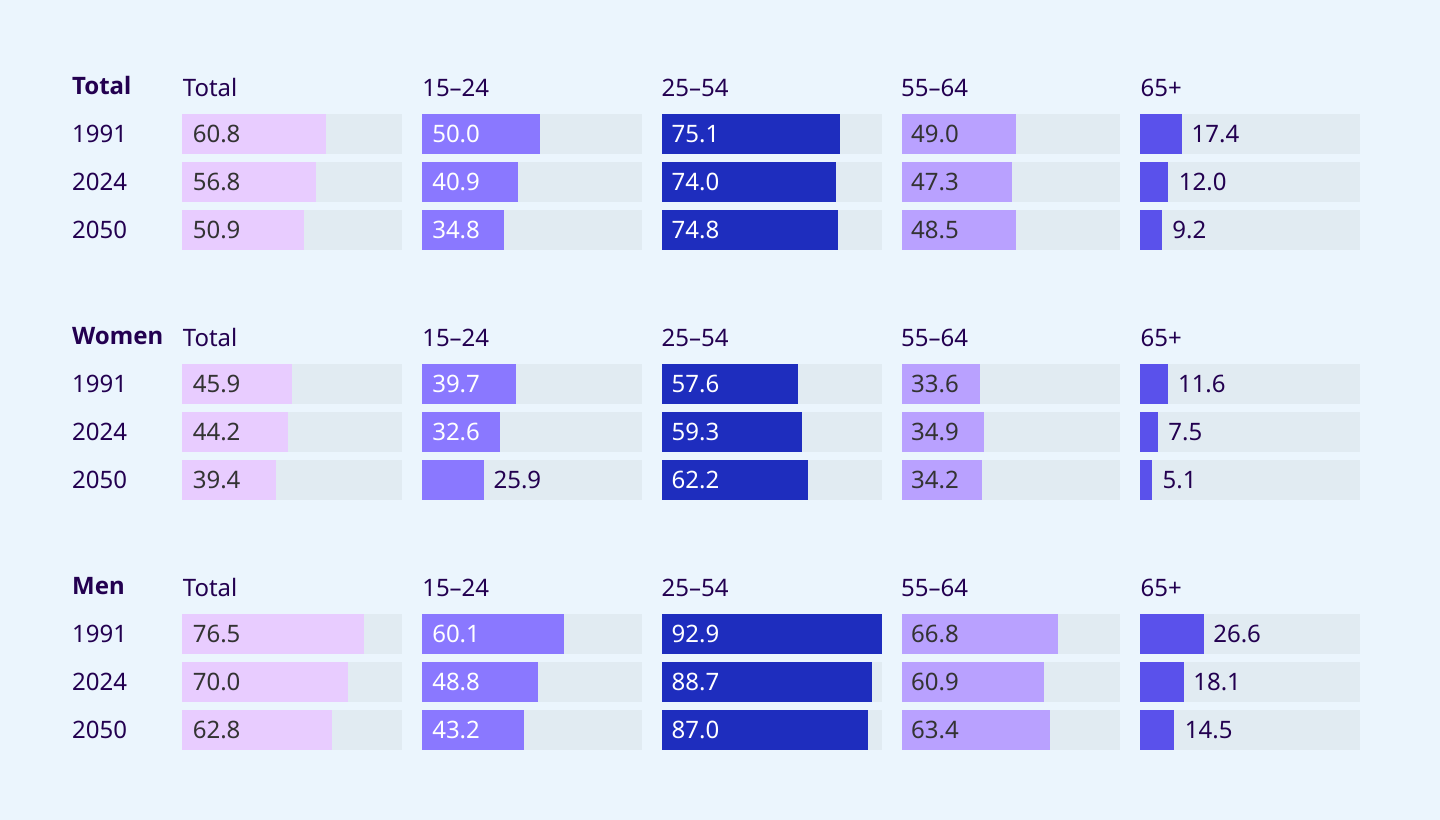
Between 1991 and 2024, the aggregate LFPR fell in both Europe and Central Asia, and it is projected to fall further by 2050 (see figures 4 and 5). Yet, participation rates of those aged 25 to 64 years, who comprise the bulk of the labour force, have even risen in Europe since 1991, and have hardly fallen in Central and Western Asia, and they are projected to rise by 2050 in both regions. Demographic change – the fact that a larger share of the population enters an age group where the LFPR is lower due to retirement – is responsible for the declining LFPR. Rising longevity also tends to raise the share of retired persons among those aged 65 years and above, which would lower the LFPR of that age group. In Europe, the share of the population aged 80 years and above among those aged 65 years and above is projected to rise from 26 per cent in 2023 to 36 per cent in 2050 (see also Pinkus and Ruer 2024).3 Youth aged 15 to 24 years have experienced declining participation rates and at the same time rising educational enrolment in both regions.
Europe has witnessed a major expansion of female participation, in particular in the age group 55 to 64 years, and this expansion is projected to continue (see figure 4). Older men aged 55 to 64 years have also expanded their LFPR significantly, implying increases in the average retirement age in the region. Participation rates among those aged 65 years and above have also risen, though only marginally, and they remain at a low level, certainly in comparison to Central and Western Asia (see figure 5). Those trends counter the impact of the demographic shift, resulting in only marginal changes of the aggregate LFPR in Europe.
Figure 4. Labour force participation rates and projections in Europe, by sex and age group, 1991, 2024 and 2050 (percentage)
Source: ILOSTAT, ILO modelled estimates, November 2024; ILO estimates.
In the absence of rising trends of LFPR in individual demographic groups, Central and Western Asia is projected to see its aggregate LFPR decline by almost 6 percentage points by 2050, as opposed to a decline of around 2 percentage point for Europe (figure 5). Between 1991 and 2024, women in Central and Western Asia experienced a much smaller decline than men in LFPR (1.7 versus 6.5 percentage points), but the gender gap remains large, at 26 percentage points in 2024. The gender gap is particularly large in the age group 55 to 64 years and, in relative terms, in the age group 65 years and above. In 2024, 12.0 per cent of persons above 65 years of age were still part of the labour force, which is likely due to economic necessity given insufficient and inadequate old-age pensions.
Figure 5. Labour force participation rates and projections in Central and Western Asia, by sex and age group, 1991, 2024 and 2050 (percentage)
Source: ILOSTAT, ILO modelled estimates, November 2024; ILO estimates.
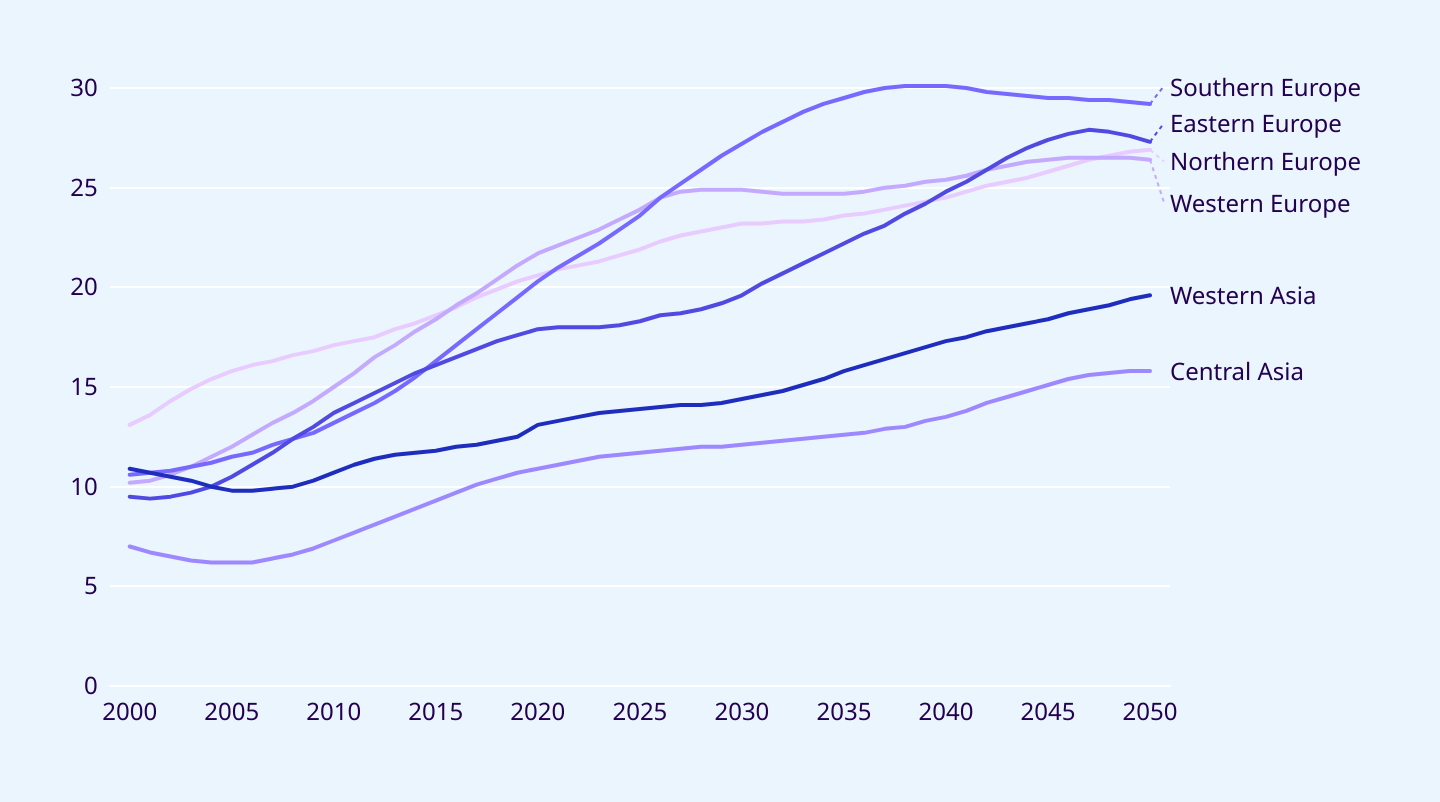
The share of those aged 55 years and above in the labour force has been rising strongly in the various subregions, but it is projected to eventually level off between 25 and 30 per cent, and to even decline again somewhat in some subregions (see figure 6). In Southern Europe, for example, the share of the population aged 55 years and above is projected to reach 46 per cent in 2040, and 48 per cent by 2100 – essentially reaching a plateau.4 Yet, the share of the population aged 80 and above is projected to rise from 10 to 19 per cent over the same period, thereby explaining the projected decline in the share of older workers in the labour force after 2040. Such a development is bound to happen in all regions undergoing a transition from high to low birth rates, unless old-age participation rates were to rise continuously.
Figure 6. Share of those aged 55 years and above in the labour force in Europe and Central Asia, by subregion, 2000–50 (percentage)
Source: ILOSTAT, ILO modelled estimates, November 2024; ILO estimates.
Economic dependency and productivity
Falling aggregate LFPRs will also lead to a falling employment-to-population ratio. This raises the old-age economic dependency ratio, which is the ratio of those who are not in employment to those who are in employment among the population aged 15 years and above.5 The shifts in the old-age dependency ratio are strongly correlated with the changes in the ratio of the population aged 65 years and above to those aged 15 to 64 years (see figure 1). Yet, rising participation rates among some demographic groups render the resulting changes in dependency ratios surprisingly small for some of the subregions. For Europe, the projected change in the old-age economic dependency ratio between 2024 and 2050 is only 5 inactive persons per 100 employed, as opposed to 20 persons in Central and Western Asia. Northern Europe is even projected to experience a slight decline, while the ratio is projected to rise in Southern Europe by 16 inactive persons per 100 employed.
A rising old-age economic dependency ratio exacerbates the distributional challenge to maintain or expand standards of living for all social and demographic groups even if GDP per capita were to continue to increase. Income redistribution through social protection would need to expand as the number of households without labour-market-based incomes increases. In addition, the financial requirements for health and other care of older people with heightened needs can go beyond old-age pensions, necessitating further financing of some form.6 Reviewing social protection systems and their financing to ensure long-term sustainability while adhering to ILO Conventions and Recommendations will be key to avoid an unequal and excessive burden on parts of society.7 Growing GDP per capita makes it more likely to establish redistributive systems where no part of society faces continually declining incomes. Yet, maintaining rising GDP per capita could prove to be very challenging in Europe and Central Asia. Furthermore, rising GDP per capita is no guarantee for improved well-being – achieving inclusive, sustained and sustainable development goes far beyond raising a single number.
The combined effect of trends in working-age population growth and employment rates is projected to lower the average annual GDP growth between 2024 and 2050 by 0.1 percentage points in Europe and Central Asia (see figure 7). Growth of labour productivity – when defined as output per worker – would need to be at least as large to stabilize GDP. The impact ranges from negative 0.7 percentage points in Southern Europe to positive 1.0 percentage points in Central Asia. Eastern and Southern Europe are the only two subregions where shrinking populations present a major drag of around 0.3 to 0.4 percentage points on GDP growth, while Northern Europe, Central Asia and Western Asia are expected to see a positive contribution from working-age population growth. The change in the employment rate is projected to lower GDP growth by 0.6 percentage points annually in Central Asia but increase it slightly in Northern Europe. The baseline European labour force projection includes rises in the LFPR of older workers and women by 2050, which cushions the overall impact of demographic change on aggregate LFPR and employment rates. If those rises were not to happen but instead the LFPR of all demographic groups were to remain at their 2024 level, then the ensuing additional fall in the employment rate would lower average annual GDP growth by an additional 0.3 to 0.4 percentage points in Europe.8 In this alternative scenario, Europe would see GDP decline by 0.6 percentage points per year, and Southern Europe even by 1.0 percentage points, unless matched by an equivalent rise in labour productivity.9
Figure 7. Impact of demography and employment rate on average annual GDP growth, in Europe and Central Asia, 2024–50 (percentage points)
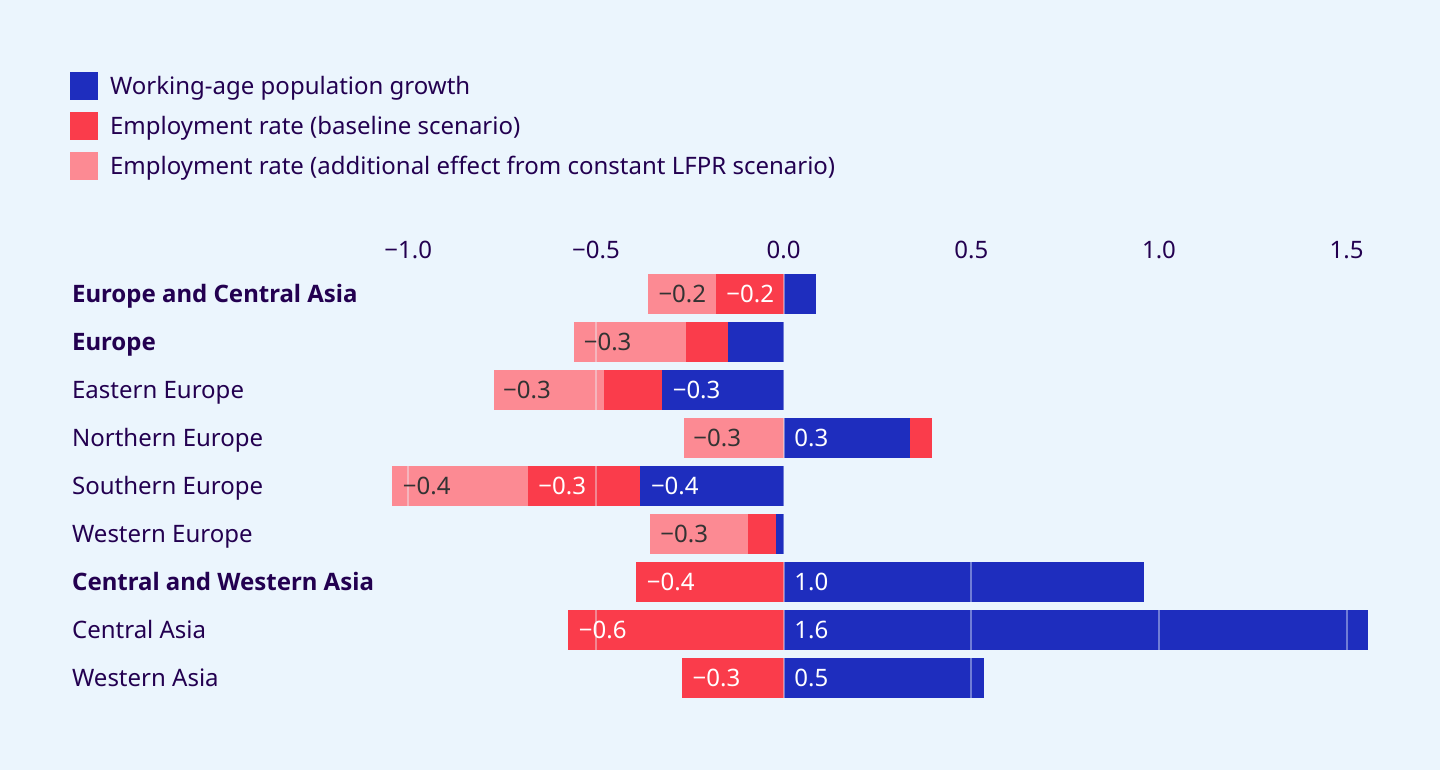
Note: GDP growth can be decomposed into growth of the working-age population plus the growth of the ratio of employment to the working-age population plus the growth of output per employed (labour productivity). The figure depicts the average annual growth effect of the first two components between 2024 and 2050, where the total effect of demographic change is the sum of these effects. The figure also shows the additional growth effect in addition to the baseline effect of a scenario where LFPRs of demographic groups in Europe were to remain at their 2024 level, which would result in a lower overall LFPR by 2050. The final impact on GDP depends on future labour productivity growth, which is not shown in the figure, as it is unknown.
Source: ILO estimates.
Ageing societies could face lower productivity growth through several channels. Yet, empirical evidence for most of those is scarce or inconclusive, highlighting the need for further research.10 While experience raises productivity, this effect tends to diminish with the years, suggesting little additional benefit for countries in Europe and Central Asia that already have fairly aged workforces (Gagliardi, Grinza and Rycx 2023; Guest 2013; Guzzo, Nalbantian and Anderson 2022). On the contrary, since younger workers tend to adopt new technologies faster and more readily, firms might move beyond the optimal mix of young versus older workers as the ageing of the labour force continues, thereby lowering productivity growth (Guest 2013). Overall, microeconomic studies are not conclusive on the age–productivity effect in firms, and in addition they often fail to establish causality (Børing and Grøgaard 2023; Guest 2013).11 Older workers tend to work fewer hours, which would lower output per worker even if hourly productivity were to remain the same. Since people usually save most while earning incomes on the labour market, ageing populations tend to experience a dissaving effect, which could reduce available domestic resources for investment. Ageing societies could experience a rising health and other care demand, to the detriment of demand for other goods and services. Yet, care sectors tend to experience lower productivity growth. As their share in total employment will likely increase, productivity growth in high-growth sectors would need to accelerate to potentially unattainable levels in order to maintain a constant aggregate productivity growth (Duernercker and Sanchez-Martinez 2021; Sheiner and Malinovskaya 2016)12. However, market pricing, as is used for measuring GDP, does not always reflect the true contribution of activities to people’s well-being – a problem particularly relevant to undervalued care activities. Finally, many European countries not only face ageing, but also an actual shrinking of the population, meaning that future internal demand is falling. Productivity growth could fall when firms cut R&D expenditure and investment into new production technology to avoid risks relating to a shrinking market. The current geopolitical environment, where future conditions of access to global markets for firms in Europe and Central Asia grow in uncertainty, only reinforces this threat.
Facing downward pressure from employment trends and ageing workforces and societies, maintaining GDP growth in Europe will require a major boost in productivity growth. Yet, productivity growth in Europe fell from 1.8 per cent per year in the period 1991 to 2007 down to only 0.8 per cent per year in the period 2007 to 2024. Such a productivity growth rate barely surpasses the projected drag from demographic change, without even considering the potential additional effects of ageing on productivity growth. If this trend were to continue, it is foreseeable that Europe would soon face shrinking GDP. Central and Western Asia also experienced a major deceleration of annual productivity growth from 4.1 per cent in the period 1991 to 2007 to 2.5 per cent in the period 2007 to 2024. This trend renders the challenge of “getting rich before getting old”13 more difficult. The downward trend in labour productivity growth is a global phenomenon rooted in a range of factors going far beyond demographic change (ILO 2023a). Conversely, the rising dependency ratio due to ageing necessitates increasing productivity growth. Consequently, Europe and Central Asia need to unlock new sources of productivity growth to maintain rising standards of living across the board.
Ageing and labour shortages
Shifting demand patterns could cause sectoral labour shortages. Labour shortages arise when employers fail to fill job openings because of a lack of suitable candidates. This can occur because of an overall shortage of workers, a mismatch between required skills and candidate profiles, a disconnect between workers’ expectations and the characteristics of available jobs, or a combination of these factors (ILO 2024a). Ageing shifts consumption patterns, as older persons tend to have different preferences and needs. For example, the number of workers required for long-term care alone is projected to increase by 35 per cent, or 6 million, between 2023 and 2050 in Europe and Central Asia, which corresponds to an additional 1.6 per cent of all employed.14 Other forms of care work, but also other services, could also see rising demands. Those additional workers needed would not be available in other sectors of the economy, thereby effectively lowering the labour supply for those other sectors. However, a major current problem seems to be the inability to fill vacancies in care occupations due to a number of factors such as gendered occupational segregation, low pay and poor working conditions (ELA 2024).
Market forces alone are unlikely to resolve all sectoral labour shortages due to the large government involvement in key sectors and institutions, such as care and education. Market forces and collective bargaining alleviate sector-specific labour shortages through labour-saving technological innovations and more attractive working conditions. Appropriate training and skill development are unlikely to follow from market forces alone but instead will require external steering. The ILO resolution concerning decent work and the care economy (ILO 2024c) states that the State has a primary responsibility for care provision, funding, regulation and ensuring high standards of quality, safety and health for care workers and care recipients. The need for adequate financing to attract enough workers faces budgetary constraints, creating conflicts between different interest groups. All this means that long-term planning and steering, through social dialogue mechanisms, is required to develop appropriate education and training programmes and to allocate sufficient resources.
Despite a projected decline in the labour force, it is unclear whether Europe will run out of workers and face aggregate labour shortages. Technological innovation and AI could create large efficiency gains, both in terms of complementing and substituting workers (Gmyrek, Berg and Bescond 2023), even though such gains have failed to boost aggregate productivity growth so far. And history shows that even in the face of massive transformative changes, countries tend not to run out of either workers or jobs.
Considerations of specific categories of workers
A focus on older workers
Although there is no internationally agreed definition of “older workers”, they can be considered employees aged over 55 years. The ILO’s Older Workers Recommendation, 1980 (No. 162), provides that, as stated in ILO (2024d):
“Older workers are all workers who might encounter employment and occupation-related difficulties due to the advancement of their age; a more precise definition of older workers, including specific age categories may be adopted in countries consistent with national practice and local conditions.”
There is now general agreement that age is not the only determinant of health and job performance. Ageing might, nonetheless, involve physical and mental changes that have an impact on the way work is performed.
Physical changes include decreased lung capacity, reduced muscular strength and endurance, poorer hearing and vision, longer time to recover from work, backache and sleeping difficulties, as well as other chronic health issues, such as cardiovascular problems. Furthermore, over the age of 45, workers have a lower heat tolerance than younger employees (Shephard 2000), which makes them more vulnerable to the consequences of rising temperatures caused by climate change. This makes them experience more occupational accidents than their younger colleagues and with more severe injuries (ILO 2024e).
Concerning cognitive functioning, as the age of 70 approaches, the ability to solve complicated issues and process complex information (“fluid intelligence”) weakens, although these limitations are normally compensated by experience. Besides age, other factors, such as lifestyle and working conditions, determine the health of older workers. This is why it is preferable to talk about “functional age” rather than “chronological age” to describe someone’s ability to work.15
The relation between individual productivity and age is not straightforward. It is closely linked to the technology used and to the work content. Factors other than age, such as education, have a much stronger impact on productivity than ageing (Prskawetz and Lindh 2006). Aged and skilled labour is likely to have had a positive effect on productivity in the European Union in the last decade (EC 2024). Extensive experience and knowledge compensate for changes in health conditions and cognitive capabilities. Older workers outperform their younger colleagues in experience, trust and independence (Eiffe, Muller and Weber 2024).
Declines in cognitive skills may be alleviated through training. Nonetheless, older workers take part in lifelong learning less often than other age cohorts (OECD 2022a). On one hand, companies tend to offer fewer training opportunities to older workers compared to their younger colleagues, and on the other, older workers themselves are less inclined to welcome training activities (ILO 2024b). The learning processes of older employees are different from those of younger colleagues. Multiple instructional methods, including lecturing, active participation and modelling, are more conducive methods for older workers’ learning. Self-pacing, on-the-job and applied training are other effective training modalities for this age group (Picchio 2021). Content wise, older employees seem to be in particular need of digital skills and skills for the green transition. In some countries, such as Latvia, specific training programmes to teach skills for the green transition to older adults have been organized. AI can help older workers perform cognitive, non-routine tasks. It can also enhance productivity. Older workers tend to have poor digital skills, and, at present, specific, targeted skills policies are absent (OECD 2024).
Older workers are often employed in jobs of low quality, with higher rates of working poverty, low pay and less social protection coverage and representation than other cohorts. When they lose their job, it is difficult for them to find another one of similar quality and pay. Former employees who become entrepreneurs improve their life quality, but they receive a lower income (ILO 2024b).
As table 1 shows, for all the indicators considered, older workers have a higher incidence, and for some of them by a large margin. Some of the figures are clearly connected. For example, older workers (65+) have a much higher incidence of rural employment, part-time employment, not high-skill employment and agriculture employment, which suggests that older people in rural agricultural areas tend to work longer than their urban counterparts, as self-employed and informal workers. The shares of women in informal and part-time jobs as well as in low-skill occupations are higher, indicating the life-cycle gender inequalities.
Table 1. Difference in incidence of employment characteristics of older workers compared to prime-age workers in Europe and Central Asia (percentage points)
|
Indicator |
Workers aged 55–64 compared to 25–54 |
Workers aged 65+ compared to 25–54 |
||||
|---|---|---|---|---|---|---|
|
Total |
Women |
Men |
Total |
Women |
Men |
|
|
Part-time employment |
4.4 |
5.6 |
4.0 |
31.8 |
30.2 |
35.9 |
|
Rural employment |
4.1 |
3.7 |
4.3 |
7.1 |
6.7 |
7.1 |
|
Informality |
5.8 |
7.3 |
5.5 |
21.9 |
24.1 |
22.7 |
|
Own-account and contributing family work |
6.1 |
6.9 |
6.0 |
31.1 |
32.8 |
32.0 |
|
Medium and low-skill occupation |
5.6 |
7.4 |
4.1 |
7.0 |
10.8 |
2.6 |
|
Agriculture employment |
10.9 |
11.9 |
10.3 |
36.8 |
38.3 |
35.3 |
Note: The table shows the unweighted mean across countries with available data of the difference in the incidence of a certain type of employment between older and prime-age workers.
Source: ILO calculations based on ILOSTAT.
Stereotypes and prejudice against older workers are still widespread. The ILO’s Discrimination (Employment and Occupation) Convention, 1958 (No. 111), does not mention age as a ground for discrimination. However, Member States are allowed to introduce other grounds. The ILO’s Employment Promotion and Protection against Unemployment Convention, 1988 (No. 168), provides that Member States are expected to ensure equal treatment on the basis of age, among other grounds (ILO 2024d). Furthermore, Recommendation No. 162 urges states to “take measures for the prevention of discrimination in employment and occupation with regard to older workers.”
Some countries in Europe and Central Asia such as Austria, Azerbaijan, Lithuania and the Netherlands have adopted measures to improve the positive image of ageing and to oppose ageism against older persons. Such actions include information campaigns through the media and intergenerational dialogue, among others. National legal provisions against discrimination in employment by reason of age exist in some countries in the region, for example Belarus, Finland and Türkiye (UNECE 2023).
Despite the challenges that older workers face in the labour market, the shrinking and ageing population that Europe and Central Asia are confronted with calls for measures aimed at retaining those who wish to work and employing those who are unemployed or inactive (UNECE 2025). Older workers may leave the labour market prematurely, even when they are employed on jobs that are not manual and strenuous. In some European countries in recent years, the statutory retirement age has been increased. In a few European countries, including the most ageing ones, such as Italy and Greece, retirement age is presently 67 years. In Denmark, it has been raised to 69 years following an agreement between the social partners and the Government (Eiffe, Muller and Weber 2024).
Ageing societies are also present in other regions of the world, including Asia and Pacific, where Japan has recently introduced special rules to encourage the retention of older workers beyond normal retirement age. As of April 2025, Japanese companies may deviate from mandatory retirement age, which is fixed at 65 years, and introduce a continuous employment system based on re-employment or extended employment whereby older workers can work until they are over 70 years of age (Asada 2024).
Women in the labour market
The LFPRs for women are lower than those for men, even though in some European countries the gap is small. Furthermore, women earn less than their male counterparts, with a ratio of women’s to men’s labour income in Europe and Central Asia at 61.9 per cent in 2024 (ILO 2024f). The need to increase the share of the economically active population in the region has urged governments to stimulate higher levels of female participation in labour markets. Factors which hinder decent employment for women include balancing paid work and unpaid care and domestic work, gendered sectoral and occupation segregation, as well as social and discriminatory norms, violence and harassment at work, and “soft” or “indirect” discrimination of gender-biased skills in career advancement (ILO 2010, 2025a).
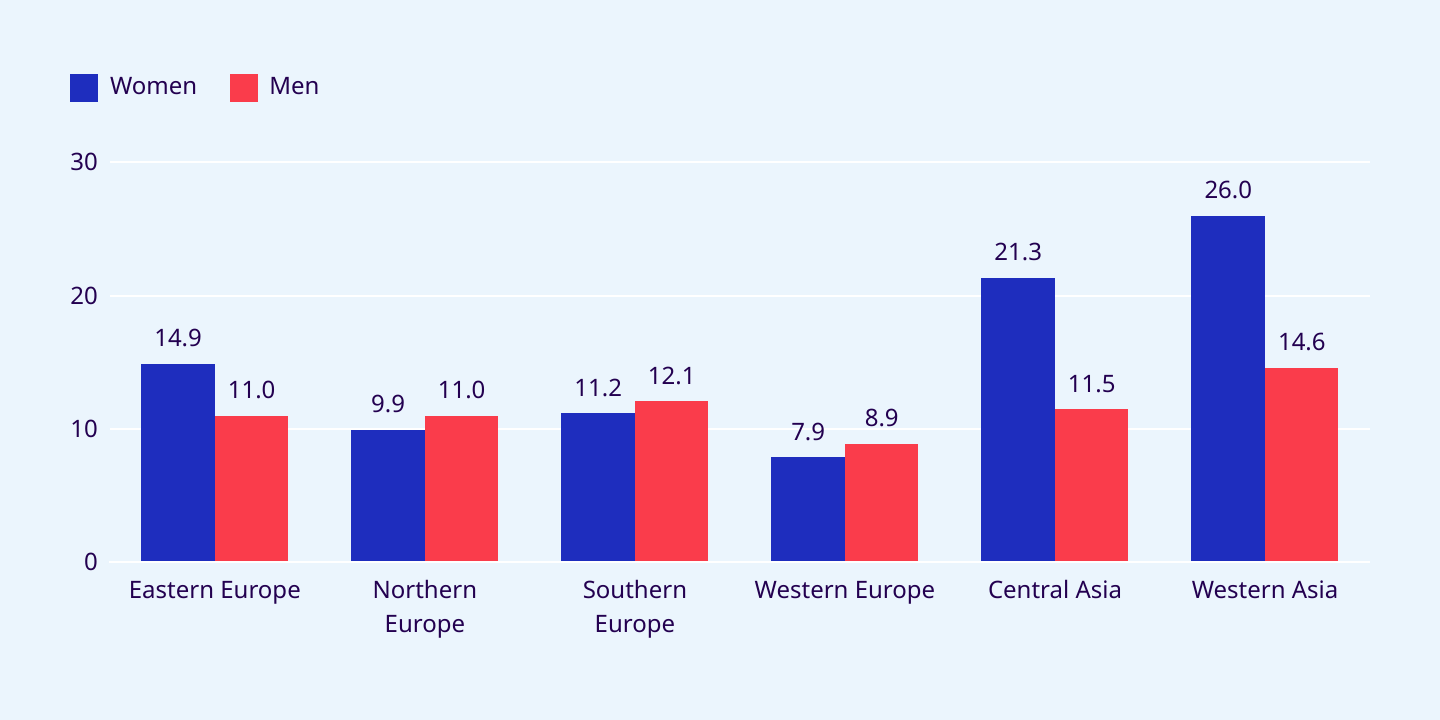
Women are still considered as the main “caregiver”. Those who are prime age with young children, low education levels and living in rural areas are less likely to be in the labour force and subject to more disproportionate responsibility for unpaid care. Young women aged 15 to 24 years are more often NEET compared to male counterparts of the same age. The NEET gender gap in Europe and Central Asia in 2024 was 3.5 percentage points compared to a global gap of 14 percentage points (ILO 2024f; see figure 8).
Figure 8. Youth not in employment, education or training in Europe and Central Asia, 2024, by sex (percentage)
Source: ILOSTAT, ILO modelled estimates, November 2024; ILO estimates.
Care work includes “childcare, elder care, care for those with physical and mental illnesses and disabilities, access to treatment for persons living with HIV, education, healthcare, and personal social and domestic services, as well as daily domestic work such as cooking, cleaning, washing and mending” (ILO 2024g). Women provide 76.2 per cent of unpaid care work globally, which hinders their participation, retention and progression in the labour market. Population ageing and the impact of climate change are further increasing care responsibilities and the need for social protection and care services. In 2023 in Europe and Central Asia, 21 per cent of inactive women justified their status with care responsibilities. On account of social policies and workplace practices in the past supporting women’s employment, Eastern Europe recorded the lowest rate at 11 per cent (ILO 2024h).
Investing in care services, especially childcare services, and parental and childcare leave is fundamental to enhancing women’s participation in the labour market. Belarus, Bulgaria, Latvia and Sweden are examples of countries where less than 10 per cent of women are outside the labour force because of caregiving (not necessarily childcare), thanks to investments in early childhood care and education (ECCE) of about 1 per cent of GDP. Kyrgyzstan and the Republic of Moldova also invest between 1 and 1.5 per cent of GDP in ECCE. Other European countries, such as Poland and Slovakia, are increasing investments in ECCE and parental leave (ILO 2024h).
The ILO Global Care Policy Investment Simulator estimates that in Azerbaijan, investing in universal childcare and long-term care services could generate more than 390,000 jobs by 2030, corresponding to 128,000 direct jobs in childcare, 232,000 direct jobs in long-term care and more than 30,000 indirect jobs in non-care sector.16 Every dollar invested in closing the childcare policy gap could result in an average increase of US$4.19 of GDP in 2030 from mothers regaining their pre-birth earnings over their lifetime. A similar exercise on Uzbekistan anticipates the creation of over one million jobs by 2030, with every US dollar invested in closing the childcare policy gap resulting in an average increase of US$6.23 of GDP growth by 2030.
If young and adult women leave the labour market, they are very likely to experience difficulties later in life. Older women often end up living in poverty due to the frequent sequence of unpaid, part-time, low-paid, interrupted or informal employment, which results in very poor pension benefits. This is why they may decide to return to work after raising children. They need to be trained and reskilled more than older male counterparts (ILO 2009). Besides the challenge of obsolete skills, older women face age discrimination more than men in returning to the labour market (UNECE 2019). Older women leave the labour market prematurely more often than men due to family obligations, poor health caused by caring commitments and menopausal symptoms at work (Eiffe, Muller and Weber 2024).
Persons with disabilities and their labour market challenges
The inclusion of persons with disabilities in the labour market could be significantly increased. Seven out of ten persons with disabilities are inactive worldwide. Furthermore, young persons aged 15 to 29 years with disabilities are five times more likely to be NEET than their peers without disabilities (Stoevska 2022). In 2023 in Europe and Central Asia, the share of persons with long-standing limitations varied from 12 per cent in Serbia to 37 per cent in Latvia, and that of people experiencing severe constraints was at least 3 per cent (World Bank 2023a).17 The estimated weighted average unemployment rate for people with disabilities in Europe and Central Asia in 2022 was around 25.4 per cent, well above the regional average for the working-age population of 4.7 per cent.18
The education level of persons with disabilities is lower than that of the rest of the working-age population. Women with disabilities earn less (6 per cent on average) than male counterparts (ILO 2025a), indicating that the wage gap between men and women is also present among persons with disabilities. When they work, persons with disabilities are employed in part-time jobs more than their peers without disabilities and their income is therefore lower. It is estimated to be as much as 12 per cent lower than that of workers without disabilities. Persons with disabilities are often self-employed, as this type of work allows for greater flexibility (Ananian and Dellaferrera 2024). Self-employment can also be the result of discrimination in regular employment.
Several barriers to their recruitment exist, including discrimination, employers’ misperceptions about the cost of work-station accommodation and a lack of knowledge of solutions available to enterprises.
Convention No. 111 does not include disability as a ground for discrimination. Like age, disability can be considered as an additional ground for discrimination as envisaged by the Convention. The UN Convention on the Rights of Persons with Disabilities, adopted in 2006, includes the principle of non-discrimination. In addition, Article 27 recognizes that persons with disabilities have the right to work on an equal basis with others. The ILO’s Vocational Rehabilitation and Employment (Disabled Persons) Convention (No. 159) and Recommendation (No. 168), 1983, are other reference international legal instruments for the employment rights of persons with disabilities.
Digitalization, AI and telework arrangements have the potential to facilitate the employment of persons with disabilities and allow them to perform a broader range of tasks at increased productivity levels. Training in digital skills becomes essential for the inclusion of workers with disabilities in the world of work, as they are normally confronted with a digital gap and have three times less access to digital technology compared to persons without disabilities (ILO 2022). Digital training should be made accessible to and inclusive of persons with disabilities. Publicly funded associations grouping persons with disabilities with the same disability can also be extremely helpful at providing disability-specific AI and digital training. Online forums and discussions can provide valuable information on the latest technological advancements for specific disabilities and strategies to overcome work-related challenges. In other words, peer-exchanges of information on AI applications to overcome limitations of a group of workers and potential employees with the same disability can play a very important role in the activation of persons with disabilities.
The provision of equipment and training to modify the telework environment for workers with physical disabilities should be planned in consultation with the employees and their representatives (WHO and ILO 2021). Despite the opportunities that telework offers to persons with disabilities, it is important to highlight that remote (online) work cannot always be considered as the best solution, and that it may involve poor working conditions with isolation, long working hours and low and irregular pay (Fundación ONCE and ILO 2021).
Situation of young workers
Young workers are those people aged 15 to 24 years. Their number is shrinking in the region overall. Central Asian countries record the largest share of youth, with fertility rates at or above replacement level (UNECE and UNFPA 2023).
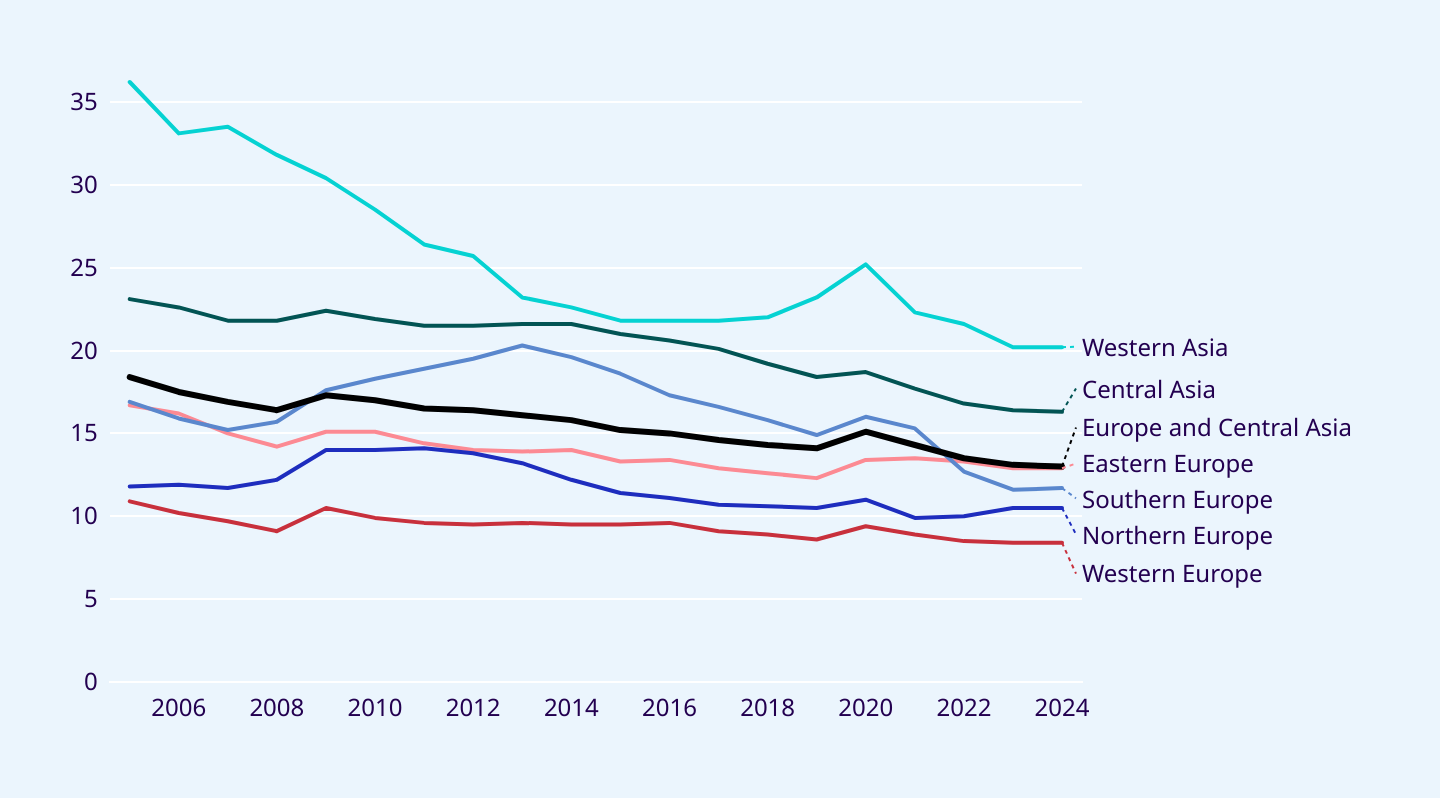
Long-term social and economic development requires a well-educated youth, especially in an era of rapid technological progress. Even after completing their studies, young people often experience a lack of decent work opportunities. The level of NEET youth in 2024 in Europe and Central Asia was 13 per cent (see figure 9). Despite its decline since 2015, this rate remains above the target of 9 per cent set by the European Pillar of the Social Rights Action Plan (European Commission 2021; ILO 2024f). Nonetheless, Eastern, Northern, Southern and Western Europe have all reduced NEET levels since 2015 (ILO 2025b).
Figure 9. Youth not in employment, education or training in Europe and Central Asia, 2005–24 (percentage)
Source: ILOSTAT, ILO modelled estimates, November 2024; ILO estimates.
The total youth unemployment rate in Europe and Central Asia stood at 13.5 per cent in 2024, following a declining trend. The subregions where the youth unemployment rate was the highest in 2024 were Southern Europe, at 23.7 per cent, and Western Asia, at 15.1 per cent.
Young workers learn fast, are eager to acquire new skills and do well, and have new ideas. However, they are still developing physically, emotionally and mentally. They are less familiar than older workers with occupation safety and health rules and measures in dealing with hazardous substances used in production processes and are more likely to take risks. A number of factors such as the pressure they feel to perform well, their lack of knowledge of safety rules, and limited skills and work experience make them more vulnerable than prime age and older workers to work-related injuries (ILO 2019).
Young people find it particularly difficult to get a job, since they possess less experience and fewer skills than older workers and often face discrimination in the labour market because of these reasons. They are often in vulnerable jobs and account for a larger share of the world’s working poor than the rest of the working-age population. Their often precarious and poor working conditions are also due to a lack of unionization among them. Young women are more likely to be in unstable, part-time and lower-paid jobs than male counterparts (DESA 2011).
The skills needed in the labour markets in Europe and Central Asia include the fields science, engineering, technology, information and communication technology and mathematics (ILO 2025b). Digital skills are essential for all of those fields. The youth possess these skills more than older workers in the region. In 2023 in the European Union, 97 per cent of young people aged 16 to 29 years used the internet daily, compared to 86 per cent of the overall population, although mainly for social networking activities. Young females had more basic digital skills than their male counterparts (73 per cent had at least basic digital skills against 69 per cent for their male counterparts). The proportion of young people who had written code through a computer-programming language was double that of the total population (Eurostat 2023). Digital skills are also useful for the professional healthcare sector, where demand for labour is expected to increase in the near future due to the rising share of elderly people. E-health solutions, including accessing electronic patient records, using clinical software and remote medicine require digital skills.
To avoid that the burden of ageing societies falls on young people, they should be offered more decent learning and work opportunities. In some countries in Europe and Central Asia, intergenerational solidarity is viewed as a mechanism to transfer skills and generate decent employment options. This occurs through apprenticeships, work-based learning, joint activities and volunteering, where older workers are considered an asset (ILO 2024d). In Italy, farmers older than 65 years transfer their skills over a period of three years to younger individuals with a business idea but without land. In Austria, the youth teach digital skills to older workers in computerias —spaces which blend a cafeteria-style setting with interactive computer skills training (UNECE 2023).
Migrant workers and refugees
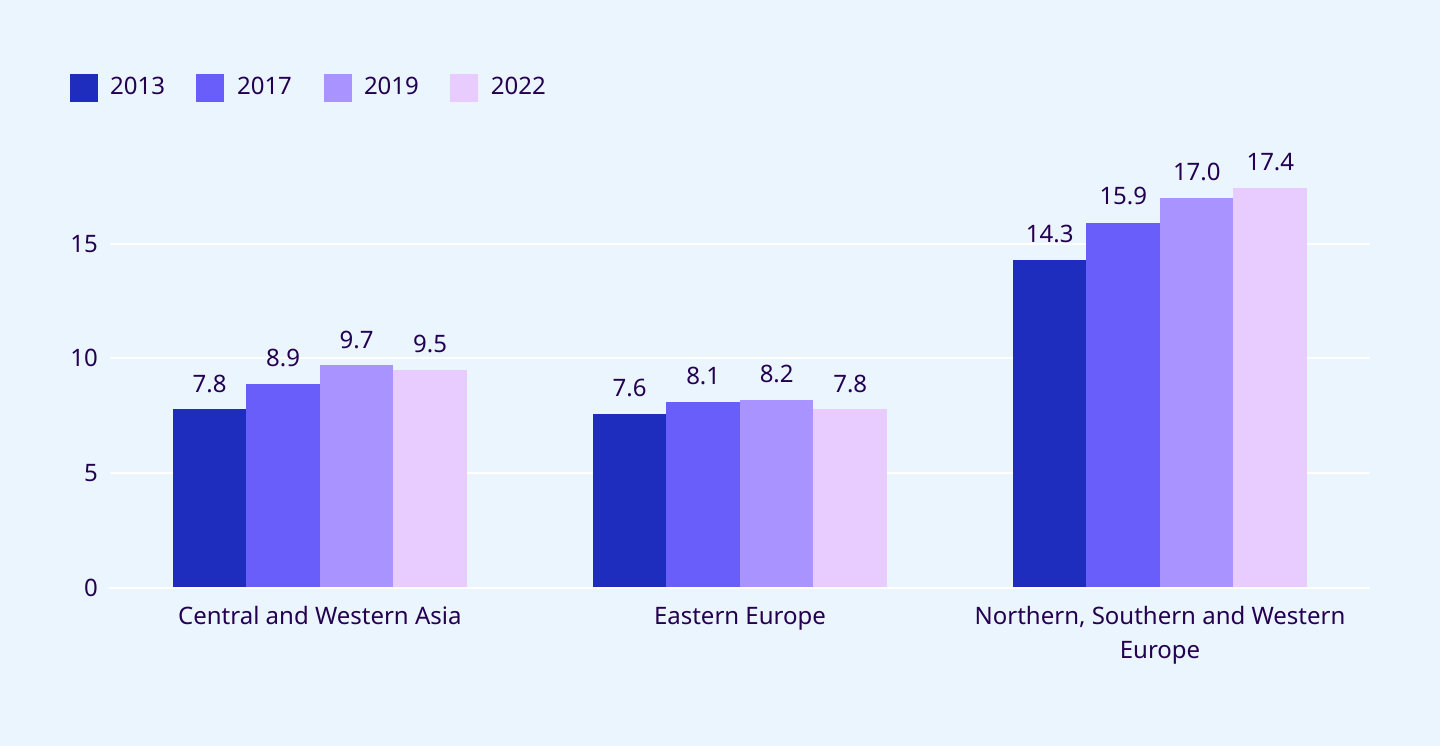
Migrant workers and refugees constitute a significant portion of the labour force in Europe and Central Asia. Migrant workers were 12.9 per cent of the region’s labour force in 2022, with the highest share of 17.4 per cent in Northern, Southern and Western Europe (see figure 10).19 The region experienced a significant influx of refugees, particularly from Afghanistan, the Syrian Arab Republic and Ukraine. Türkiye remains a leading example, hosting 3.1 million Syrians (72.5 per cent of all Syrians in the region) and 13.1 per cent of Afghan refugees as of 2024 (IOM 2024). Moreover, the war in Ukraine drove a surge in refugees and displaced persons across Europe.20 Since 2000, migration patterns have undergone substantial changes, influenced by economic globalization, demographic shifts and geopolitical factors. In 2022, 34.5 per cent of the 168 million international migrants in the global labour force resided in Europe and Central Asia. Among them, women represented 38.8 per cent, contributing significantly to key sectors such as care and services (ILO 2024i). However, their distribution across subregions varies.
Figure 10. Proportion of international migrants in the labour force in Europe and Central Asia, by broad subregion, 2013–22 (percentage)
Source: ILO (2024i). ILO Global Estimates on International Migrant Workers: International Migrants in the Labour Force. 4th edition.
Central and Western Asia experienced an increase in the share of international migrants in the labour force from 7.8 per cent in 2013 to 9.5 per cent in 2022 (see figure 10). Eastern Europe experienced minor fluctuations, rising to 8.2 per cent in 2019 before returning to 7.8 per cent in 2022. Meanwhile, Northern, Southern and Western Europe had the highest share, steadily increasing from 14.3 per cent in 2013 to 17.4 per cent in 2022.
Benefits and challenges for destination countries
Migrant workers and refugees help to address skill shortages and to support economic growth in destination countries. Their presence is particularly vital in agriculture, healthcare, construction and other essential sectors, especially in ageing societies facing workforce shortages. For example, Poland has integrated Ukrainian refugees into formal employment, particularly into manufacturing and IT sectors to help alleviate labour shortages (World Bank 2023b), while Germany relies on migrants to strengthen its healthcare sector (OECD 2022c; World Bank 2021). Several countries in Europe and Central Asia, attract skilled migrants to meet labour demands in IT and engineering (OECD 2021).
Skilled migrants enhance innovation, productivity, and entrepreneurship in receiving countries (Docquier and Rapoport 2012). Globally migrants, especially those aged 25 to 54 years, have higher LFPRs (65.8 per cent) compared to non-migrants (60.1 per cent), helping to mitigate demographic challenges in ageing societies (ILO 2024i).
Migration also benefits economies when well governed, particularly through policies that improve skills recognition and labour market inclusion. For instance, Germany’s Skilled Workers Immigration Act (Fachkräfteeinwanderungsgesetz) provides clear pathways for recognizing foreign qualifications, allowing migrants to work in sectors aligned with their expertise (OECD 2021).
While migrant workers and refugees contribute significantly to labour markets of destination countries, many migrants and refugees struggle with language difficulties, legal restrictions and the lack of recognition of prior learning – all preventing them from securing jobs that match their skills. These hurdles lead to underemployment, skill mismatches and wasted human capital (ILO 2021b). Work permit restrictions and lengthy bureaucratic processes further complicate labour market access for migrants and refugees.21 In addition, migrants and refugees may face challenges in joining trade unions and exercising their right to organize, limiting their ability to advocate for better working conditions and protections. For instance, in Georgia, weak legal frameworks limit refugees’ ability to secure formal employment (PMC RC 2023).
Even when migrants secure jobs, many remain in informal employment without legal protections, making them vulnerable to exploitation (ILO 2021c). Informal work is especially common among low-skilled migrants and refugees, who may lack access to contracts, social security and workplace rights (OECD 2020a; PMC RC 2023).
These challenges are even more pronounced for women migrants, particularly those working in caregiving and domestic roles. Limited access to formal training, recognition of prior learning system and labour market integration programmes creates further barriers (IOM 2021; OECD 2017). The undervaluation of women’s work in essential sectors such as healthcare and domestic care restricts their ability to advance professionally (Duffy and Armenia 2021).
As migration continues to reshape labour markets, addressing legal, linguistic and credentialing barriers is essential to ensure that both migrants and host countries can fully benefit from migration. Policies that promote fair labour market access, skills recognition and stronger social protections can help to unlock the economic potential of migrant workers and refugees.
Benefits and challenges for origin countries
Migration provides substantial benefits to origin countries through remittances, skills development and reduced youth unemployment. In countries such as Kyrgyzstan, Tajikistan and Uzbekistan, remittances account for a significant share of GDP – exceeding 30 per cent in some cases – playing a crucial role in poverty reduction and macroeconomic stability (World Bank 2021). However, the developmental impact of remittances is not automatic. Effective policies are essential to ensure that remittances contribute to inclusive growth and do not exacerbate inequalities. Without supportive frameworks, remittances can create regional disparities and hinder long-term economic development. In addition, reintegration policies play a vital role in maximizing the benefits of return migration. With the appropriate support and right mix of policies, returning migrants can transfer valuable skills and experiences, contributing to local economies and innovation (ILO 2023b; OECD 2020b).
A major challenge for origin countries is brain drain, particularly the loss of skilled workers. In Albania, 40 per cent of professors and researchers emigrated between 1990 and 1999, and 66 per cent of Albanian doctoral graduates from EU Member States and the United States have not returned (ILO 2023c). Similarly, Armenia and the Republic of Moldova face high emigration rates, with 45 per cent of young Moldovans seeking work abroad (DESA 2020).
The depopulation effect is particularly concerning in Eastern Europe and the Western Balkans, where projections indicate a continued population decline by 2050, driven in part by the persistent outflow of working-age citizens in search of better opportunities (Lutz and Gailey 2020). As skilled workers leave, local labour markets struggle to maintain productivity, leading to labour shortages, slower economic growth and reduced innovation capacity.
In addition, migrants may experience deskilling when employed in jobs well below their qualifications. This can result from difficulties with credential recognition, certification barriers or workplace discrimination, further undermining the potential benefits of migration for both origin and destination countries (ILO 2020).
Conclusion
This paper has presented the main issues stemming from the demographic transformation that Europe and Central Asia are experiencing. The following paragraphs provide a brief basis for discussion and social dialogue on existing challenges, hopefully leading to the formulation of suitable strategies and policies as anticipated in the introduction and the questions raised therein.
Europe and Central Asia are undergoing significant demographic changes, with an ageing population reshaping the structure of the workforce. The ratio of people aged 65 years and above to those aged 15 to 64 years is expected to follow a trajectory similar to that of high-income countries. In 2024, this ratio stood at 0.28 and is projected to rise to 0.43 by 2050. However, subregional variations exist – Southern Europe faces a more pronounced ageing trend, while Central Asia is expected to maintain a lower dependency ratio due to its relatively young population.
By 2050, the labour force in the region will see a notable shift: the proportion of older workers (55 years and above) will increase, while the prime-age workforce (25 to 54 years) will decline. This demographic transition is expected to result in a net loss of 10 million workers in Europe and Central Asia. Moreover, the share of employed individuals relative to the total population – including those outside the labour force – will shrink, leading to a rising old-age economic dependency ratio. As pension systems increasingly have to rely on a diminishing pool of younger workers, sustaining current living standards will become more challenging.
Maintaining increasing GDP per capita may prove difficult in Europe and Central Asia. If the current average productivity per worker were maintained, average annual GDP growth would decrease by 0.1 per cent in 2050 in the region as a whole. Productivity growth in Europe and Central Asia has been falling since 1991. New sources of productivity have to be unlocked if current standards of living are to be maintained.
The number of those who will be employed out of the whole population (including those who are not part of the labour force) will also fall, with a subsequent increase in the old-age economic dependency ratio. This means that by 2050, there will be many more elderly persons who rely on pension systems or other forms of transfer, which depend largely on shrinking numbers of working people. Maintaining or advancing standards of living will be challenging. Boosting the productivity growth of the declining share of workers beyond the levels achieved in the last decade could offset this trend, although the recent historical record is not promising.
Despite a shrinking labour force, the extent to which Europe will experience aggregate labour shortages remains uncertain. While technological innovation and AI can drive efficiency gains and partially offset labour demand in some sectors, they may not fully compensate for workforce declines, particularly in sectors requiring human-centric roles, such as long-term care.
With a shrinking workforce, increasing social inclusion and the participation of inadequately represented groups is critical to sustaining labour supply and economic growth. Increasing the LFPR of those groups may only partially improve the situation. However, it would be a step forward in improving the outlook for the challenges that the region is experiencing.
Older workers: Older workers can be considered employees aged over 55 years. They might encounter employment and occupation-related difficulties due to the advancement of their age. Ageing might involve physical and mental changes that have an impact on the way work is performed. Besides age, other factors, such as lifestyle and working conditions, determine the health of older workers. This is why it is preferable to talk about “functional age” rather than “chronological age” to describe someone’s ability to work. Older workers are more often employed in jobs of low quality than younger peers, with higher rates of working poverty, low pay and less social protection coverage and representation than other cohorts. Stereotypes and prejudice against older workers are still widespread. Older workers tend to have poor digital skills, and, at present, specific, targeted skills policies are absent. Despite the challenges that older workers face in the labour market, the shrinking and ageing population that Europe and Central Asia are confronted with calls for measures aimed at retaining those who wish to work and employing those who are unemployed or inactive.
Women: Women participate in the labour market less than men, and they earn less than male counterparts. They continue to bear the primary responsibility for caregiving, often engaging in unpaid care work, which limits their employment opportunities. Investing in care services, especially childcare services, parental and childcare leave, and closing the wage gap between men and women are fundamental to enhance women’s participation in the labour market. Older women are especially vulnerable to poverty due to a history of informal, low-paid or unpaid work. Furthermore, discrimination and outdated skills remain significant barriers to the employment of women, particularly those who are older.
Persons with disabilities: Persons with disabilities tend to have lower education levels than the general working-age population and have three times less access to digital technology. Training in digital skills becomes essential for the inclusion of workers with disabilities in the world of work. Persons with disabilities are employed in part-time jobs more than their peers without disabilities, and their income is therefore lower. Key barriers to their employment include discrimination, employer misperceptions about the costs of workplace accommodations and a lack of awareness of available support solutions for enterprises. Addressing these challenges through inclusive policies and workplace adjustments is crucial to improving employment opportunities for persons with disabilities.
Youth: Central Asian countries have the largest share of young people, with fertility rates at or above replacement level. Despite efforts to reduce youth NEET rates across Europe and Central Asia, progress remains insufficient, and youth unemployment remains high. Young workers are adaptable, eager to acquire new skills and bring fresh ideas to the workforce. However, they are also more vulnerable to work-related injuries. Their strong digital skills give them a competitive edge over older workers. Promoting intergenerational solidarity through joint activities and mentorship programmes can help to bridge skill gaps, with older workers transferring experience while benefiting from younger workers’ technological expertise.
Migrants and refugees: Europe and Central Asia have experienced significant refugee inflows, particularly from Afghanistan, the Syrian Arab Republic and Ukraine. Barriers to their labour market integration include skill mismatches, the lack of recognition of prior learning, limited access to work permits and informal employment. Migration patterns vary across the region: Northern, Southern and Western Europe have the highest shares of migrant workers, while Eastern Europe faces significant outflows, especially from the Western Balkans and Ukraine to EU Member States. Skilled migration can drive innovation and economic dynamism in receiving countries but may also lead to brain drain in countries of origin. Migrants play a vital role in sectors such as agriculture, care and construction – particularly in ageing societies faced with labour shortages. Migration also contributes to remittances, skills development and lower youth unemployment in countries of origin while facilitating skills transfer when migrants return with valuable experience and are provided with an enabling environment to do so. Bilateral labour migration agreements are an important cooperation tool to address skills’ needs actively used in the region.
Ensuring economic resilience in the face of demographic change requires a multifaceted policy response. The 2013 International Labour Conference resolution concerning employment and social protection in the new demographic context (ILO 2013) offers valuable guidance for policy formulation. In particular, it prescribes “a comprehensive multidimensional and integrated policy mix that recognizes the interdependency between demographic shifts, employment, labour migration, social protection and economic development.”
Key policy areas outlined in the resolution – many of which have been discussed in this paper: education, training and lifelong learning; combating discrimination; promoting the inclusion of vulnerable and under-represented groups in the labour market; and well-managed migration policies. Policies to increase productivity are equally described, including frameworks for work practices conducive to improvements in productivity and policies that support innovation.
These key policy areas and the summary in these conclusions can guide and foster a fruitful and constructive social dialogue on the issues raised in this paper. As remarked in the resolution (ILO 2013), when managed effectively, “demographic transitions not only become manageable and sustainable but can be turned into opportunities”.
Appendix. Methodology underlying the long-term projections of labour force participation rates
Labour force participation rates (LFPRs) have strongly persistent trends, meaning that a certain change over a certain period is likely followed by a similar change over the next period. This characteristic gives a reasonable statistical basis to longer-term LFPR projections. In addition, external factors can play an important role; the decision to participate in the labour force is based on considerations such as macroeconomic conditions, social security systems and cultural determinants. Cultural determinants, for example, is a very important factor in driving trends in gender gaps. While long-term projections of macroeconomic factors, such as GDP per capita and the composition of GDP, are available, existing social security systems are too diverse and complex to quantify them consistently for use in an econometric set up for all countries in Europe and Central Asia.
The baseline labour force data are the ILO modelled estimates (November 2024) of LFPRs by sex and age (see ILO 2025c). The historical estimates are available as of 1991. The LFPR is estimated for men and women for four age groups: youth (15 to 24 years), prime age (25 to 54 years), older (55 to 64 years) and 65 years and above. The 2024 revision of the World Population Prospects by the United Nations Department of Economic and Social Affairs Population Division serves as the benchmark population data and projections. The database provides estimates and projections of population until 2100 by sex and five-year age group, which are aggregated to match the age groups of the labour force estimates. The historical data of GDP per capita comes from the World Bank World Development Indicators, and the share of government consumption in GDP from the UN estimates of national accounts. The October 2024 projections of GDP growth from the International Monetary Fund are used to construct projections of GDP (and relatedly GDP per capita) up to 2029. The Economist Intelligence Unit provides long-term projections (until 2050) of GDP growth and the share of government consumption for a sizeable number of countries. For other countries, projections of GDP per capita are made using historical growth rates and an estimated convergence mechanism. The government spending share is projected using an econometric approach to estimate long-term changes.
The baseline approach to conducting long-term projections is by trend extrapolation, taking macroeconomic projections into account. This means that the future impact of all unobserved and unquantified determinants on LFPR trends is assumed to be the same as it has been in the recent past. For example, the projection does not make any assumptions about changes in retirement age. As such, the long-term projection presents only one of a multitude (in fact infinite) possible scenarios that could materialize and is thereby subject to substantial uncertainty.
The general regression approach is to regress the six-year change in the transformed target variable on some explanatory variables using a panel model. Using the six-year change reduces the variance of the dependent variable by focusing on drivers of medium-term changes, which is also in line with the objectives of long-term projections.22 The explanatory variables – whose coefficients have been estimated in a panel – should explain changes in the trend. Multiple specifications are feasible and estimated. Those encompass using country-fixed effects or not, using a lagged dependent variable, estimating a global or income grouping panel, and different macroeconomic explanatory variables. Model averaging across different specifications has been shown to reduce the variance of the final prediction. This paper follows the approach of cross-validation and so-called Jackknife model averaging as described in Gomis et al. (2022). It minimizes the sum of squared errors of the leave-one-out prediction errors across the various specifications through appropriate weighting.
This extrapolation is made within certain boundaries. Besides the obvious boundary that the LFPR needs to lie between 0 and 100, the approach establishes maximum allowed changes with respect to the last observed value, based on past observed changes in data.23 The LFPR is projected separately for men and women, and for four distinct age groups: 15 to 24 years, 25 to 54 years, 55 to 64 years and 65 years and over. Each of these demographic groups has distinct features and trends.
References
Ananian, Sévane and Giulia Dellaferrera. 2024. “A Study on the Employment and Wage Outcomes of People with Disabilities”. ILO Working Paper 124. https://www.ilo.org/publications/study-employment-and-wage-outcomes-people-disabilities.
Asada, Yuriko. 2024. “Overview of the Japanese Mandatory Retirement Age System”. Chambers and Partners. 24 December 2024. https://chambers.com/articles/overview-of-the-japanese-mandatory-retirement-age-system.
Børing, Pål and Jens B. Grøgaard. 2023. “Do Older Employees Have a Lower Individual Productivity Potential than Younger Employees?”. Journal of Population Ageing 16: 369–397. https://doi.org/10.1007/s12062-020-09323-1.
Docquier, Frédéric and Hillel Rapoport. 2012. “Globalization, Brain Drain, and Development”. Journal of Economic Literature 50 (3): 681–730. http://dx.doi.org/10.1257/jel.50.3.681.
Duernecker, Georg and Miguel Sanchez-Martinez. 2021. “Structural Change and Productivity Growth in Europe: Past, Present and Future”. CESifo Working Papers 9323. https://www.cesifo.org/node/65357.
Duffy, Mignon and Amy Armenia. 2021. Paid Care Work Around the Globe: A Comparative Analysis of 47 Countries and Territories. UN Women. https://www.unwomen.org/en/digital-library/publications/2021/04/discussion-paper-paid-care-work-around-the-globe.
Eiffe, Franz F., Jessye Muller and Tina Weber. 2024. “Keeping Older Workers Engaged: Policies, Practices and Mechanisms”. Eurofound Working Paper. https://www.eurofound.europa.eu/en/publications/eurofound-paper/2024/keeping-older-workers-engaged-policies-practices-and-mechanisms.
European Commission (EC). 2021. The European Pillar of Social Rights Action Plan. https://op.europa.eu/webpub/empl/european-pillar-of-social-rights/en.
———. 2024. “Productivity Growth in the EU: Is There a Trade-Off with Employment Growth?”. Economy and Finance. 15 November 2024. https://economy-finance.ec.europa.eu/economic-forecast-and-surveys/economic-forecasts/autumn-2024-economic-forecast-gradual-rebound-adverse-environment/productivity-growth-eu-there-trade-employment-growth_en#:~:text=In%20the%20last%20decade%2C%20strong,2.1)..
———. 2025. Annual Report on Intra-EU Labour Mobility: Edition 2024. https://doi.org/10.2767/2077850.
European Labour Authority (ELA). 2024. EURES Report on Labour Shortages and Surpluses 2023. https://doi.org/10.2883/973861.
Eurostat. 2023. “Young People: Digital World”. Statistics Explained. https://ec.europa.eu/eurostat/statistics-explained/index.php?title=Young_people_-_digital_world#:~:text=97%20%25%20of%20young%20people%20in%20the%20EU%20use%20the%20internet%20daily&text=On%20average%2C%20in%20the%20EU,and%20in%202022%2C%2012%20pp.
Fundación ONCE and ILO. 2021. An Inclusive Digital Economy for People with Disabilities. https://www.ilo.org/publications/inclusive-digital-economy-people-disabilities.
Gagliardi, Nicola, Elena Grinza and François Rycx. 2023. “Workers’ Tenure and Firm Productivity: New Evidence from Matched Employer–Employee Panel Data”. Industrial Relations: A Journal of Economy and Society 62 (1): 3–33. https://doi.org/10.1111/irel.12309.
Gmyrek, Paweł, Janine Berg and David Bescond. 2023. “Generative AI and Jobs: A Global Analysis of Potential Effects on Job Quantity and Quality”. ILO Working Paper 96. https://doi.org/10.54394/FHEM8239.
Gomis, Roger, Paloma Carillo, Steven Kapsos, Stefan Kühn and Avichal Mahajan. 2022. “The ILO Nowcasting Model: Using High-Frequency Data to Track the Impact of the COVID-19 Pandemic on Labour Markets”. Statistical Journal of the IAOS 38 (3): 815–830. https://doi.org/10.3233/SJI-220055.
Gordon, Jennifer. 2019. “Refugees and Decent Work: Lessons Learned from Recent Refugee Jobs Compacts”. EMPLOYMENT Working Paper No. 256. ILO. https://www.ilo.org/publications/refugees-and-decent-work-lessons-learned-recent-refugee-jobs-compacts.
Guest, Ross. 2013. “Population Ageing and Productivity: Implications and Policy Options for New Zealand”. New Zealand Treasury Working Paper 13/21. https://www.treasury.govt.nz/publications/wp/population-ageing-productivity-and-policies-survey-implications-new-zealand-wp-13-21.
Guzzo, Richard A., Haig R. Nalbantian and Nicholas L. Anderson. 2022. “Age, Experience, and Business Performance: A Meta-Analysis of Work Unit-Level Effects”. Work, Aging and Retirement 8 (2): 208–223. https://doi.org/10.1093/workar/waab039.
ILO. 2009. Gender Equality at the Heart of Decent Work. https://www.ilo.org/sites/default/files/wcmsp5/groups/public/@ed_norm/@relconf/documents/meetingdocument/wcms_105119.pdf.
———. 2010. Women in Labour Markets: Measuring Progress and Identifying Challenges. https://www.ilo.org/publications/women-labour-markets-measuring-progress-and-identifying-challenges.
———. 2013. Resolution concerning employment and social protection in the new demographic context. International Labour Conference. 102nd Session. https://www.ilo.org/resource/record-proceedings/ilc/102/resolution-concerning-employment-and-social-protection-new-demographic.
———. 2015. “Labour Migration and Skills Matching”. Labour Migration Highlights No. 6. https://www.ilo.org/publications/labour-migration-highlights-no-6.
———. 2019. Improving OSH for Young Workers: A Self-Training Package. https://www.ilo.org/publications/module-3-osh-management-workplace-addressing-young-workers-needs.
———. 2020. How to Facilitate the Recognition of Skills of Migrant Workers: Guide for Employment Services Providers. 2nd ed. https://www.ilo.org/sites/default/files/wcmsp5/groups/public/%40ed_protect/%40protrav/%40migrant/documents/publication/wcms_748721.pdf
———. 2021a. World Social Protection Report 2020–22: Social Protection at the Crossroads – in Pursuit of a Better Future. https://www.ilo.org/publications/flagship-reports/world-social-protection-report-2020-22-social-protection-crossroads-pursuit.
———. 2021b. World Employment and Social Outlook 2021: The Role of Digital Labour Platforms in Transforming the World of Work. https://www.ilo.org/publications/flagship-reports/role-digital-labour-platforms-transforming-world-work.
———. 2021c. World Employment and Social Outlook: Trends 2021. https://www.ilo.org/publications/world-employment-and-social-outlook-trends-2021.
———. 2022. Inclusion of Persons with Disabilities in the Digital and Green Economy: Paper Prepared for the 1st Employment Working Group Meeting under the Indonesian Presidency. https://www.ilo.org/publications/inclusion-persons-disabilities-digital-and-green-economy.
———. 2023a. World Employment and Social Outlook: Trends 2023. https://doi.org/10.54394/SNCP1637.
———. 2023b. Guidelines on Labour Market Reintegration Upon Return in Origin Countries. https://www.ilo.org/publications/guidelines-labour-market-reintegration-upon-return-origin-countries.
———. 2023c. World Employment and Social Outlook 2023: The Value of Essential Work. https://doi.org/10.54394/OQVF7543.
———. 2024a. World Employment and Social Outlook: Trends 2024. https://doi.org/10.54394/HQAE1085.
———. 2024b. Asia-Pacific Employment and Social Outlook 2024: Promoting Decent Work and Social Justice to Manage Ageing Societies. https://doi.org/10.54394/EZFF3499.
———. 2024c. Resolution concerning decent work and the care economy. ILC.112/Resolution V. https://www.ilo.org/resource/record-decisions/resolution-concerning-decent-work-and-care-economy.
———. 2024d. Technical Note 4.4: Instruments Concerning Older Workers. https://www.ilo.org/resource/other/technical-note-44-instruments-concerning-older-workers.
———. 2024e. Heat at Work: Implications for Safety and Health – A Global Review of the Science, Policy and Practice. https://www.ilo.org/publications/heat-work-implications-safety-and-health.
———. 2024f. “World Employment and Social Outlook: September 2024 Update”. ILO Brief. September 2024. https://www.ilo.org/publications/flagship-reports/world-employment-and-social-outlook-september-2024-update.
———. 2024g. Decent Work and the Care Economy. ILC.112/VI. https://www.ilo.org/resource/conference-paper/decent-work-and-care-economy.
———. 2024h. “The Impact of Care Responsibilities on Women’s Labour Force Participation”. ILO Statistical Brief. October 2024. https://www.ilo.org/publications/impact-care-responsibilities-women%25s-labour-force-participation.
———. 2024i. ILO Global Estimates on International Migrant Workers: International Migrants in the Labour Force. Fourth edition. https://doi.org/10.54394/ESKI5420.
———. 2025a. “Women and the Economy: 30 years After the Beijing Declaration”. ILO Brief. March 2025. https://www.ilo.org/publications/women-and-economy-30-years-after-beijing-declaration.
———. 2025b. World Employment and Social Outlook: Trends 2025. https://www.ilo.org/publications/flagship-reports/world-employment-and-social-outlook-trends-2025.
———. 2025c. ILO Modelled Estimates: Methodological Overview. https://ilostat.ilo.org/methods/concepts-and-definitions/ilo-modelled-estimates.
International Organization for Migration (IOM). 2021. Gender and Migration Data: A Guide for Evidence-Based, Gender-Responsive Migration Governance.https://publications.iom.int/system/files/pdf/Gender-and-Migration-Data.pdf.
———. 2024. Migration and Demographics in Europe and Central Asia. https://eca.iom.int/sites/g/files/tmzbdl2626/files/documents/2024-12/migration-and-demographics-in-the-eca-region-1.pdf.
Lee, Yen Nee. 2017. “Emerging Asia Risks Growing Old Before Becoming Rich”. CNBC Investing in Megatrends. 19 April 2017 (updated 14 September 2018). https://www.cnbc.com/2017/04/19/emerging-asia-risks-growing-old-before-becoming-rich.html.
Lutz, Wolfgang and Nicholas Gailey. 2020. Depopulation As a Policy Challenge in the Context of Global Demographic Trends. UNDP Serbia. https://eeca.unfpa.org/en/publications/depopulation-policy-challenge-context-global-demographic-trends.
Madgavkar, Anu, Marc Canal Noguer, Chris Bradley, Olivia White, Sven Smit and T.J. Radigan. 2025. Dependency and depopulation? Confronting the Consequences of a New Demographic Reality. McKinsey & Company. https://www.mckinsey.com/mgi/our-research/dependency-and-depopulation-confronting-the-consequences-of-a-new-demographic-reality.
Organisation for Economic Co-operation and Development (OECD). 2017. “Migrant Women and European Labour Markets”. Migration Data Brief No. 1. https://www.oecd.org/en/publications/migrant-women-and-european-labour-markets_65e64d8e-en.html.
———. 2020a. International Migration Outlook 2020. https://doi.org/10.1787/ec98f531-en.
———. 2020b. Sustainable Reintegration of Returning Migrants: A Better Homecoming. https://doi.org/10.1787/5fee55b3-en.
———. 2021. International Migration Outlook 2021. https://doi.org/10.1787/29f23e9d-en.
———. 2022a. Comprehensive Review of Policies to Facilitate Active Ageing in Lithuania. https://www.oecd.org/content/dam/oecd/en/topics/policy-issues/ageing-and-employment/study-visit-netherlands.pdf.
———. 2022b. Disability, Work and Inclusion: Mainstreaming in All Policies and Practices. https://doi.org/10.1787/1eaa5e9c-en.
———. 2022c. International Migration Outlook 2022. https://doi.org/10.1787/30fe16d2-en.
———. 2024. Training Supply for the Green and AI Transitions: Equipping Workers with the Right Skills. https://doi.org/10.1787/7600d16d-en.
Picchio, Matteo. 2021. “Is Training Effective for Older Workers?”. IZA World of Labour 2021: 121. https://doi.org/10.15185/izawol.121.v2.
Pinkus, David and Nina Ruer. 2024. “Beyond Retirement: A Closer Look at the Very Old”. Bruegel Analysis. 30 April 2024. https://www.bruegel.org/analysis/beyond-retirement-closer-look-very-old.
PMC Research Center (PMC RC). 2023. Assessment of Asylum Seeker, Refugee and Humanitarian Status Holder Youth in Georgia. UNHCR. https://pmcg-i.com/research/assessment-of-asylum-seeker-refugee-and-humanitarian-status-holder-youth-in-georgia.
Prskawetz, Alexia and Thomas Lindh, eds. 2006. “The Impact of Population Ageing on Innovation and Productivity Growth in Europe”. Vienna Institute of Demography Research Report 28. https://www.oeaw.ac.at/fileadmin/subsites/Institute/VID/PDF/Publications/Forschungsberichte/FB_28.pdf.
Sheiner, Louise and Anna Malinovskaya. 2016. “Measuring Productivity in Healthcare: An Analysis of the Literature”. Hutchins Center on Fiscal and Monetary Policy at Brookings. May 2016. https://www.brookings.edu/wp-content/uploads/2016/08/hp-lit-review_final.pdf.
Shephard, Roy J. 2000. “Ageing and Productivity: Some Physiological Issues”. International Journal of Industrial Ergonomics 25 (5): 535–545. https://doi.org/10.1016/S0169-8141(99)00036-0.
Stoevska, Valentina. 2022. “New ILO Database Highlights Labour Market Challenges of Persons with Disabilities”. ILOSTAT Blog. 13 June 2022. https://ilostat.ilo.org/blog/new-ilo-database-highlights-labour-market-challenges-of-persons-with-disabilities.
Tessier, Lou, Nathalie De Wulf and Yuta Momose. 2022. “Long-Term Care in the Context of Population Ageing: A Rights-Based Approach to Universal Coverage”. ILO Working Paper 82. https://www.ilo.org/publications/long-term-care-context-population-ageing-rights-based-approach-universal-1.
United Nations Department of Economic and Social Affairs (DESA) (2011). World Youth Report 2011. https://www.un.org/development/desa/youth/publications/2011/09/world-youth-report-2011-youth-employment.
———. 2020. World Youth Report: Youth Social Entrepreneurship and the 2030 Agenda. https://social.desa.un.org/publications/world-youth-report-2020.
———. 2024. World Population Prospects 2024. https://population.un.org/wpp.
United Nations Economic Commission for Europe (UNECE). 2019. “Combating Ageism in the World of Work”. UNECE Policy Brief on Ageing No. 21. https://doi.org/10.18356/27083047-21.
———. 2023. Ageing Policy in Europe, North America and Central Asia in 2017–2022. https://unece.org/statistics/documents/2022/09/reports/ageing-policy-europe-north-america-and-central-asia-2017-2022.
———. 2025. “Unlocking the Potential of an Ageing Workforce”. UNECE Policy Brief on Ageing No. 30. https://unece.org/population/publications/unlocking-potential-ageing-workforce.
UNECE and United Nations Population Fund (UNFPA). 2023. Ensuring Rights and Choices Amid Demographic Change. https://eeca.unfpa.org/en/publications/ensuring-rights-and-choices-amid-demographic-change.
World Health Organization (WHO) and ILO. 2021. Healthy and Safe Telework: Technical Brief. https://www.ilo.org/publications/healthy-and-safe-telework.
World Bank. 2021. “Recovery: COVID-19 Crisis Through a Migration Lens”. Migration and Development Brief 35. https://documents1.worldbank.org/curated/en/099738408132414027/pdf/IDU110e1541c1704b14821196441e301ab86ff0b.pdf.
———. 2023a. “Disability-Inclusive Social Protection Across Europe and Central Asia”. Brief. 28 June 2023. https://www.worldbank.org/en/region/eca/brief/disability-inclusive-social-protection-across-europe-and-central-asia.
———. 2023b. Economic Empowerment of Forcibly Displaced Persons from Ukraine. https://thedocs.worldbank.org/en/doc/899da35b4a168c6426798f5760a71964-0570012023/original/Poland-Report.pdf.
Acknowledgements
The authors would like to extend their appreciation to the representatives of ACTEMP and ACTRAV, Samuel Asfaha and Michael Watt, respectively, for their constructive feedback. Furthermore, the following ILO colleagues are gratefully thanked for their thorough comments: Emmanuel Julien, Dorothea Schmidt-Klau, Sara Elder, Gianni Rosas, Daniela Zampini, Kazutoshi Chatani, Miguel Sanchez Martinez, Sévane Amanian, Fabiola Mieres, Chidi King, Anam Butt, Ozge Berber Agtas, Esteban Tromel, Jenni Jostock and Steven Kapsos. Last but not least, this paper would not have been prepared without the invaluable guidance and support of Beate Andrees, Assistant Director-General and Regional Director for Europe and Central Asia.