


The role of collective bargaining in promoting just transitions
Abstract
This working paper explores the role of collective bargaining in achieving a just transition, drawing on recent literature and a sample of 512 collective agreements. An in-depth study of six country case studies from various regions highlights key themes in just transition clauses, namely upskilling/retraining workers; consultation processes, including on redundancies and early retirement; and transitioning workers to greener jobs.
The study finds that while many agreements reference just transition, most only contain broad or symbolic language unlikely to drive meaningful change. However, the case studies also demonstrate that, in some industrialized countries, collective agreements have the potential to be an important tool to regulate just transition while balancing the interests of workers and employers and their organizations.
A central conclusion is that the increasing relevance of just transition offers new opportunities for collective bargaining to go beyond traditional employment terms to play a broader role in the inclusive governance of work amid technological and environmental transitions.
Introduction1
This working paper illustrates the role of collective bargaining as a mechanism towards sustainable reforms aiming at just transition. It provides an overview of how recent literature has covered these issues, as well as insights regarding just transition clauses that were identified from a sample of collective agreements. It also analyses selected case studies in several regions of the world where employers’ and workers’ organizations have negotiated and agreed on just transition measures through collective agreements.
Just transition involves maximizing the social and economic opportunities of climate and environmental action, including an enabling environment for sustainable enterprises, and is based on respect for the fundamental principles and rights at work and effective social dialogue, in accordance with international labour standards (ILO 2023a, para. 12).
The ILO’s work on a just transition follows the organization’s 2015 Guidelines for a Just Transition towards Environmentally Sustainable Economies and Societies for All, which recognizes the link between collective bargaining and just transition, namely that social dialogue, including collective bargaining, can be an important vehicle to implement just transition at the workplace level (ILO 2015). To this end, the Guidelines state that social partners2 should:
promote the inclusion of specific environmental provisions through collective bargaining and collective agreements at all levels, where appropriate, as a concrete way of facilitating cooperation between employers’ and workers’ organizations and encouraging enterprises to comply with environmental regulations, including but not limited to emission reductions, to meet enterprise objectives regarding sustainability and develop the training of workers and managers. (ILO 2015, para. 18(d)).
This study is also a follow-up to the Conclusions concerning a just transition towards environmentally sustainable economies and societies for all, adopted in a resolution by the International Labour Conference in 2023. The Conclusions describe just transition as “the promotion of environmentally sustainable economies in a way that is inclusive, by creating decent work opportunities, reducing inequality and by leaving no one behind” (ILO 2023a, para. 11). They also emphasize that “[u]rgent action to advance just transition is an imperative to achieving social justice, decent work and poverty eradication, and to tackling environmental and climate change. The future of economies, societies, jobs and livelihoods is at stake as they depend on the planet’s ecosystems and natural environments” (ILO 2023a, para. 1). In addition, the Conclusions state that governments in consultation with the most representative employers’ and workers’ organizations should “actively promote freedom of association and inclusive and effective social dialogue, including collective bargaining and tripartite cooperation, at all levels to forge social consensus for ambitious policies and measures for a just transition” (ILO 2023a, para. 21(q)), and that employers’ and workers’ organizations should “effectively engage in social dialogue in all its forms, including collective bargaining, to share the benefits of technological progress, green transition and demographic changes and advance just transition and decent work at enterprise, sectoral and national levels” (ILO 2023a, para. 22(a)).
A 2024 United Nations Framework Convention on Climate Change (UNFCCC) decision on the "United Arab Emirates just transition work programme", also highlights the essential role of social dialogue in advancing a just transition. The decision states that the work programme in question shall include: "Just transition of the workforce and the creation of decent work and quality jobs in accordance with nationally defined development priorities, including through social dialogue, social protection and the recognition of labour rights" (UNFCCC 2024, 31). During the 28th session of the United Nations Climate Change Conference (COP28) in 2023, the ILO and the European Commission demonstrated their commitment to the need for social dialogue in just transition by hosting a Just Transition pavilion together with the International Organisation of Employers (IOE), the International Trade Union Confederation (ITUC) and the UNFCCC, and also organized a high-level discussion that highlighted the nexus between climate change and action, gender equality, inclusion and the world of work.
The concept of a just transition has been increasingly receiving significant attention from trade unions (IndustriALL 2022b; Thomas 2021; ITUC 2022a) and employers’ organizations (IOE 2022), as well as governments, international organizations and academics. This being so, this study explores the literature around innovative practices in collective bargaining aimed at promoting a just transition in the world of work. It reviews debates on the inclusion of just transition clauses in collective agreements, focusing on their impact and controversies. An analysis of the ILO’s database of 512 collective agreements3 provides also insights into the presence and scope of just transition clauses in such agreements, and to deepen the understanding, six case studies were developed, analysing specific agreements beyond the ILO database. These case studies highlight the opportunities, challenges and rationale for negotiating just transition clauses, along with the processes and results identified by the parties involved. Together, the review, the database analysis, and the case studies contribute to understanding how collective bargaining can support a just transition, emphasizing both best practices and areas for improvement.
This working paper provides a basis for discussion, further debate and research on the role of collective bargaining for just transition.
Literature review
This literature review of the role of collective bargaining in the development of just transition sets out some of the key areas that have been explored to date. Although extensive literature searches in all regions were carried out, most of the literature identified and examined originated in Europe and North America, with a few contributions from Asia, South America and Africa.
1.1 Key topics on just transition in collective agreements
To date, much of the literature has focused on the more general principles of just transition and how they might be embedded in different settings, including under the scope of social dialogue in general. The examination of just transition within collective agreements – as an outcome of collective bargaining – has received considerably less attention. Nevertheless, there are useful databases4 that document what are described as “green clauses” within collective agreements. Studies that have analysed the content of collective agreements and green clauses or just transition clauses have found a wide degree of heterogeneity with regard to the topics covered (Markey and McIvor 2019; Goods 2017; Bugada et al. 2020; Chacartegui Jávega and Canalda Criado 2021).
The most salient topics in the just transition clauses were:
-
green pilot projects;
-
training and education on just transition;
-
employee green code of conduct/compliance;
-
protection from extreme weather conditions;
-
environmental reporting/measuring;
-
recycling initiatives;
-
providing financial incentives to workers to use public transport;
-
whistle-blower protection in the context of environmental issues;
-
right to refuse work in the event that workers deem the work to be dangerous for the environment (for example, pollution or biohazards);
-
green reinvestment; and
-
green procurement.
Specific topics on representation and consultation of workers under the scope of environmental issues included:
-
establishment and operation of workplace environmental committees;
-
regional/national environment committees;
-
rights and obligations of representatives of environmental committees;
-
environmental consultation/information sharing; and
-
commitment between social partners to environmental improvement.
Topics such as skills, worker consultation, social dialogue and trade union representation are key areas that appear in collective agreements and are central principles that can help facilitate just transition.
Another emerging topic within collective agreements is the adaptation of work practices within the context of climate change, such as extreme heat, and how this may be managed (Newman and Humphrys 2020). In the past, extreme heat was primarily a concern in areas such as South and South-East Asia, Australia and Oceania, Sub-Saharan Africa and parts of South America, but now other areas, such as North Africa, Southern Europe and North America, are increasingly concerned as well. The 2024 ILO reports Ensuring Safety and Health at Work in a Changing Climate and Heat at Work: Implications for Safety and Health include several examples of collective agreements that have resulted in improved occupational safety and health protection for workers in various industries in a changing climate, including in relation to heat-related risks in the workplace. Examples along these lines mentioned in the reports include the general collective agreement for the construction sector in Spain and the national collective agreement for the construction sector and related industries in Greece, as well as a collective agreement in the shipping company UPS. The reports also refer to collective agreements that deal with extreme weather conditions, such as a regional collective agreement in the Vaud Canton of Switzerland to protect construction workers from snow, heavy rain or extreme cold. Another example is a collective agreement in Spain that aims at protecting firefighters’ exposure to carcinogens during wildfires.
At the sector level, the fossil fuel extraction and energy sectors have garnered the majority of research attention, but other industries have also emerged as key areas of focus for collective bargaining and just transition initiatives, such as:
-
manufacturing – particularly automotive manufacturing (IndustriALL and Just Transition Centre 2021; Galgóczi 2019);
-
construction (Clarke and Sahin-Dikmen 2020; Calvert 2023);
-
food production (Blattner 2020; IUF 2022); and
-
transportation (Maritime Just Transition Task Force 2022; ITF 2022).
1.2 Level of collective agreements
Overwhelmingly, the literature cited above underscores that collective agreements in support of just transition happen at the enterprise or sectoral level. Nevertheless, there is evidence that collective agreements in support of just transition also occur at the national level (Johansson 2023; ETUC 2021; Bugada et al. 2020; IndustriALL 2022a).
Similarly, there are emerging joint initiatives between social partners at the international level to introduce just transition principles. For example, in 2021 the International Chamber of Shipping, the International Transport Workers’ Federation, the United Nations Global Compact, the ILO and the International Maritime Organization created the Maritime Just Transition Taskforce during COP 26. In November 2022, the Taskforce published a report detailing how a just transition for maritime workers could be secured (Maritime Just Transition Task Force 2022). According to the Taskforce report, it is central for a just transition to develop consensus around decarbonization through social dialogue. Once consensus is reached, the focus needs to shift to recruitment, labour force attrition, and the skills and training required to decarbonize the shipping industry.
This strong and growing focus on skills and just transition is also reflected in collective agreements at the national level – for example, in 2022 a collective agreement in Sweden on skills related to just transition was signed by the Confederation of Swedish Enterprise, the Council for Negotiation and Cooperation and the Swedish Trade Union Confederation. The agreement provides “individuals who are employed or in-between jobs the right to financial support for shorter or longer training courses to develop their skills” (IndustriALL 2022a). Financial support from the Swedish Government provides significant replacement wages for current workers while they upskill or retrain for jobs in the green economy. This reflects both a recognition of, and response to, the significant upskilling and reskilling needed to meet the climate transformation, and shows that skill development is an essential part of just transition agreements.
National and international agreements can also support collective agreements at the sectoral or enterprise level (Olsen 2010; Stevis and Felli 2015). However, the legality and enforceability of agreements at the transnational and international level is seen as a limitation (Fichter and McCallum 2015). While there is significant evidence of clauses and collective agreements supporting just transition in different regions and across different settings, evidence concerning the degree of coverage of these agreements is limited.
1.3 Linkages between collective bargaining and just transition
ILO fundamental Conventions on freedom of association and the right to collective bargaining
Freedom of association and the effective recognition of the right to collective bargaining are prerequisites for any form of social dialogue. The Freedom of Association and Protection of the Right to Organise Convention, 1948 (No. 87), requires that “workers and employers, without distinction whatsoever shall have the right to establish and … to join organisations of their own choosing without previous authorisation” (Article 2).
The Right to Organise and Collective Bargaining Convention, 1949 (No. 98), obliges Member States “to encourage and promote the full development and utilisation of machinery for voluntary negotiation between employers or employers’ organisations and workers’ organisations, with a view to the regulation of terms and conditions of employment by means of collective agreements” (Article 4). The ILO supervisory bodies regularly emphasize the essential role of Conventions Nos 87 and 98 in enabling mature industrial relations and fostering social justice. By 2024, Convention No. 87 has been ratified by 158 Member States, and Convention No. 98 has been ratified by 168 Member States.
Note: For more on the implementation of Conventions Nos 87 and 98, see the database of the Committee on Freedom of Association (CFA).
The link created between collective agreements and just transition provides an important regulatory space for environmental and social justice issues to be interlinked (ILO 2022b; Bosch 2023). Just transition challenges are particularly significant in industries where the impact on the climate is most immediate, that is, among industries that have the largest carbon emissions. Thus, many countries with significant coal or coal-fired power industries have received the greatest attention in the literature, such as Australia (Snell 2018), China (Wang and Lo 2022), Germany (Kalt 2021; Reitzenstein, Schulz and Heilmann 2020), South Africa (Kalt 2022), Spain (Sanz-Hernández et al. 2020) and the United States of America (Hess, McKane and Belletto 2021). This is perhaps unsurprising given two interconnected factors. First, coal and coal-fired power generation are at the centre of just transition discussions and policy due to climate action and technological shifts – primarily towards renewable energy. Second, the coal and energy sectors present a relatively higher unionization rate in some countries, and are therefore more likely to see collective bargaining between employers and trade unions. To varying degrees, collective agreements have contributed to each of the transitions already undertaken or currently in progress.
As will be seen in section 3.1.1 below, Germany is commonly cited as an interesting example when it comes to collective bargaining contributing to a successful just transition. In Australia, however, collective bargaining and agreements on just transition are less common. The most important factor for this is a tradition of conflictual industrial relations, which has resulted in just transition being viewed by some social partners and impacted workers as illusionary (Snell 2018). Thus, while collective bargaining can support just transition principles and actions, the institutional context, state support, industrial relations culture, strength of the trade union movement and employers’ organizations, and institutional practices can be significant factors impacting the effectiveness of just transitions.
The most significant underlying limitation of collective bargaining on just transition is that the principles underpinning just transition – namely social dialogue and recognition that actors’ mutual interests are best addressed through common action – are often not present (Giupponi 2023; Snell 2018). While the term “just transition” might be mentioned in collective agreements, the clauses in these agreements often leave room for interpretation on what concrete actions need to be taken to achieve such a transition. Critically, because the words “just transition” have been adopted within these vague circumstances, the concept itself may increasingly be viewed with scepticism (Houeland and Jordhus-Lier 2022; Banerjee and Schuitema 2022; Gärdebo 2022).
1.4 Macroeconomic and growth policies
The literature on the interconnection between macroeconomic policies and just transition has focused on what has been termed “green new deal” policies or “green Keynesianism”, often in the context of economic recovery or growth agendas (ILO 2021a), where state policies seek to stimulate investment in new green industries or in greening existing industries (Cha et al. 2022; Galvin and Healy 2020; Bosch 2023). Emerging research has also suggested that green financial instruments such as carbon taxes, cap-and-trade schemes or green bonds can help support a growth-oriented just transition (Braga and Ernst 2023). Equally, there has been some debate around “post-growth” and “degrowth” and their interconnection with just transition (Keil and Kreinin 2022; Hickel 2020; Brand and Niedermoser 2019). To date, however, the connection between macroeconomic policies, just transition and collective agreements has not been a focus of research. However, what clearly emerges from this working paper’s six case studies of collective bargaining supporting just transition (see Section 3 below) is the role played by macroeconomic and/or international, national or regional climate policy shifts. For example, and most typically, the development of closure plans for fossil fuel industries (coal, coalfired power and so on) – which is often linked to climate regulations – is the impetus for just transition policies and collective agreements in these sectors. This interconnection between cessation of operations and just transition has led some to suggest that the focus needs to switch to “just cessation” (Flanagan 2023).
South Africa offers an interesting example of the interplay of global and national and growth policies and the subsequent search for a just transition. Since 2011, trade unions in South Africa have advocated for a just transition plan to be embraced as the South African coal and coalfired power sectors faced major challenges and closures (Kalt 2022). However, it was not until 2020 that a Presidential Climate Commission was established, and in 2022 at COP 26, a Just Transition Energy Partnership with US$8.5 billion in climate financing among high-income countries and South Africa was announced (ITUC 2022b). Later that year, the South African Government released the report A Framework for a Just Transition in South Africa (South Africa, Presidential Climate Commission 2022), which committed to working with social partners in the development of just transition principles in energy transition. As part of this project, the state-owned energy company Eskom and trade unions established just transition principles through social dialogue, including transfers of workers to other Eskom projects and operations, skills and training programmes to shift to new industries such as renewable energy, voluntary separation packages, and ongoing employment in the decommissioning of coal power plants. While these actions sound uniformly positive, green financing combined with energy privatization plans have seen trade union support for the transition and the Just Transition Energy Partnership fade (Valentin and Steinfort 2023; ITUC 2022b).
1.4.1 Principal motivations of workers’ and employers’ organizations for just transition
There is potential for expanding knowledge on the goals of employers’ organizations engaged in negotiating just transitions (Moussu 2020; Goods 2022; Goods and Ellem 2022). In general, the principles driving positive employer engagement are:
-
meeting national and/or international carbon emission regulations;
-
brand reputation;
-
consumer demand/expectations;
-
staff development/skills and training;
-
staff retention;
-
reducing costs (for example, energy costs, resource efficiency); and
-
new market opportunities (Just Transition Centre and The B Team 2018; IOE 2022; ILO 2022b).
The motivations for workers’ organizations have been covered more extensively within the literature.5 The major themes uncovered in this literature focus on just transition as an important mechanism or strategy for trade unions to work through the inherent tensions brought about by climate action and its impacts on trade unions and trade union members. That is, climate action without just transition principles can destroy jobs, livelihoods, industries and communities, and thus just transition provides a framework to limit these negative outcomes for workers and trade unions. With collective agreements, trade unions prioritize the following key objectives:
-
strengthening collective bargaining;
-
employment/job security;
-
workers’ protection including through financial compensation for those impacted;
-
skills development of workers, including reskilling;
-
retraining and retention programmes; and
-
decent job creation to create new job opportunities and support communities.
The other motivation for trade unions concerns trade union identity and purpose, and centres around how climate change confounds existing trade union practices and requires trade unions to do things differently. Engaging with the challenge of just transition can therefore widen the objectives of trade unions and expand how they meet the needs of their members beyond the workplace through engagement with other actors (Snell and Fairbrother 2011; Rathzel and Uzzell 2013; Cha et al. 2022; Thomas 2021; Hultgren and Stevis 2020).
Workers’ organizations have also developed useful guides for just transition, which underscore these priority areas.6
1.5 A gender perspective on just transition
What also emerges from the literature is that just transition is currently highly gendered (ILO 2024; Fredman 2023; Cohen 2017). To date, the literature focuses almost exclusively on industries where the workforce is male-dominated (energy and mining), and the focus on developing green industries and green job opportunities is also predominately centred on male-dominated industries, such as renewable energy, construction and manufacturing (Masterman-Smith 2010; Cohen 2015; Ravenswood 2022; Acha 2016). While some of the literature calls for just transition processes to combat gendered labour market segregation (Maritime Just Transition Task Force 2022), this is not common. Indeed, the criticism from within the literature is that the green economy is replicating the same gendered labour market segmentation as the “old economy”. The gendered nature of current just transition research and practice also points to a larger issue, which is that much of the female-dominated “low environmental impact work” that needs to be supported and grown as part of a just transition – such as education, care work and health services – is largely ignored in the literature (Ravenswood 2022). Revaluing and upgrading work that is highly gendered and frequently undervalued could be a key driver of successfully achieving just transitions. This could mean improving the working conditions in these industries for existing workers, but also diversifying the focus of just transition policy and action beyond energy, construction and manufacturing. Collective agreements could be a key driver of such upgrading. One example of a collective agreement that addresses both just transition and gender equality is the French National Interprofessional Agreement on Green Transition and Social Dialogue (2023),7 which commits the parties to raising awareness on green transition and emphasizes the need to adopt a gender-sensitive approach to social dialogue.
1.6 Issues arising in collective bargaining processes
There is limited literature on explicit challenges surrounding the negotiation of agreements around just transition (Markey, McIvor and Wright 2014; Chacartegui Jávega and Canalda Criado 2021; Bugada et al. 2020; Lambropoulos 2009), and indeed, some of the challenges are not significantly different from those experienced in any collective bargaining between social partners. The legal frameworks and institutions within each country are an important factor, with some evidence that collective bargaining around environmental issues is a legal grey area within some jurisdictions (Arabadjieva et al. 2023; Giupponi 2023; Novitz 2023). This also connects to a common challenging aspect of bargaining around just transition, which is financial responsibility, with the more successful examples of both negotiations and just transition outcomes involving significant state coordination and financing (Bosch 2023; IndustriALL 2022a). The other key issue relates to enforcement, which can be challenging in settings with less mature industrial relations institutions.
Just transition provisions in collective agreements: Similarities and differences across sectors, enterprises, countries and regions
The available literature enables one to differentiate between sectors where transition is primarily a process of phasing out (fossil fuel/fossil fuel-based energy generation) versus sectors where transition involves the implementation of new work practices, skills and technology (transport, manufacturing, agriculture). In what can be labelled as “phasing out transitions” there is a strong focus on retirement assistance, job placement and re-training. While in transitions towards sustainable economies, also referred to as “technology switching transitions”, the focus is on clean technology adoption,8 with a concomitant emphasis on skills development, retention and apprenticeship programmes. Technology switch transitions might also be facilitated by macro policies aimed at fostering structural change (for example, the energy tax in Germany aimed at lowering pension contributions and financing green investments). There is also a stark difference in countries and/or industries that have existing social dialogue frameworks and those where such frameworks are not part of normal industrial relations practice. The former are more likely to forge collective agreements on just transition that embed strong ongoing social dialogue mechanisms; whereas in the latter contexts, interactions with trade unions during the development of just transition arrangements are usually framed as “worker consultations”, with ongoing dialogue less likely to be a feature.
Implementation of just transition clauses in collective agreements
The literature review underscores that there is a need for research that monitors just transitions over time, including the implementation of just transition clauses in collective agreements. Central to maintaining the implementation of just transitions are legal protections through collective agreements as well as strong labour market institutions.
Analysis of just transition clauses in collective agreements
An analysis of the ILO’s database of collective agreements was carried out with a view to contributing to a better understanding of the presence and scope of clauses on just transition in the 512 collective agreements included in the database. This analysis sought to address questions such as:
-
What key topics on just transition can be found in collective agreements?
-
At what level are those collective agreements signed? That is, are the signed at the enterprise/establishment/plant level, the industry/sectoral/branch of activity level, the territorial or national level, the occupational level or the interprofessional level?
-
In which ways can collective bargaining contribute to a just transition, and what are the underlying limitations?
-
Can similarities or differences regarding just transition provisions in collective agreements be identified?
Further details on the methodological steps, as well as an overview of results, can be found below.
2.1 Methodological steps
The agreements found in the ILO’s database of collective agreements originate from several regions and were mostly concluded during 2020–21. The analysis of the collective agreements in the database relied on three main steps: the first was a word frequency query; the second was the elimination of false positives; and the third was manual coding of results based on a textual analysis.
The word frequency query using a set of 25 keywords related to just transition (see annex table 1 in the Annex to this paper) was run to search the database of collective agreements. Relevant clauses were identified and irrelevant results (false positives) were removed. The remaining clauses were then manually coded based on textual analysis using all the keywords. Another parallel search in the same database was carried out to identify collective agreements that contained clauses on occupational safety and health (OSH) with specific references to just transition or to the impact of environmental changes in the health and safety of workers and enterprises.
2.2 Overview of results
Clauses related to just transition were found in 58 (11 per cent) of the 512 collective agreements that form the ILO database.9 These 58 agreements originate from diverse regions of the world including Europe, Asia and Pacific, and the Americas. The great majority of the collective agreements with clauses on just transition (46 out of 58) contained clauses that can be considered to only be of a “declarative nature” (table 1); that is, they commonly reflect broad agreements between labour and management regarding compliance with environmental legislation or the implementation of measures aimed at a reduction of the ecological footprint, but they lack measurable or objective goals.
Nevertheless, 12 out of the 58 identified collective agreements contained clauses of a more transformative nature in the context of just transition, and therefore do have measurable goals that offer the possibility of driving meaningful change. These agreements were signed in five countries at the enterprise level (six agreements), at sector level (five agreements) or at national/interprofessional level (one agreement). In addition, the 12 agreements belong to different economic sectors, including manufacturing, information and communication, public administration, energy, and health services (see table 2).
The relevant transformative clauses in these 12 agreements covered an array of topics within the scope of just transition, which could be organized as follows:
-
Sustainable commuting, including through alternative means of transportation for workers (such as public transport or bicycles).
-
Hybrid work or telework aimed at contributing to environmental protection (reducing carbon emissions from commuting).
-
Development and training for the upskilling of workers and managers under the scope of just transition, including through investment in research and new technology.
-
Working time organization that considers adverse work conditions such as extreme heat.
-
Provision of eco-friendly products at the workplace and fostering recycling and reuse (for example, reusable water bottles, adaptation of canteen menus, favouring the purchase of local products and so on).
-
Payment of supplements to the base wage, such as vouchers for the purchase of ecological products and services (for example, energy-saving appliances, vehicles providing environmentally friendly mobility and so on).
-
Avoiding pollution, minimizing waste, rationalizing the use of natural resources and reducing emissions into the atmosphere.
-
Raising awareness and disseminating information about environmental issues.
Annex figure 1 presents a graphic visualization that aims to systematize and summarize some key aspects of this set of 12 collective agreements with just transition clauses.
Table 1. Overview of identified clauses on just transition in the sample of collective agreements
|
Type of clauses |
No. of collective agreements with clauses on just transition |
Share of ILO database of 512 collective agreements (%) |
|
Declarative nature |
46 |
9% |
|
Transformative nature |
12 |
2% |
|
Total |
58 |
11% |
Table 2. Key characteristics of the collective agreements with transformative clauses on just transition
|
Number and
|
Sector |
Date
|
Level |
|
CBA-France#160 |
Manufacturing |
2021 |
Enterprise level |
|
CBA-France#161 |
Activities of extraterritorial organizations and bodies |
2021 |
Enterprise level |
|
CBA-France#215 |
Public administration and defence; compulsory social security |
2021 |
Sector level |
|
CBA-France#229 |
Manufacturing |
2021 |
Sector level |
|
CBA-France#347 |
All activities |
2020 |
Interprofessional |
|
CBA-Indonesia#417 |
Manufacturing |
2019 |
Enterprise level |
|
CBA-Italy#39 |
Information and communication |
2020 |
Sector level |
|
CBA-Italy#446 |
Electricity, gas, steam and air conditioning supply |
2020 |
Enterprise level |
|
CBA-Japan#337 |
Manufacturing |
2005 |
Enterprise level |
|
CBA-Republic of Korea#108 |
Human health and social work activities |
2021 |
Sector level |
|
CBA-Republic of Korea#74 |
Manufacturing |
2018 |
Enterprise level |
|
CBA-Republic of Korea#75 |
Human health and social work activities |
2021 |
Sector level |
Regarding the results of the additional search in the database to identify clauses on OSH, 17 collective agreements out of the 512 in the database were identified as containing specific references to just transition or to the impact of environmental changes in the health and safety of workers and enterprises.10 This set of 17 collective agreements covered subjects such as:
-
Establishment of bipartite environmental committees at the enterprise level or inclusion of environmental/sustainable development issues in existing OSH committees.
-
Fostering shorter commuting times to reduce workers’ fatigue and ecological footprint.
-
Job descriptions referring to environmental protection and health and safety.
-
Coordination across integrated companies on environmental issues.
-
Provision of rehydration drinks during the warm season.
-
Payment of supplements to the base wage for workers who live in “ecopoverty zones”.
-
Raising awareness and providing training on environmental/sustainable development issues.
Annex figure 2 displays a graphic visualization that aims to systematize and summarize some key aspects of the OSH/just transition clauses that were found in this set of 17 collective agreements.
2.3 Conclusions
Most of the collective agreements in the ILO database that contained clauses on just transition were of a declarative nature, while only a small portion reflected clauses of a more transformative nature. To complement this analysis, six case studies were selected from outside the scope of the ILO database of collective agreements for further study in the section that follows.
Collective bargaining and just transition across six case studies
In this chapter, six case studies from Chile, Germany, Ghana, India, the Republic of Korea, and the United Kingdom of Great Britain and Northern Ireland are drawn upon to explore the extent to which just transition practices are emerging within collective bargaining. This section gives an overview on collective bargaining and just transition in the countries of the selected case studies, the key areas of focus, the strengths and weaknesses of the approaches, and what opportunities exist to improve some practices. The evidence from the six case studies underscores that there is a high degree of heterogeneity in terms of how collective agreements are negotiated by employers and their organizations and workers’ organizations and in regard to the level of detail found in the just transition clauses within the agreements.
The use of collective bargaining to support just transition practices are evident across the six case study countries. However, such practices still remain nascent and restricted to a small number of cases within each country. The most comprehensive linking of collective bargaining to just transition practices is associated with institutional contexts where tripartite social dialogue and collective bargaining have long been established and state polices play a central coordinating role. One example would be the Germany case study (section 3.1.1), where strategic long-term planning between employers’ and workers’ organization and other stakeholders led to laws regulating Germany’s phase-out from lignite, a low-quality form of coal, often referred to as “brown coal”. The laws in Germany also provided incentives for social partners to use collective bargaining to regulate just transition through collective agreements. In all of the other case studies, leadership from a trade union or an employer at the enterprise level has been the primary driver of the adoption of just transition practices or principles within workplace agreements. These agreements include dialogue through establishing environmental committees, expanding the scope of existing committees (occupational, health and safety) and/or referring to reducing the environmental impacts of the enterprise.
The barriers to expanding and deepening just transition within collective bargaining are often context-specific. Nevertheless, there are common challenges, such as:
-
Strong tripartite social dialogue is generally not well established.
-
There is limited state recognition and support for the role that industrial relations must play in the transition to a low-carbon economy;
-
There is limited awareness and education around just transition from workers, trade unions and employers.
-
There is a lack of evidence establishing the link between collective bargaining and climate action.
These limitations and evidence from the case study countries point to key opportunities, most particularly around education and establishing a stronger research base for the relationship between collective bargaining, just transition, climate action and mature industrial relations.
3.1 The six case studies
3.1.1 Germany case study: Collective agreement in the lignite industry
Background
In Germany, trade unions and employers and their organizations play a significant role in various advisory and coordination bodies at the national level that are pivotal for just transition.
The green transformation and the digitalization of the economy, which is referred to as “Industry 4.0” in Germany,11 are associated with considerable risks for workers. Workers may lose well-paid jobs, and their skills may be devalued. These risks are particularly pronounced in countries with dualized labour markets, such as Germany, where good working conditions are only secured in the primary segment of the labour market (Bosch 2023). Industry 4.0 and the successful decarbonization of industry stand out as pivotal macroeconomic policy endeavours for achieving sustainability while bolstering the competitiveness of German industry. At the forefront of this effort is the Industry 4.0 platform within the Federal Ministry of Economics, comprising representatives from businesses, academia and the metal industry trade union (IG Metall).
Germany also created an Alliance for Work and Environment, which focuses on employment creation through the founding of a new industry (namely, making buildings energy efficient) rather than on the phase-out of an industry. Furthermore, the “Coal Commission” (Commission on Growth, Structural Change and Employment) was created to foster growth and employment through structural change, including the socially responsible phase-out of lignite by 2038 (Bosch 2023). The Coal Commission consists of representatives from:
-
trade unions, namely the German Trade Union Confederation, the Chemical Workers' Union (IGBCE) and the services trade union ver.di (Vereinte Dienstleistungsgewerkschaft);
-
employers’ and their organizations;
-
Members of Parliament;
-
academics; and
-
NGOs.
Key information on industrial relations in Germany
In 2019, the overall trade union density rate in Germany was 16.3 per cent, and the collective bargaining coverage rate was 51.8 per cent (ILO, n.d.-a; ILO, n.d.-b). The 2019 collective bargaining coverage rate represents a substantial decrease from the 85 per cent rate seen in 1985 (in West Germany). The reasons for this are the deregulation of product and labour markets, the fragmentation of companies through outsourcing, the increase in non-standard forms of work, the dissolution of classic working-class milieus and the declining trade union density, which fell from 35.5 per cent in 1978 in West Germany (Visser 2019) to the aforementioned 16.3 per cent in 2019.
However, both trade union density and collective bargaining coverage are high in sectors that are particularly important for just transition, such as mining and energy (over 75 per cent in 2022). In lignite mining, trade union coverage was around 90 per cent in 2022 (Bosch 2023). The mining and energy sectors also have a high prevalence of works councils, which hold the rights of access to statutory information, consultation and co-determination. Seats on supervisory boards are apportioned equally between shareholder and employee representatives in companies above 1,000 employees. Collective bargaining primarily occurs at the industry level. The trade union movement is unitary, meaning there is only one confederation at national level. Negotiations on a fair and inclusive structural change have a long tradition in these sectors. In the metal and electrical industry, numerous "future collective agreements" have been negotiated in recent years to shape the transformation, and primarily aim at socially acceptable internal change.
Collective agreements on the fair and inclusive design of the green transformation and the digitalization of the economy are only negotiated in sectors with high collective bargaining coverage and strong trade unions.
Case study
In Germany, collective agreements supporting just transition are present in industries such as mining, energy and manufacturing. This case study focuses on the collective agreement on the phase out of the lignite industry that was signed in 2021, which is one of the most prominent examples of a collective agreement supporting just transition.12 About 8,000 workers are covered under this agreement.
The contents of this collective agreement are outlined below and it essential to understand the context in which the agreement was established.
In 2020, the Government (both at federal and at state level), after a process of wide consultation and social dialogue, mandated the closure of lignite-fired power plants by 2038, which contribute 70 per cent of carbon dioxide (CO2) emissions in the Germany energy sector. This was a political decision, and since the phase-out means an intervention in profitable private companies, the companies receive compensation from the Government. At the same time, policymakers wanted to ensure security of supply in electricity production until the end of phase-out. The phase-out decision was underpinned by significant financial support for adjustment allowances for early retirement of employees, structural adjustment funding and regional development projects.
Alongside this government support, the major lignite companies and trade unions developed sector-level coordination of the lignite phase-out in which the parties committed to key principles, such as prohibiting compulsory redundancies, increasing the adjustment allowances, supporting younger workers not covered by adjustment allowances into comparable jobs, and providing transferred workers with training. These sectoral commitments are underpinned by company-level collective agreements that formalize these core principles, but also contain further clauses concerning maintaining apprenticeship programmes, more comprehensive severance agreements, training and placement of workers in comparable jobs.
Examples of just transition clauses within the collective agreement
The entire collective agreement is dealing with just transition. Below are some of the most important clauses of the agreement.
-
The statutory adjustment allowance, which is roughly equivalent to the individual pension, will be topped up so that workers receive 60 per cent of their gross salary, which is usually equivalent to 80 per cent of their previous net salary.
-
Workers who accept the adjustment allowance within 14 days will receive a fixed bonus.
-
The company pension (which is paid in addition to the statutory pension) is calculated based on the last salary prior to the receipt of the adjustment allowance and is increased during the period of receipt of the adjustment allowance in line with the salary development of comparable employees.
-
To ensure that all employees who are eligible for an adjustment allowance can leave, transfers are necessary. Transfers to reasonable jobs are to be accepted. Once the reasonableness of the transfer has been determined by a joint commission, workers may be dismissed without severance pay if they refuse the transfer.
-
In the event of termination of the employment contract by mutual agreement, severance payments are made, the amount of which is determined by age, length of service and social factors.
-
From 2023 to 2025, the same number of apprentices will be hired as before. A training quota of 5 per cent is guaranteed for 2026 to 2030. Apprentices will receive a fixed-term contract of at least one year after their training and will have priority in filling permanent vacancies in the company.
-
Employees who are not covered by the adjustment allowance are to be placed in another job without a time break. Individual qualification needs are to be developed through profiling and the necessary qualification is to be carried out at the company's expense. An advisory board with equal representation of members of the works council and the company, which is to be established from 2026, is to accompany the process described.
-
Employees who were employed by the company on 30 September 2019 and who cannot be placed after these measures have been completed have the option to move to a transfer company for one year with a payment of 80 per cent of their net salary and a payment of 50 per cent of their severance entitlement. Employees who were hired after this cut-off date have a lower severance entitlement.
Outcomes
Monitoring of the implementation of the agreement is led by social partners, just like collective bargaining itself. To date, adjustment allowances have already resulted in many workers leaving the industry, while apprenticeship programmes have been maintained. Indeed, one of the challenges is maintaining adequate levels of trained staff to ensure the smooth shutdown of the lignite-fired energy sector. This is partly being managed by increasing training. As the case study observes, the collective agreements and social dialogue supporting the just transition of the lignite industry are built on longstanding and strong social partnerships and underpinned by significant financial support from the State. The good social protection of workers during early phase-out and their transitions to new employment would not have been conceivable without the strong social partnership and co-determination in this industry. The collective agreements at the company level and their implementation within each company exemplify long-term, forward-looking human resource planning. While the phase-out of environmentally harmful coal production has not been met with widespread enthusiasm, it has at least garnered the acceptance of both the companies and their employees due to the strong social measures.
It is noteworthy that the Government will only subsidize the phase-out in an industry that provides essential goods. Other sectors can benefit from “qualification subsidies”, which are provided for major company transformation in non-essential segments of society. The chances of similar just transition agreements being replicated across other countries are therefore uncertain.
3.1.2 United Kingdom case study: Joint Environment and Climate Change Agreement
Background
In 2023 the Government of the United Kingdom committed to ensuring that the country becomes more energy independent by diversifying, decarbonizing and domesticating energy production, with the aim of doubling electricity generation capacity by the end of 2030s. This trajectory is aligned with the goal to decarbonizing the power sector by 2035 – subject to security of supply (United Kingdom, Government of the United Kingdom 2023, 19).
At a national level, the Trade Union Congress (TUC) has produced a comprehensive guide to support their affiliates to develop workplace agreements around climate change and just transition, with a strong focus on the creation of elected “green representatives” in the workplace (TUC 2008).13 UNITE, the second largest trade union in the United Kingdom, also developed an Environment Charter in 2021 that calls for the decarbonization of workplaces, industry and society; job guarantees as part of the just transition; and for workers to lead just transitions (both locally and internationally).14
On the employers’ side, the Confederation of British Industry (CBI) has been engaged in driving sustainable growth through campaigns that support their members in this commitment.15 The CBI, together with other business organizations, have also produced a joint report that sets a framework aiming at better collaboration between the Government and businesses towards a carbon neutral economy.16
Key information on industrial relations in the United Kingdom
In 2019, trade union density in the United Kingdom was 23.4 per cent, and collective bargaining coverage was 26.9 per cent (ILO, n.d.-a; ILO, n.d.-b). The United Kingdom’s industrial relations system became increasingly fragmented between the 1980s and the 2020s. However, coverage and density remain relatively high in the public sector, where the present case study is set.
Case study
The case study focuses on the Joint Environmental and Climate Change Agreement (JECCA) between the local government of the Borough of Stockport17 and the public sector trade union UNISON (which operates across the United Kingdom). This was one of the first bipartite collectively agreed frameworks for climate action within UK local government.
The JECCA built on the longstanding commitment of senior officers, politicians and trade union actors towards a just transition, while also articulating a clear role for UNISON in overseeing its implementation, including delivering carbon literacy training.18
As with other JECCAs, this agreement includes clauses that focus on two issues. First, it establishes a joint commitment from both the trade union and management to reduce environmental impacts. Second, it develops mechanisms to support ongoing workplace decisions around environmental impacts – often through the development of green representatives.
Several long-running projects and activities led by different actors across Stockport – such as promoting cycling and reducing emissions across the borough – preceded the signing of the agreement, which was ultimately realized quickly and on the basis of general consensus.
Examples of just transition clauses within the collective agreement
The Stockport JECCA starts with a joint commitment by the parties to “encourage managers, staff and trade union environmental representatives to share responsibility for ‘greening’ the workplace”. The parties also acknowledge that they “will work together through constructive dialogue on how to achieve these goals”, that the necessary changes will be gradually implemented and that there will be “regular monitoring of environmental impacts … particularly carbon impacts”. The agreement tackles just transition in several dimensions, including energy use, recycling, resource use and transport. Under the scope of energy use, one of the clauses aims at “ensuring purchases meet the latest energy and environmental standards, are sourced from suppliers with good employment and environmental standards”, and another clause encourages “energy-saving measures in those aspects of the operation that are most energy intensive”. On recycling and resource use, the parties will continually seek ways to “minimise the use of resources including energy, equipment and goods such as non-recycled raw materials” as well as “purchasing supplies from sustainable sources – i.e., sources that are local where possible, accredited under a formal environmental management system”. Concerning transport, one of the clauses in the agreement mentions that the parties will work together to provide “work cycling incentives such as a mileage allowance and tax-free bicycle purchase scheme for work use” and “reduc[e] the impact of the ‘grey fleet’, both essential and casual car users, in relation both to commuting and work journeys such as through the introduction of low emission pool cars”.
The JECCA formalized trade union environmental representatives within workplaces and committed the local authority to honouring working time for trade union duties specifically relating to environmental issues.
Outcomes
The outcomes of the Stockport JECCA are in three key areas:
-
carbon literacy training for staff and management at all levels in the workplace;
-
raising awareness of environmental issues via green representatives and/or joint management worker committees; and
-
improving environmental impacts through “win–win” solutions (reducing energy demand, waste and water usage – among others – and therefore reducing costs).
In addition, the agreement enabled mechanisms of representation to bring any environmental concerns to senior officials in the council through bi-monthly meetings. This feature became vital during the years after the JECCA was first signed, when political leadership changed, a number of senior managers moved on or retired, and there were local changes within the trade union branch.
The Stockport JECCA was seen as a model example for other local authorities to follow and helped consolidate the emerging national system of environmental representatives within the UNISON trade union.
3.1.3 Chilean case study: Collective agreement in Santiago Metro Train
Background
In December 2021, Chile published the Strategy for a Just Transition in the Energy Sector, which targets the replacement of fossil fuels in the different sectors of the economy, such as transport, power generation, mining, industry, commerce and buildings. The strategy aims at fair and equitable social and environmental development, promoting the creation of jobs that improve people's quality of life while seeking to retrain workers impacted by the closures and/or new uses of coal-fired power plants in the country (Chile, Ministry of Energy 2021).19
Key information on industrial relations in Chile
According to the most recent ILO data, the trade union density rate in Chile in 2018 was 17.1 per cent, and the collective bargaining coverage rate was 21 per cent. The private sector has limited collective bargaining coverage, and the public sector has much higher trade union density and collective bargaining coverage (ILO 2018). The trade union movement is highly fragmented, with around 9,000 trade unions in the private sector alone. Collective bargaining primarily occurs at the enterprise level.
Case study
Just transition clauses in collective agreements are limited to a few cases in Chile. One such example is the Santiago Metro Train enterprise level agreement of 2022, which covers all the workers of the company and is the subject of this case study. Santiago Metro Train is a public owned company in which almost all workers are unionized.20
The focus of the just transition content in this agreement is the establishment of a bipartite committee to engage in social dialogue over the automation of the expanding rail network in the city of Santiago, which is a critical move towards a low-carbon transport future. The collective agreement states that the bipartite committee is composed of representatives from the employer and from the Federation of Metro Unions.21
Just transition clauses were initially proposed by the company’s trade union and welcomed by the employer, which identified the topic as crucial in terms of relations with the workers and also terms of the company’s responsibility towards the environment.
The Federation of Metro Unions provided the company’s trade union with access to research and information on just transition as well as guidance regarding the drafting of the clauses as a basis for the collective agreement negotiation. Through the Federation, the company’s trade union was also able to engage in exchanges with other trade unions in the public transport sector at the local22, national and regional levels23 in Latin America as well as with the International Transport Workers’ Federation. These regional and international contacts fostered dialogue and coordination on transformations associated with just transition and technological change, as well as expanding the company trade union’s knowledge on strategies that would help them to, at least partially, overcome limitations related to organizational and institutional power resources.
The employer carried out similar endeavours, including by integrating a task group that gathered together metro companies from Latin America,24 Spain and Portugal to share experiences and promote knowledge, leading to the implementation of best practices among members. Employer representatives view just transition clauses as an example of social dialogue that strengthens trust between the employer and the trade union based on voluntary negotiations rather than legislative action. However, given that metro workers generally have long years of service in familiar roles, there was a certain apprehension on the part of the employer about the workers’ capacity to adapt to new processes and new technologies.
Examples of just transition clauses within the collective agreement
As noted above, the parties to the Santiago Metro Train collective agreement agreed to form a bipartite committee “composed of representatives of the company and trade union representatives of the Federation of Metro Unions in equal proportion of participants”. One of the clauses in the agreement25 defines the committee as a “body for the democratization and inclusion of workers” that may channel their participation “so that they can express their concerns and problems regarding the technological implementation or operational modifications” while “tending to cancel or at least diminish the negative impact on workers”. Furthermore, the clause describes the committee’s mission as “to agree, study, investigate, reach consensus, negotiate and incorporate the participation of workers in the different projects of technological change and/or digital transformation that occur within the company”. The clause is further supplemented by more concrete actions that can be taken by the parties, such as generating “measures and mechanisms for compensation, training, retraining, capacity development and reconciliation of work and personal life”. A gender perspective is also considered by establishing “a mechanism for the effective representation of women in order to incorporate a gender lens in the analyses, conclusions and agreements”.
In brief, through the collective agreement, both parties are represented and influence the decision-making process when technologies are introduced.
Outcomes
The trade union and the employer see the just transition committee as a positive step in their relations, fostering trust and goodwill even though measurable outcomes from the agreement have not yet been established. Furthermore, both parties succeeded in bringing the concept of a just transition to the public agenda by forging alliances outside the company’s perimeter, including with NGOs and parliamentarians on the workers’ side and with other transport companies at the international level on the employers’ side.
3.1.4 Ghana case study: Collective agreement in the agricultural industry
Background
Initiatives under the scope of just transition in Ghana have so far taken place mostly at the enterprise level rather than being driven by national policy. Nevertheless, the Government of Ghana has engaged on several commitments under the scope of the United Nations Framework Convention on Climate Change (UNFCCC). In 2022, the Government launched the National Energy Transition Framework, which sets policy recommendations aiming at contributing to the achievement of the country’s commitments towards decarbonizing the energy sector while ensuring socio-economic growth (Ghana, Government of Ghana 2023).
Key information on industrial relations in Ghana
In 2019, the trade union density rate in Ghana was 16.8 per cent, and in 2020, the collective bargaining coverage rate was 38.4 per cent (ILO, n.d.-a; ILO, n.d.-b). Collective bargaining can take place at the enterprise level as well as at the national level. Ghana is estimated to have a high level of informality.26
Case study
The case study in Ghana focuses upon just transition clauses – including on OSH and environment concerns – in six enterprise-level collective agreements in the agricultural sector, but with a specific focus on an agreement with an employer in the palm oil industry.
The just transition clauses under consideration originally stem from a suggestion by the General-Secretary of General Agricultural Workers Union (GAWU) that just transition concerns could be considered in collective agreements with employers, an idea that was very well received by the palm oil company's management, who recognized need to take action in this regard. The GAWU leadership's commitment to climate action was influenced by the ITUC's international initiatives for global environmental protection. Management's motivation for supporting the just transition clauses was also related to the company’s efforts to obtain Sustainable Palm Oil Certification.
Examples of just transition clauses within the collective agreement
The six enterprise-level collective agreements between the GAWU and its counterpart companies, all of which include a clause addressing just transition, broadly share the same content, but for the purposes of this case study, the agreement with the palm oil company is the one that has been examined in detail.27 The agreement starts with mutual acknowledgement by management and the trade union that “the reality of climate change … is threatening quality of life on the planet”, followed by a joint commitment “to developing a policy on climate change with the active participation of the workers and their organization … to contribute to the process of a just transition”. This commitment is supported by three action points, which are to:
(1) … raise awareness on climate change; (2) develop capacities for reducing the negative impact of climate change on people, the communities and the operations of the company; (3) promote collaboration with GAWU and other stakeholders to promote sustainable production and consumption patterns that contribute to reducing global warming (clause 4).
The palm oil company has developed detailed environmental policies at the workplace level; promoted regular staff training on environmental sustainability principles and on related OSH concerns. In addition, the collective agreement has led to the creation of a sustainability manager role to monitor and ensure the enforcement of the respective clauses.
There were also efforts to build the capacity of both management and workers towards adopting changes to production processes aimed at reducing environmental impacts, including through the replacement of chemical fertilizers by organic varieties, reducing water usage, carrying out wastewater treatment and quality checks, controlling erosion and phasing out agricultural burning. The company has also engaged in information sharing initiatives with neighbouring communities on best environmental practices.
Outcomes
Collective bargaining has contributed to raising awareness about environmental sustainability principles and has promoted concrete actions such as worker education and certification initiatives from the employer side. It also created a platform for a management–trade union partnership and collaborative problem-solving. Furthermore, the environmental concerns reflected in these collective agreements in the agriculture sector represent a positive advancement in terms of more broadly promoting the role of collective bargaining for just transition in Ghana.
However, other key aspects, such as protection against climate-induced job losses and/or income cuts for workers or enhanced sustainability or productivity for the company, have not been addressed so far.
3.1.5 India case study: Collective agreement in the automotive manufacturing sector
Background
India’s economy is highly dependent on carbon-intensive sectors. However, there is increasing national recognition of the need to not only transition away from fossil fuels, but to do so in a socially just way. With this in mind, India’s Long Term Low Emission Development Strategy focuses on workforce reskilling and redeployment (Tandon 2024). And according to India’s reporting to the UNFCCC, the country’s international efforts to combat climate change include the foundation of the International Solar Alliance (ISA) and the Coalition of Disaster Resilient Infrastructure, as well as the rolling out of programmes and policies related to affordable housing, waste management and circular economy, and conservation of water, as well as providing adequate infrastructure (India, MOEFCC 2023).
However, only a few collective agreements in India contain clauses addressing the need for reducing the environmental impacts of a company’s operations. A number of factors may account for the low incidence of collective agreements with just transition clauses. These include (but are not limited to):
-
the lack of any immediate threat of job losses on account of climate change, industrial decarbonization or environmental degradation;
-
the lack of awareness among workers about the need for participation in just transition plans; and
-
the weakening of trade unions due to the increasing employment of workers in a diversity of contractual arrangements.
Key information on industrial relations in India
According to ILO statistics, as of 2017, the trade union density rate in India was around 19.8 per cent (ILO, n.d.-a). It is difficult to gauge the extent of collective bargaining coverage in the country, as no reliable estimates are available. Collective bargaining in India is highly fragmented, partly due to the large number of trade unions and the huge share of workers in the informal economy (Chakraborty et al. 2019).
Case study
This case study discusses a collective agreement28 at the enterprise level that advances just transition. It outlines the benefits of just transition clauses and contains insights with respect to the limitations and challenges faced in the process of incorporating and implementing such clauses. The case focuses on an enterprise agreement in a vehicle manufacturer covering 675 workers across four factories. In 2022, the company trade union and company entered into collective bargaining, which culminated in a collective agreement that was signed on 25 January 2023 and ends on 30 June 2026.
The just transition clause in the collective agreement focuses on workers reducing waste and environmental harm and adhering to the company’s environmental management and OSH plans. The just transition clause was proposed by management, to support its environmental and health and safety accreditation through the International Organization for Standardization (ISO)29, and was strongly supported by the trade union, as it aligned with the trade union’s commitments.
Examples of just transition clauses
The collective agreement regulates working conditions in the company in general and includes one clause on just transition (clause 17), which is entitled “Environment”. Clause 17 reads as follows:
It has been discussed and decided by and between the parties that the workmen will adhere to the company’s environmental and OSHAS policy while working and follow the guidelines, rules and regulations laid under the ISO 14001 and OHSAS 1800130 Management Systems for prevention of wastage of natural resources, disposal of wastage in appropriate bins, optimum utilization of equipment and resources like compressed air, electricity, fuel, hand gloves, lubricants etc. and prevention of spillage of any material, or liquid on shop floor or any other area in the premises.
It is further decided by and between the parties that as an initiative towards preserving the natural resources, the practice of submission/distribution of hard copies of various forms, records, applications, and to Time Office will discontinue. The same will be made available online on ESS or mobile app introduced by the company. All types of applications for loans, advances, certificates etc. to Time Office shall be made through the said system. As usual, hard copies of pay slips, forms, form 16, certificates etc. can either be taken prints from the ESS or can approach Time Office with proper justification.31
Outcomes
The company runs regular training workshops on topics relating to health, safety and the environment for all staff and management. Furthermore, an employee has been designated the “energy captain” to increase worker participation and to support awareness and compliance with the environment clause cited above. Other outcomes include the use of renewable energy resources and eco-friendly gases, rainwater harvesting, and reducing paper and energy consumption.
3.1.6 Republic of Korea case study: Transition to electric vehicles
Background
The emergence of serious discussions on industrial transformation in the Republic of Korea is a relatively recent development, gaining momentum since 2018. As the nation grappled with the effects of COVID-19, the Korean Government began advocating a “Green New Deal”, strengthening the discourse towards an environmentally sustainable society. In the process, a consensus was formed that measures were needed not only for the technical and economic dimensions of industrial transformation, but also the social and normative aspects. Soon, the problem on the table was no longer seen as being the transition itself, but how to achieve a just transition. In the Republic of Korea, “just transition” is understood as a direction or goal of “policy that minimizes the burden and damages shouldered by vulnerable groups in regions or industries that may be directly or indirectly harmed in the process of moving to a carbon-neutral society” (Republic of Korea, Ministry of Environment 2021). Implementation of just transition based on this interpretation is mainly conducted under the leadership of the Government, but is strongly characterized by the Government reluctantly following the discourse of the international community rather than pursuing an active transformation policy.32
Key information on industrial relations in the Republic of Korea
In 2020, trade union density was 12.4 per cent, and in 2019, collective bargaining coverage was 15.6 per cent in the Republic of Korea (ILO, n.d.-a; ILO, n.d.-b). Collective bargaining can take place at the national, sectoral and enterprise levels. Currently, it is primarily undertaken at the enterprise level, despite the fact that the number of industry-level trade unions and supra-company trade unions continues to increase.
Case study
A major motor company was anticipating shifting production to place an increased emphasis on producing electric vehicles, which was going to have major impacts on the company’s workers. Industrial relations at the company have a dual structure. There is bargaining at the workplace level, where automobiles are produced, as well as enterprise-level bargaining, during which companies and trade unions engage in collective bargaining. In workplace-level negotiations, matters such as production speed and personnel allocation are determined, and consultations take place between business unit representatives and trade union shop stewards. At the enterprise-level, formal labour and management representatives are central to negotiations, resulting in legally binding collective agreements. While enterprise-level bargaining holds a formal role in the company’s industrial relations, workplace-level bargaining also plays a significant role.
As electric vehicles were being introduced at a fast pace, labour and management at the motor company began negotiations at both levels. Negotiations commenced at the workshop level, where automobiles are manufactured. In labour–management negotiations, key issues revolved around changes in work methods due to the introduction of electric vehicles, the workforce required and volume distribution. For instance, the building of electric vehicles results in more modular manufacturing requiring less labour and different skills. These issues were crucial, as they were all linked to employment matters, and consequently trade unions viewed the introduction of electric cars as a substantial challenge, which prompted them to enter into negotiations with the aim of securing workers’ employment in the face of the expected changes.
The negotiations resulted in just transition agreements being signed in 2020 and 2021. The latter of these two collective agreements, referred to as the “Future Agreement”, is practically binding on the parties to the collective agreement. However, although this agreement contains provisions to respond to the climate crisis by encouraging the development and production of eco-friendly cars, its main focus is on resolving trade union members’ employment-related concerns that could arise in the transition to future cars, such as employment guarantees and the provision of job-transition training.
The motor company has about 50,000 trade union members who are covered by the Future Agreement. The agreement establishes a joint management, trade union and expert member advisory committee to make recommendations on how to best transition to the electrification of cars. While negotiations at each plant were not always seamless, most of them were ultimately resolved without the significant employment adjustments initially feared.
It is also worth noting that around the same time, a related agreement was being forged at the sector level in the Republic of Korea’s metal industry, which is intimately tied to the automobile production industry. The metal industry covers around 2.2 million workers and employees, and in 2021, an “Industrial Transformation Agreement” was signed between the metal industry’s national-level partners. In this agreement, employers and their organizations and workers’ organizations in the metal sector acknowledged the importance of the climate crisis for the metal industry. In essence, the industry transformation agreement established the principle that as the industry is transformed by digitalization, automation, electrification and the climate crises, social partners at the enterprise and national level will establish a collaborative arrangement to implement actions focused on maintain job quality, security and training in the industry. However, the limitation of the national agreement was that the consensus achieved largely remained symbolic instead of leading to substantive just transition measures. But looking beyond the specific provisions of the agreement, it is important to note that this sector-level arrangement still provided an overarching environment for engaging in collective bargaining on just transition, ultimately supporting the enterprise-level Future Agreement negotiated at the motor company.
Examples of just transition clauses within the collective agreement
Part of the Future Agreement is a social declaration that was signed in 2020. The social declaration encompasses the following six components:
-
Ensuring the future competitiveness of domestic plants and job security for existing employees.
-
Establishing a Task Force Team (TFT) to respond to changes in the future automobile industry, such as expanding of electric vehicles.
-
Implementing a job conversion programme to prepare for forthcoming industry transformations.
-
Collaboration between labour and management with customers and citizens.
-
Providing mutually beneficial support to parts suppliers to overcome challenges in the automobile industry.
-
Achieving customer satisfaction through quality improvements.
A crucial point of the Future Agreement is that both labour and management have set the transition to future vehicles and job stability as significant objectives. One of the mechanisms for effectively implementing this agreement is the creation of the “Future Change Response TFT”. Comprising six members from both labour and management, the TFT, along with an advisory committee mainly consisting of automotive industry experts, continues to operate. While the TFT does not possess decision-making authority, it serves as a platform for interpreting the transition to electric vehicles within the framework of a just transition by examining and discussing various electric vehicle-related trends.
Outcomes
The Future Agreement signed by the motor company is considerably more detailed and binding compared to the metal industry’s Industrial Transformation Agreement. Furthermore, through the activities conducted by the TFT under the Future Agreement, the company’s labour and management came to recognize the automobile industry's role in carbon reduction. However, the agreement has limitations in that there was insufficient discussion between labour and management regarding climate crisis responses and there were no concrete measures in place in this regard, which means that the agreement’s active response to the climate crisis is relatively weak. Even so, through its focus on employment stability, the Future Agreement partially reflects the principles of a just transition by addressing the adverse effects of industrial transformation on workers' employment.
3.2 Key focus areas of collective bargaining and just transition in the six case studies
3.2.1 Predominant level of bargaining and coverage
Three out of the six case studies cover agreements that were reached at the enterprise level. However, evidence from Germany, the Republic of Korea and the United Kingdom highlights that enterprise bargaining around just transition is often supported by national and/or industry-level dialogue that buttresses the creation of a framework of principles, these are then adapted at the enterprise level as required.
3.2.2 Awareness among social partners on just transition clauses
The case studies highlight awareness and information about just transition clauses, although it is usually too early to assess their impact. The UK study shows that a comprehensive trade union education and training programme – in this case, training green representatives – was driving engagement and participation around just transition action in the workplaces. In Ghana, the GAWU approach to just transition had been informed by the actions of the International Trade Union Confederation (ITUC), and this had led to the ongoing adoption of model just transition clauses in several GAWU agreements. The German case study underscores the important role an employers’ association can play in bringing employers to the bargaining table around just transition. Finally, the role of other international frameworks, such as certification or accreditation, helping to drive the development of just transition clauses were outlined in the India and Ghana case studies.
3.2.3 Key topics on just transition in collective agreements
There are four common themes within the just transition clauses of the six studies: (i) workers’ representation; (ii) planning; (iii) education; and (iv) environmental management. While these are each discussed individually below, in practice they are frequently interconnected.
Representation of workers
Representation of workers in decisions on just transition was the most common theme across the case studies. There are strong co-determination rights, as set out in the Germany case, where collective bargaining involved management and trade unions developing detailed binding plans around how the transition from lignite would be co-managed. The outcome provided workers with several rights and protections, such as no forced redundancies and the joint approval of job transfers. In the United Kingdom, representation of workers was improved through the formal training of green representatives (such as OHS training) and by providing these green representatives with participation in workplace committees. In the Indian case, management aimed to establish dialogue by creating worker representatives called ”energy captains”.
The cases in Ghana, the Republic of Korea and Chile, improved dialogue at the workplace and representation of workers involved setting up committees or frameworks for social dialogue and consultation around the transition process. In the Chilean case, an employer–trade union bipartite committee was created, while joint trade union collaboration to strengthen trade union participation and engagement was also important. In Ghana, the focus was on extending existing OSH joint meetings to include climate action. In the Republic of Korea, a national tripartite dialogue was created, as well as tripartite industry-level dialogue, and at the enterprise level a joint management, trade union and expert advisory committee was created to make recommendations on how to best deal with the electrification of the auto sector. Thus, while improving representation of workers was a central feature in all cases, this was achieved in different forms and at varying levels.
Planning
Transition often requires workforce changes, thus topics of redundancy, job security and/or transition to retirement were features of collective bargaining. Interconnected to workforce change is the need for changes in production processes and skills. For example, as can be seen from the Republic of Korea case study, electric vehicles require less labour in production and require different skills than producing conventional vehicles, thus the parties are seeking to develop new job opportunities and to reskill existing workers. Considering these workforce and organizational changes, planning also links back to social dialogue, for example, the motor company Future Agreement between the parties’ states: “The Union and the company shall establish and operate from the first half of 2022 a body to jointly draw up and implement specific industrial transformation plans, and detailed plans will be decided for each business site.”
The central focus of collective bargaining in the German case study centres on a smooth shutdown of lignite production with clear binding plans focused on redundancy, job security, transition to retirement, transition to equivalent work with equivalent conditions and maintaining skills and training all being central features of collective bargaining between the social partners. Critically, this planning and the financial commitments linked to it were significantly supported by the German Government.
In the Chilean case, where the rail network has been expanded and automated, the bipartite committee is central to dialogue around planning this network transformation. Similarly, in the United Kingdom case, the focus on green representatives and associated committees is centred on developing plans to green workplaces by undertaking environmental audits or by developing green-focused workplace changes such as introducing new technologies or changing work behaviours.
Environmental education
Several of the cases had a strong focus on environmental awareness-raising. For example, the Indian and Ghanian cases both outline education and training programmes for workers around issues of environmental harm, reducing waste and changing work practices to improve workplace environmental sustainability. In the Ghanian case, environmental education and awareness-raising extended beyond the workplace to engagement with the local communities around issues such as “zero-burning”. Moreover, trade unions in both the Indian and Ghanian cases recognized the need for the trade unions involved to raise awareness of environmental issues and just transition among their members.
A strong focus on trade union training is also well reflected in the green representatives and green education actions in the United Kingdom case. Green education was often linked to the practices or actions of workplace committees and rights. For example, environmental committees and trade union-trained green representatives were involved in leading efforts to improve worker and management awareness around environmental issues at the workplace level. This was achieved by holding workplace environmental days or environmental training programmes. In the United Kingdom, there is a national level trade union plan to develop a network of environmental representatives to drive climate change actions at the workplace level.
Environmental management
Some clauses related to developing or adhering to environmental management practices in the workplace. These could be linked to environmental committees, green representatives (UK case) or energy captains (Indian case). In some instances, including Ghana and India, these were also connected to external accreditation or certification practices, whereby worker skills, practices or workplace technologies needed to be altered to meet new environmental management requirements. Thus, there was often a strong interconnection between environmental management, education and training.
3.2.4 Principal bargaining motivations of workers’ and employers’ organizations when negotiating clauses for just transition
The cases reveal varying drives for both workers’ and employers’ organizations engaging in negotiating just transition clauses. For workers’ organizations, emerging changes at the workplace level, such as automation (Chile), or changes at the industry level, such as the electrification of vehicles (Republic of Korea), are impacting employment (skills, job security), and therefore trade unions are seeking to manage these impacts through negotiating just transition clauses. Some motivation was also driven by trade union members’ and/or trade union leaders’ more general concern about the climate crisis (United Kingdom and Ghana). In the case of Germany, state regulation to phase out lignite resulted in the social partners negotiating just transition plans. Beyond changes in state regulation, employers’ organizations were motivated by market incentives, such as external certification or accreditation, as well as by sustainability of production processes, competitive advantage and increasing engagement of workers (Ghana and India).
3.2.5 The strengths and weakness of current just transition approaches
An assessment of what has worked is premature. Nevertheless, the evidence suggests a few aspects that could be important to developing just transition clauses in collective bargaining settings:
-
Social dialogue and collective bargaining can play an important role for just transition efforts. However, there is no one-size fits all approach and the content, level and whether collective agreements are actually signed always remains a decision of the social partners.
-
Clauses on just transition in collective agreements may typically be of a declarative nature, but there remains the possibility that they will transform into more transformative approaches later on, as has been observed in other policy contexts (Edelman 1985).
-
The strong accountability framework seen in the collective agreement in Germany demonstrates how just transition can be effectively supported by collective agreements.
-
A policy framework set by government – but that fully respects the autonomy of the social partners – can create important incentives or act as a catalyst for developing just transition clauses.
-
Workers – together with employers – are vital in following up on implementing just transition guidelines into practice.
-
Education of both social partners is essential to bring an understanding of the role collective bargaining can play in the transition to a low-carbon economy. This is best exemplified by the United Kingdom case.
While agreements of a declarative nature can be a useful first step to establishing just transition principles and actions, the case studies underscore that agreements that drive sustained action have binding accountability mechanism as part of the agreement. Thus, while the case studies reveal promising actions, these actions need to be significantly expanded and accelerated to meet the requirement of global emission reduction targets that are socially equitable.
3.2.6 Potential contribution of green bargaining on mitigation and adaptation to climate change
The cases provide some evidence that collective bargaining has offered a platform to social partners to discuss how reduction of carbon emissions and/or adapting to climate change measures can materialize. The UK example highlights how a joint agreement between management, trade unions and environmental representatives can encourage social partners to mitigate carbon emissions with a focus on energy and water saving measures. The Indian and Ghanian cases also highlight improvements in waste and resources usage at the workplace level. The Republic of Korea case points to the importance of collective bargaining when considering adaptation. Specifically, the electrification of the Korean automotive industry is resulting in significant changes for auto workers, and collective bargaining has been central to managing the impacts on auto workers covered by the agreement. The strength of current approaches to just transition found in the case studies is the emphasis on establishing social dialogue frameworks or processes. Previous research has suggested that organizations with greater worker participation have improved reductions in business-related emissions (Markey et al. 2019). While the case studies suggest a link between business mitigation and collective bargaining, this is not established robustly, and further research is required.
Potential contribution of green bargaining to a gradual and smooth transition to a low-carbon economy
The central objective of just transition clauses in the case studies is focused on mitigating the negative effects of the transition to a low-carbon economy. For example, in the German case, the provision of financial assistance packages to workers; the continuation of apprenticeship programmes, skills and training packages; and the provision of financial assistance to impacted companies were all predicated on smoothing the phase-out of coal-fired energy generation and mining. Similarly, the Republic of Korea case, while still in development, is centred on smoothing the transformation of the automotive industry.
The evidence collected from the cases does not provide a clear understanding of the degree to which just transition clauses have been implemented. The establishment of committees and “green representative” roles is the most common mechanism to track implementation. However, several of the agreements in the case studies are of a declarative nature, and therefore there are few mechanisms to track implementation. This is a clear limitation of current approaches, and further research is required.
The case studies underscore that collective bargaining can provide for orderly and equitable management of the social and environmental transformations that the shift to a low-carbon economy requires. Moreover, collective bargaining is a critical tool for establishing environmental and social actions that are legally binding on the parties.
Connection between green bargaining and an enabling business environment and sustainable enterprise development
Many of the enterprise-level clauses focused on energy and waste reduction and strengthening existing OSH and environmental practices, and thus, cost reduction and organizational performance were emphasized elements in the agreements. Equally, there was also some attention paid to industry transformation to ensure the sustained development of organizations (Republic of Korea and Chile). Finally, as noted, some transition clauses supported certification/accreditation, which was primarily aimed at improving business performance (India and Ghana).
Conclusion
A review of the just transition and collective bargaining literature shows that there is a rapid and growing engagement with the concept and principles of just transition – particularly since the embrace of the term within the ILO Guidelines for a Just Transition towards Environmentally Sustainable Economies and Societies for All (ILO 2015) and the UNFCCC process (UNFCCC 2015). There is a large volume of literature outlining the principals of just transition and examining one-off just transition case studies, particularly from fossil fuel-embedded industries in industrialized economies in the global North. But the literature on the role of just transition clauses in collective bargaining agreements is limited. However, within the literature examined, there were key themes that appear to be commonly included in just transition clauses within collective agreements:
-
the setting-up of social dialogue mechanisms between social partners;
-
support for workers to upskill or retrain;
-
support for social protection and consultation processes on topics such as redundancy and retirement programmes; and
-
initiatives to transition impacted workers to new job opportunities often linked to greener and more sustainable industries.
The analysis of the available literature showcased some challenges and opportunities in terms of including just transition clauses in collective agreements. One of the major challenges is that coordination and collective bargaining in general have become more difficult due to the fragmentation of labour markets due to digitalization and outsourcing (Weil 2014). In some countries, there has been a decline in trade union density and collective bargaining coverage (ILO 2022c).
Awareness among industrial relations actors of just transition principles and the important role that collective bargaining can play in responding to climate change is currently limited and should be enhanced. While the urgency of climate action is partly recognized in the world of work, the concept of just transition – including its principles, its implementation and the role of social partners, especially within collective bargaining – remains poorly established.
The review of the literature also underscored its limitations and the need for further research. Key gaps in the literature include:
-
how social partners have negotiated the inclusion of just transition clauses in collective agreements;
-
the promotion of just transition in collective agreements in weak industrial relations contexts;
-
how just transition programmes embedded in collective agreements have been implemented over time; and
-
the impact of such programmes where they exist.
Moreover, “technology-switching” transitions, which emphasize skills development, worker retention and apprenticeship programmes, remain understudied despite likely driving most just transitions globally.
The analysis of a sample of collective agreements showed that, currently, most of the collective agreements that contain clauses on just transition were of a declarative nature – that is, broadly supportive of just transition principles, but without objective or measurable goals – while only a small portion showcased clauses of a more transformative nature that might offer the chance for meaningful change. However, these declarative clauses can still represent an important first step in raising awareness on just transition and could eventually be renegotiated into more transformative clauses in the future that offer concrete goals for furthering just transition at the national, sector and enterprise levels.
The case studies have shown that education around the need to move climate change/action into the collective bargaining space appears to be crucial. The educational role that global trade unions (“Global Unions”) and the International Organisation of Employers can play in building such awareness was apparent in several case studies. In some instances, external reporting requirements (accreditation/certification) motivated social partners to establish just transition principles in collective agreements.
Social dialogue around climate action creates opportunities for collective bargaining beyond working conditions and terms of employment. Collective agreements can contribute to fostering inclusive and efficient governance of work, especially during technological and environmental transitions. Collective bargaining encourages social partners to discuss issues of joint concern and benefit, and thus, just transition may itself be a mechanism to foster improved social dialogue. In industrialized countries with mature industrial relations, collective agreements have long been a powerful tool for finding a balance between interests of workers and employers, and they now offer a potentially impactful means of regulating and ensuring just transition within enterprises and more broadly across economic sectors (as seen in the Germany case study above).
In conclusion, just transition clauses in collective agreement can help facilitate workforce reskilling and adaptation, potentially ensuring the smooth integration of new technologies and environmentally sustainable practices. By doing so, these agreements support the shift towards greener production methods. Moreover, collective agreements allow workers and employers and their organizations to maintain economic stability and industrial pace in times of change, while paving the way for innovative regulatory frameworks that address the evolving landscape of work.
Annex
Annex table 1. Key words used to search the ILO collective agreements database
|
English |
French |
Spanish |
|
|
|
Annex figure 1. Visualization of the collective agreements in the ILO collective agreement database with just transition clauses
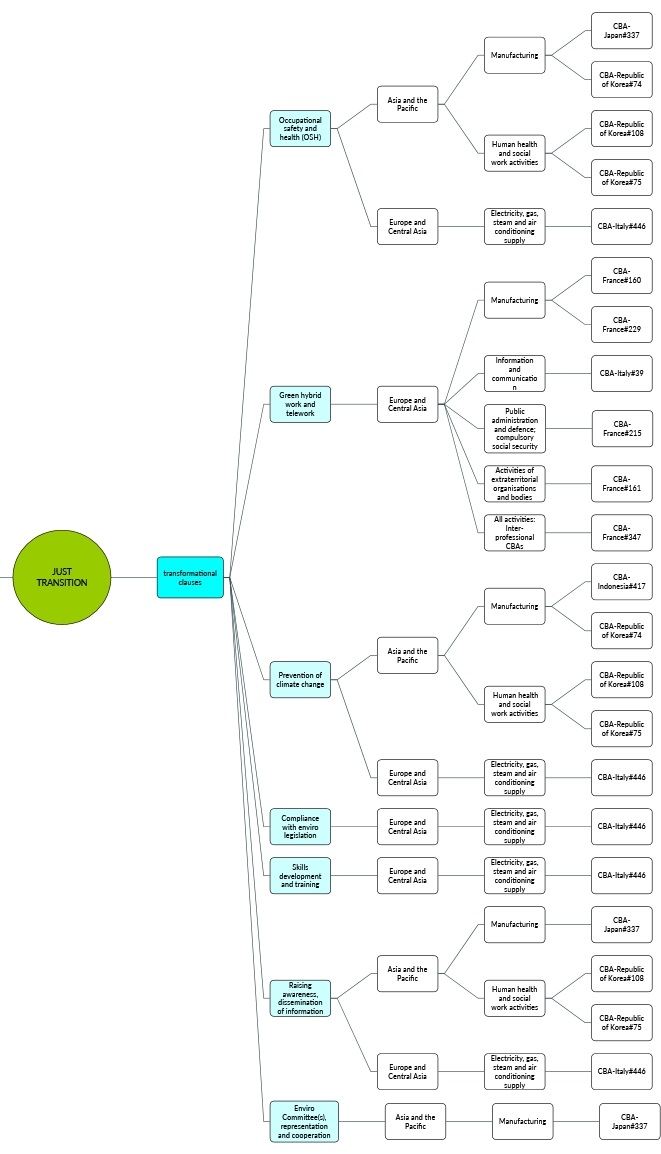
Annex figure 2. Visualization of the collective agreements in the ILO collective agreement database with OSH clauses related to just transition or environmental change
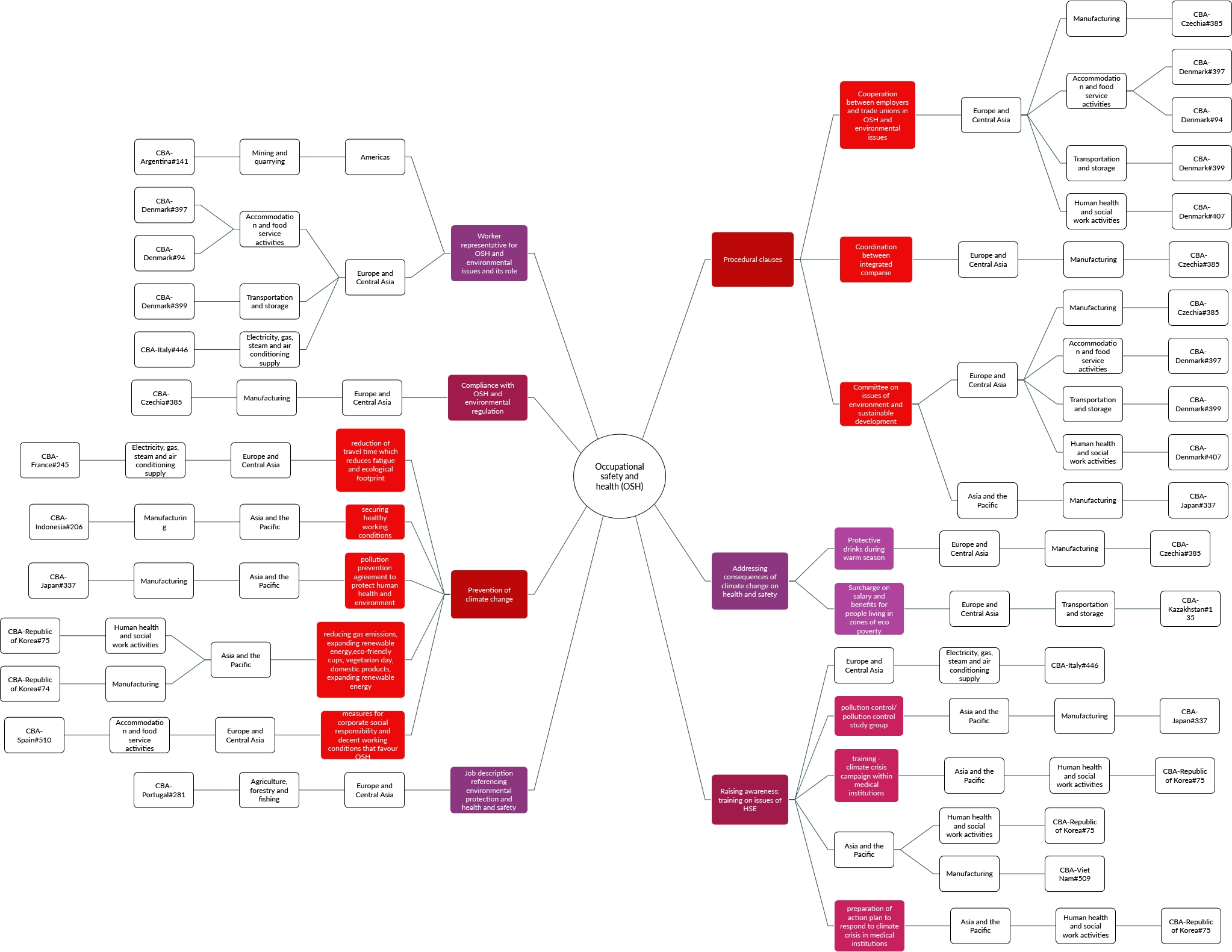
References
Acha, Majandra Rodriguez. 2016. “Gender Equality and Just Transition”, WEDO Discussion Paper, 25 May 2016.
ACTU (Australian Council of Trade Unions). 2023. Energy Transition Authority: What Workers Need.
Allan, Kori, and Joanna Robinson. 2022. ”Working towards a Green Job?: Autoworkers, Climate Change and the Role of Collective Identity in Union Renewal”. Journal of Industrial Relations 64 (4): 585–607.
Arabadjieva, Kalina, Alexis Bugada, Consuelo Chacartegui, Paolo Tomassetti and Ania Zbyszewska. 2023. “Introduction: The Labour-Environment Nexus - Exploring New Frontiers in Labour Law”. International Journal of Comparative Labour Law and Industrial Relations 39 (3–4): 271–280.
Baccaro, Lucio, and Chris Howell. 2017. Trajectories of Neoliberal Transformation: European Industrial Relations Since the 1970s. Cambridge: Cambridge University Press.
Banerjee, Aparajita, and Geertje Schuitema. 2022. “How Just Are Just Transition Plans? Perceptions of Decarbonisation and Low-Carbon Energy Transitions among Peat Workers in Ireland”. Energy Research & Social Science 88 (8): 102616.
Blattner, Charlotte E. 2020. “Just Transition for Agriculture? A Critical Step in Tackling Climate Change”. Journal of Agriculture, Food Systems, and Community Development 9 (3): 53–58.
Bosch, Gerhard. 2023. “Employment Policy for a Just Transition – The Example of Germany”. Transfer: European Review of Labour and Research 29 (3): 405–421.
———. 2023. “Digitalization, Automatization and Decarbonization: Opportunity for Strengthening Collective Bargaining in the Metal Sector”. Barmetal.
Braga, João Paulo, and Ekkehard Ernst. 2023. “Financing the Green Transition. The Role of Macro-Economic Policies in Ensuring a Just Transition”. Frontiers in Climate 5: 1192706.
Brand, Ulrich, and Mag Kathrin Niedermoser. 2019. “The Role of Trade Unions in Social-ecological Transformation: Overcoming the Impasse of the Current Growth Model and the Imperial Mode of Living”. Journal of Cleaner Production 225: 173–180.
Bugada, Alexis, Balázs Rossu, Paolo Tomassetti, Miriam Kullmann, Consuelo Chacartegui, Sergio Canalda Criado, Ania Zbyszewska and Marie Pillon. 2020. Agreenment: Labour and Environmental Sustainability (A Green Mentality for Collective Bargaining). ADAPT.
Calvert, John. 2023. “Just Transition in the Construction Industry: A Union’s Campaign to Create Jobs by Promoting Climate Change Upgrades in Buildings”. Alternate Routes: A Journal of Critical Social Research 35: 101–117.
Carbon Literacy Project. n.d. “What on Earth Is Carbon Literacy”. https://carbonliteracy.com/what-on-earth-is-carbon-literacy/.
Cha, J. Mijin, Dimitris Stevis, Todd Vachon, Vivian Price and Maria Brescia-Weiler. 2022. “A Green New Deal for All: The Centrality of a Worker and Community-led Just Transition in the US”. Political Geography 95: 102594.
Chacartegui Jávega, Consuelo, and Sergio Canalda Criado. 2021. “Collective Bargaining, Labour and Environmental Rights: The Spanish Experience”. E-Journal of International & Comparative Labour Studies 10 (1): 22–38.
Chakraborty, Achin, Subhanil Chowdhury, Supurna Banerjee and Zaad Mahmood. 2019. “Collective Bargaining in India: An Overview”. In Limits of Bargaining: Capital, Labour and the State in Contemporary India, edited by Achin Chakraborty, Subhanil Chowdhury, Supurna Banerjee and Zaad Mahmood, 14–25. Cambridge: Cambridge University Press.
Chile, Ministry of Energy. 2021. Estrategia de Transición Justa en el sector Energía.
Chile, Santiago Metro. 2023. Memoria Integrada 2022.
Clarke, Linda, and Melahat Sahin-Dikmen. 2020. “Unions and the Green Transition in Construction in Europe: Contrasting Visions”. European Journal of Industrial Relations 26 (4): 401–418.
Cohen, Marjorie Griffin. 2015. “Gendered Emissions: Counting Greenhouse Gas Emissions by Gender and Why It Matters”. In Working in a Warming World, edited by Carla Lipsig-Mummé and Stephen McBride, 59–81. Montreal and Kingston: McGill-Queen’s University Press.
———. 2017. “Introduction: Why Gender Matters When Dealing with Climate Change”. In Climate Change and Gender in Rich Countries, edited by Marjorie Griffin Cohen, 3–18. New York: Routledge.
Edelman, Murray. 1985. The Symbolic Uses of Politics. Chicago, IL.: University of Illinois Press.
ETUC (European Trade Union Confederation). 2021. ETUC Position: A Just Transition Legal Framework to Complement the Fit for 55 Package.
Fichter, Michael, and Jamie K. McCallum. 2015. “Implementing Global Framework Agreements: The Limits of Social Partnership”. Global Networks 15 (s1): S65–S85.
Flanagan, Frances. 2023. “Just Cessation: How Might the Climate Imperative to Phase out Fossil Fuel Extraction Reshape the Conception of Just Transition?” International Journal of Comparative Industrial Relations and Labour Law 39 (3–4): 393–418.
Flanagan, Frances, and Caleb Goods. 2022. “Climate Change and Industrial Relations: Reflections on an Emerging Field”. Journal of Industrial Relations 64 (4): 479–498.
Fredman, Sandra. 2023. “Greening the Workforce: A Feminist Perspective”. International Journal of Comparative Labour Law and Industrial Relations 39 (3–4): 337–358.
Galgóczi, Bela (ed.). 2019. Towards a Just Transition: Coal, Cars and the World of Work. ETUI.
———. 2020. “Just Transition on the Ground: Challenges and Opportunities for Social Dialogue”. European Journal of Industrial Relations 26 (4): 367–382.
Galvin, Ray, and Noel Healy. 2020. “The Green New Deal in the United States: What It Is and How to Pay for It”. Energy Research & Social Science 67: 101529.
Gärdebo, Johan. 2022. “Transitioning Unions: What Constitutes a Just Transition for Swedish Trade Unions?” Oxford Open Climate Change 3 (1): kgac006.
Ghana, Government of Ghana. 2023. Ghana Energy Transition and Investment Plan.
Giupponi, Belen Olmos. 2023. “Just Transition in the Global South: Alternative Approaches from Latin America”. International Journal of Comparative Labour Law and Industrial Relations 39 (3–4): 381–392.
Goods, Caleb. 2013. “A Just Transition to a Green Economy: Evaluating the Response of Australian Unions”. Australian Bulletin of Labour 39 (2): 13–33.
———. 2017. “Climate Change and Employment Relations”. Journal of Industrial Relations 59 (5): 670–679.
———. 2022. “How Business Challenges Climate Transformation: An Exploration of Just Transition and Industry Associations in Australia”. Review of International Political Economy 29 (6): 2112–2134.
Goods, Caleb, and Bradon Ellem. 2022. “Employer Associations: Climate Change, Power and Politics”. Economic and Industrial Democracy 44 (2): 481–503.
Hampton, Paul. 2018. “Trade Unions and Climate Politics: Prisoners of Neoliberalism or Swords of Climate Justice? Globalizations 15 (4): 470–486.
Hess, David J., Rachel G. McKane and Kaelee Belletto. 2021. “Advocating a Just Transition in Appalachia: Civil Society and Industrial Change in a Carbon-Intensive Region”. Energy Research & Social Science 75 (2): 102004.
Hickel, Jason. 2020. Less Is More: How Degrowth Will Save the World. New York, NY: Penguin Random House.
Houeland, Camilla, and David Jordhus-Lier. 2022. “‘Not My Task’: Role Perceptions in a Green Transition among Shop Stewards in the Norwegian Petroleum Industry”. Journal of Industrial Relations 64 (4): 522–543.
Houeland, Camilla, David Jordhus‐Lier and Frida Hambro Angell. 2021. “Solidarity Tested: The Case of the Norwegian Confederation of Trade Unions (LO‐Norway) and Its Contradictory Climate Change Policies”. Area 53 (3): 413–421.
Hultgren, John, and Dimitris Stevis. 2020. “Interrogating Socio-ecological Coalitions: Environmentalist Engagements with Labor and Immigrants’ Rights in the United States”. Environmental Politics 29 (3): 457–478.
ILO. 2015. Guidelines for a Just Transition towards Environmentally Sustainable Economies and Societies for All.
———. 2021a. Resolution concerning a lobal call to action for a human-centred recovery from the COVID-19 crisis that is inclusive, sustainable and resilient, ILC.109/Resolution I.
———. 2021b. User’s Manual to the ILO’s Guidelines for a Just Transition towards Environmentally Sustainable Economies and Societies for All.
———. 2022a. “Climate Action with Jobs and a Just Transition for All”, ILO Message Brief for COP27.
———. 2022b. Greening Enterprises: Transforming Processes and Workplaces.
———. 2022c. Social Dialogue Report 2022: Collective Bargaining for an Inclusive, Sustainable and Resilient Recovery.
———. 2023a. Resolution concerning a just transition towards environmentally sustainable economies and societies for all, ILC.111/Resolution V.
———. 2023b. Women and Men in the Informal Economy: A Statistical Update.
———. 2023c. Programme and Budget for 2024–25.
———. 2024a. Gender, Equality and Inclusion for a Just Transition in Climate Action. A Policy Guide.
———. 2024b. Ensuring Safety and Health at Work in a Changing Climate.
———. 2024c. Heat at Work: Implications for Safety and Health – A Global Review of the Science, Policy and Practice.
———. n.d.-a. “Trade Union Density Rate (%)”, ILOSTAT Statistics on Social Dialogue database. Accessed 6 October 2023.
———. n.d.-b. “Collective Bargaining Coverage Rate (%)”, ILOSTAT Statistics on Social Dialogue database. Accessed 6 October 2023.
India, MOEFF (Ministry of Environment, Forest and Climate Change). 2023. India: Third National Communication and Initial Adaptation Communication to the United Nations Framework convention on Climate Change.
IndustriALL. 2022a. “Press Release on Sweden: Ground-breaking Agreements on Education Support to Enable a Just Transition”, 11 July 2022.
———. 2022b. A Trade Union Guide of Practice for a Just Transition.
IndustriALL and Just Transition Centre. 2021. “Delivering the Just Transition: The Social Gap in the Fit for 55 Package for Automotive Workers and Workers in the Wider Mobility Eco-system”, Just Transition Coalition Briefing.
IOE (International Organisation of Employers). 2022. Guidance Paper on Employment, Just Transition and Climate Governance, February 2022.
IPCC (Intergovernmental Panel on Climate Change. 2022. Climate Change 2022: Mitigation of Climate Change – Technical Summary, Working Group III contribution to the Sixth Assessment Report of the IPCC.
ITF (International Transport Workers’ Federation). 2022. A Just Transition for Urban Transport Workers: Issues and Experiences from Unions in Cities of the Global South.
ITUC (International Trade Union Confederation). 2022a. ITUC Frontline Campaigns and Four Pillars for Action 2022.
———. 2022b. “Press Release on A Just Transition Energy Partnership for South Africa”, 18 March 2022.
IUF (International Union of Food, Agricultural, Catering Tobacco and Allied Workers’ Associations). 2022. Fighting for our Future: An IUF Guide on Tackling the Climate Crisis in Intensive Livestock Production.
Johansson, Vilja. 2023. “Just Transition as an Evolving Concept in International Climate Law”. Journal of Environmental Law 35 (2): 229–249.
Just Transition Centre and The B Team 2018. Just Transition: A Business Guide.
Kalt, Tobias. 2021. Jobs vs. Climate Justice? Contentious Narratives of Labor and Climate Movements in the Coal Transition in Germany”. Environmental Politics 30 (7): 1135–1154.
———. 2022. “Agents of Transition or Defenders of the Status Quo? Trade Union Strategies in Green Transitions”. Journal of Industrial Relations 64 (4): 499–521.
Keil, A. Katharina, Halliki Kreinin. 2022. “Slowing the Treadmill for a Good Life for All? German Trade Union Narratives and Social-ecological Transformation”. Journal of Industrial Relations 64 (4): 564–584.
Lambropoulos, Victoria. 2009. “Greening Australian Workplaces: Workers and the Environment”. Alternative Law Journal 34 (3): 189–192.
Maritime Just Transition Task Force. 2022. Mapping a Maritime Just Transition for Seafarers. ICS, ITF and UNGC
Markey, Raymond, and Joseph McIvor. 2019. “Environmental Bargaining in Australia”. Journal of Industrial Relations 61 (1): 79–104.
Markey, Raymond, Joseph McIvor, Martin O'Brien and Chris F. Wright. 2019. “Reducing Carbon Emissions through Employee Participation: Evidence from Australia”. Industrial Relations Journal 50 (1): 57–83.
Markey, Raymond, Joseph Mclvor and Chris F. Wright. 2014. Climate Change and the Australian Workplace. Macquarie University, Centre for Workplace Futures.
Masterman-Smith, Helen. 2010. “Green Collaring a Capital Crisis”. Labour and Industry 20 (3): 317–330.
Morena, Edouard, Dunja Krause and Dimitris Stevis. (eds.). 2020. Just Transitions: Social Justice in the Shift towards a Low-Carbon World. London: Pluto Press.
Moussu, Nils. 2020. “Business in Just Transition: The Never-ending Story of Corporate Sustainability”. In Just Transitions: Social Justice in the Shift Toward a Low-Carbon World, edited by Edouard Morena, Dunja Krause and Dimitris Stevis, 56–75. London: Pluto Press.
Newman, Freya, and Elizabeth Humphrys. 2020. “Construction Workers in a Climate Precarious World”. Critical Sociology 46 (4–5): 557–572.
Novitz, Tonia. 2023. “Human Rights as a Regulatory Tool for ‘Just Transition’ in Europe (and Beyond)”. International Journal of Comparative Labour Law and Industrial Relations 39 (3–4): 439–452.
Núñez, Pedro F. and Maria Elena López. 2016. “Solo salarios en la negociación colectiva en Argentina? Nuevos Desafíos”. Revista Ideides (1): 3.
Olsen, Lene. 2010. “Supporting a Just Transition: The Role of International Labour Standards”. International Journal of Labour Research 2 (2): 293–318.
Perry, Elizabeth. 2022. “Green Collective Agreements Database”. https://yorkspace.library.yorku.ca/xmlui/handle/10315/39403.
Pucheta, Mauro, and Ana Belén Sánchez. 2022. “Just Transition in the Global South”, ETUI Policy Brief, July 2022.
Rathzel, Nora, and David Uzzell. 2011. “Trade Unions and Climate Change: The Jobs Versus Environment Dilemma”. Global Environmental Change 21 (4): 1215–1223.
———. 2013. Trade Unions in the Green Economy: Working for the Environment. New York, NY: Routledge.
Räthzel, Nora, Dimitris Stevis and David Uzzell. 2021. The Palgrave Handbook of Environmental Labour Studies. Cham: Palgrave Macmillan.
Ravenswood, Katherine. 2022. “Greening Work–Life Balance: Connecting Work, Caring and the Environment”. Industrial Relations Journal 53 (1): 3–18.
Republic of Korea, Ministry of Environment. 2021. Framework Act on Carbon Neutrality and Green Growth for Coping with the Climate Crisis.
Republic of Korea, Office for Government Policy Coordination. 2023. First National Carbon Neutrality and Green Growth Basic Plan.
Reitzenstein, Alexander, Sabrina Schulz and Felix Heilmann. 2020. “The Story of Coal in Germany: A Model for Just Transition in Europe?”. In Just Transitions: Social Justice in the Shift Toward a Low-Carbon World. edited by Edouard Morena, Dunja Krause and Dimitris Stevis, 151–171. London: Pluto Press.
Romo, Oscar Molina. 2022c. “The Role of Tripartite Social Dialogue in Facilitating a Just Transition: Experiences from Selected Countries”, ILO Working Paper No. 76, August 2022.
Rugiero, Serena. 2019. “Decarbonisation in the Italian Energy Sector: The Role of Social Dialogue in Achieving a Just Transition – The Case of Enel”. In Towards a Just Transition: Coal, Cars and the World of Work., edited by Béla Galgóczi, 109–133. ETUI.
Sanz-Hernández, Alexia, Cristina Ferrer, Maria Esther López-Rodríguez and Miguel Marco-Fondevila. 2020. “Visions, Innovations, and Justice? Transition Contracts in Spain as Policy Mix Instruments”. Energy Research & Social Science 70: 101762.
Schofield-Georgeson, Eugene. 2023. “Legal Obstacles and Possibilities for Environmental Bargaining in Australia”. Journal of Industrial Relations 65 (3): 00221856231166549.
Sheldon, Peter, Raja Junankar and Anthony De Rosa Pontello. 2018. “The Ruhr or Appalachia? Deciding the Future of Australia's Coal Power Workers and Communities”. Industrial Relations Research Centre.
Snell, Darryn. 2018. “‘Just Transition’? Conceptual Challenges Meet Stark Reality in a ‘Transitioning’ Coal Region in Australia”. Globalizations 15 (4): 550-564.
Snell, Darryn, and Peter Fairbrother. 2011. “Toward a Theory of Union Environmental Politics: Unions and Climate Action in Australia”. Labor Studies Journal 36 (1): 83–103.
South Africa, Presidential Climate Commission. 2022. A Framework for a Just Transition in South Africa.
Stevis, Dimitris. 2018. “US Labour Unions and Green Transitions: Depth, Breadth, and Worker Agency. Globalizations 15 (4): 454–469.
Stevis, Dimitris, and Romain Felli. 2015. “Global Labour Unions and Just Transition to a Green Economy”. International Environmental Agreements: Politics, Law and Economics 15 (1): 29–43.
Tandon, Suranjali. 2024. “Just Transition Is Gaining Momentum in India”. Just Transition Finance Lab Blog (blog). 1 March 2024. https://justtransitionfinance.org/commentary/just-transition-is-gaining-momentum-in-india/.
Thomas, Adrien. 2021. “Framing the Just Transition: How International Trade Unions Engage with UN Climate Negotiations”. Global Environmental Change 70 (4): 102347.
Thomas, Adrien, and Nadja Doerflinger. 2020. “Trade Union Strategies on Climate Change Mitigation: Between Opposition, Hedging and Support”. European Journal of Industrial Relations 26 (4): 383–399.
Trades Union Congress, 2008. “Go Green at Work: A handbook for union green representatives”. https://www.tuc.org.uk/sites/default/files/extras/gogreenatwork.pdf
United Kingdom, Government of the United Kingdom. 2023. Powering up Britain, March 2023.
United Kingdom, Stockport Metropolitan Borough Council, n.d. “Equality and Diversity”. https://www.stockport.gov.uk/equality-and-diversity.
UNFCCC (United Nations Framework Convention on Climate Change). 2016. Report of the Conference of the Parties on its twenty-first session, held in Paris from 30 November to 13 December 2015. FCCC/CP/2015/10.
———. 2024. Decisions Adopted by the Conference of the Parties Serving as the Meeting of the Parties to the Paris Agreement, Addendum to the Report on the Conference of the Parties Serving as the Meeting of the Parties to the Paris Agreement on Its Fifth Session, FCCC/PA/CMA/2023/16/Add.1.
Valentin, Louisa, and Lavinia Steinfort. 2023. “Transforming Eskom's Slow Death into Democratic Public Ownership in South Africa”. TNI Blog (blog), 12 October 2023. https://www.tni.org/en/article/transforming-eskoms-slow-death-into-democratic-public-ownership-in-south-africa.
Wang, Xinxin, and Kevin Lo. 2021. “Just Transition: A Conceptual Review”. Energy Research & Social Science 82 (3): 102291.
———. 2022. “Political Economy of Just Transition: Disparate Impact of Coal Mine Closure on State-Owned and Private Coal Workers in Inner Mongolia, China”. Energy Research & Social Science 90 (4): 102585.
Weil, David. 2014. The Fissured Workplace. Cambridge, MA: Harvard University Press.
Acknowledgements
This working paper, titled “The role of collective bargaining for just transition”, was prepared under the overall guidance of Philippe Marcadent, Chief of the ILO’s Inclusive Labour Markets, Wages and Working Conditions Branch (INWORK). We thank him for his important guidance and support. We also thank John Ritchotte for his support.
Various bureaux and branches and ILO colleagues have been involved in the Working Paper. Moustapha Kamal Gueye represented the Priority Action Programme for Just Transitions; Lene Olsen and Melanie Jeanroy represented the Bureau for Workers’ Activities (ACTRAV) and Jose Luis Viveros Añorve and Roberto Villamil represented the Bureau for Employers’ Activities (ACT/EMP) in the advisory committee for this paper. We would like to thank them for their valuable comments. Additionally, we extend our gratitude to Marek Harsdorff for his comments on an earlier draft.
Case studies were conducted by national experts, and we thank them all for their important work: Gerhard Bosch on the German case study; Mat Johnson and Eva Herman on the United Kingdom, Gonzalo Durán S. on Chile, Angela D. Akorsu on Ghana, Ramapriya Gopalakrishnan on India and Hyunil Hwang on the Republic of Korea. We also acknowledge Caleb Goods for preparing a literature review and contribution to the overall analysis, and Maria Sedlakova for the quantitative analysis of the database findings.
We are grateful to John Maloy for his excellent editing work. We also thank Angélique Flores-Girod and Claire Piper (INWORK) for providing very valuable secretarial support.