


Opportunities and Challenges for Decent Work in the Platform Economy in Asia and the Pacific
Abstract
This paper explores how the evolving platform economy is reshaping the economic landscape across Asia and the Pacific, and how countries in this diverse region are navigating emerging opportunities and challenges. It situates platform work within the broader context of the region's economic transformation toward service-led growth and highlights how varying levels of development, demographic profiles, and digital infrastructure influence how the platform economy is evolving, and how it affects employment in countries across the region.
Through an analysis of legislative frameworks based on information publicly available as of August 2025, the paper presents examples of how countries in Asia and the Pacific are governing platform work. The findings reveal that while digital labour platforms offer income-generation opportunities, regulatory frameworks are evolving more slowly than the platforms themselves. The paper concludes that comprehensive governance frameworks that address legal and policy dimensions, highlight social and labour protections, and underscore the importance of social dialogue are essential for realizing decent work in the platform economy.
Acknowledgements
The research study was conducted by the Regional Office for Asia and the Pacific in collaboration with the Inclusive Labour Markets, Labour Relations and Working Conditions Branch of the Department on Conditions of Work and Equality. Funding for the research was provided by the ILO/Japan Multi-bilateral Programme.
The opinions and views expressed in this publication are those of the authors and do not necessarily reflect the opinions, views or policies of the ILO or the Government of Japan.
Introduction
In a technologically driven world, digital platforms are increasingly the enablers of economic transactions.1 Digital platforms are often defined as an interface that connects consumers (individuals or businesses) to providers of various types of goods, services or information through a technology-based application.2 An evolving platform economy now underpins service-led growth in many countries, especially in Asia and the Pacific – a region that is embracing technological change to propel its dynamism and economic expansion.3
This report situates the Asia-Pacific platform economy within the broad context of the region’s economic, demographic and labour market landscape. It provides an overview of the concerns that have emerged as digital labour platforms restructure the world of work in the region and the ways that governments are navigating these uncharted waters.
Platform-enabled companies are tapping into a market that once belonged to traditional firms.4 They offer the promise of the delivery of goods, services and information quickly, efficiently and at scale. They have created new and different opportunities for income generation while enabling flexible work arrangements in the process.5 They are transforming traditional work arrangements and are leading policymakers and regulators into new territory as they consider how to govern digital platforms and their impact on economies and labour markets.
The true impact of the “platformization” of economies, not to mention its more granular impact on different types of workers, has yet to be fully understood. There is consensus that the economic and labour market restructuring associated with the platform economy present both opportunities and challenges. Nonetheless, the ability of the Asia and Pacific region to sustain its economic dynamism hinges on its ability to understand its platform economy and to maximize the benefits and reduce the costs for individuals, enterprises and societies.
Yet, from the structures of their economies and their levels of development to their demographic and labour market profiles, there is significant variation across sub-regions and countries in Asia and the Pacific that manifest in how the platform economy is developing and how it operates. The region is home to some countries that have high levels of human development and others that rank among the lowest. Some countries in Asia and the Pacific have large and growing youth populations, while others are facing ageing populations. In addition, varying socio-cultural contexts across the countries create different opportunities and challenges for women.
While data on the size of the platform economy or the number of workers it engages is lacking, the importance of the platform economy to Asia and the Pacific is clear. In 2017, the global aggregate value of digital platform companies with a market capitalization of more than US$100 million was estimated to be more than US$7 trillion dollars, or 20 per cent of the global gross domestic product (GDP).6 Revenue in the “platform as a service”7 market was projected to grow to US$116.9 billion in 2023; and at an expected annual growth rate (compound annual growth rate 2023-2028) of nearly 15.9 per cent, it is projected to reach US$244.1 billion by 2028.8
In 2019 and at US$1.8 trillion, the Asia and Pacific region accounted for 48 per cent of total global sales revenue generated from platforms, equivalent to 6 per cent of the regional GDP.9 China led the region, accounting for US$1.2 trillion in revenue, or 68.2 per cent of Asia’s total (8.8 per cent of China’s GDP). The region also had the highest growth in sales revenue at 25 per cent, compared with global growth of 20.7 per cent.10 In 2020, the region’s share of global sales revenue from platforms increased to 60 per cent, at US$2.4 trillion of the US$3.9 trillion spent globally.11
Among the many types of platforms that facilitate different transactions (see Annex Figure A1), there are platforms involving the intermediation and organization of services related to the provision of work. This subset of the platform economy, often described as digital labour platforms, includes location-based services (such as passenger transportation, delivery or personal care services) and online (web-based) services that are provided remotely. Online platforms are often further categorized as crowdwork (microtasking) or freelancing.12 These task-based opportunities are also referred to as “gig work”. Digital labour platforms manage several aspects of working conditions and access to work, including assigning tasks and payments.
There is no systematic data collection across the region on the number of workers carrying out work via digital labour platforms. To date, only a limited number of enterprise surveys or labour force surveys have systematically captured the number of digital platform workers. Some surveys in, for example, Australia, Indonesia, Philippines and Viet Nam are evolving to capture more of this information, but most countries do not collect this data.
There are, however, several estimates for online platform work. The Online Labour Observatory of the Oxford Internet Institute and the International Labour Organization (ILO) estimate there are 163 million registered user accounts, with 8.6 per cent of them “active” and 2 per cent having completed at least ten projects or earned at least US$1,000.13 The World Bank estimates there are 154 million unique registered online gig workers worldwide.14 The Association of Southeast Asian Nations (ASEAN) estimates suggest that there are 63 million registered workers engaged in online freelancing services and roughly 40 million in on-demand digital services.15
In the Philippines, data suggests that platform workers constitute 4 per cent of the employed16 population.17 Estimates from China point to an increase in the number of workers in the provision of services in the platform economy, from 50 million in 2015 to 84 million in 2020, amounting to a growth rate of 68 per cent. Based on this data, the estimated proportion of China's workforce that has ever participated in the platform economy increased from 6.5 per cent in 2015 to more than 10 per cent in 2020.18 In India, at 6.8 million, gig workers constitute an estimated 2.4 per cent of the non-farm workforce, or 1.3 per cent of all workers.19
Despite the increasing numbers of workers engaged in online platform work, it continues to be less regulated than location-based work. An added issue is that online work can span different legal jurisdictions, within or between countries, despite the work often being performed mostly within the boundaries of workers’ residence.
A growing number of countries around the world are developing policies to promote the business opportunities through platforms. At the same time, they are seeking to adapt their legal frameworks to respond to the challenges arising from these new forms of work. These issues have also entered the public policy debate in Asia and Pacific. However, only a small number of countries in the region have policies or legislation that pertains to platform workers. Several countries are engaging in policy debates to find optimal ways of dealing with the large, diverse and evolving ecosystem of the platform economy and digital labour platforms. Some countries have guidance for legal practice to deal with platform workers.
This report provides an analysis of the evolving platform economy in the region. Following the introduction, chapter 1 sets the context, providing insight into the heterogeneity that characterizes Asia and the Pacific. It discusses the structural transformation in the region and how the shift to a service-led growth model is driving the platform economy and vice versa. Chapter 1 also delves into how varying levels of development in countries across the region have a bearing on the advancement of the platform economy. Countries in the region face multiple challenges ranging from an inadequate supply of good jobs on the one hand, to labour shortages on the other, as well as deep structural inequalities in access to decent jobs. Developed and less developed countries in the region also have divergent demographic profiles that influence how platforms operate, especially digital labour platforms. Chapter 2 discusses the nature of digital labour platforms and the opportunities and challenges they present as well as the specific issues relating to conditions of work in the platform economy. Chapter 3 then examines the emergence of legislation seeking to regulate aspects of work in the platform economy, with Australia, China, India, Indonesia, Malaysia, Republic of Korea and Singapore all having adopted legal instruments of varying scope. Chapter 4 summarizes the main findings pertaining to decent work and the governance of digital labour platforms in Asia and the Pacific.
The report deals with legal frameworks rather than specific case law, based on information publicly available as of August 2025. Where relevant, it highlights examples of collective agreements that seek to address aspects of platform work.
Economic context and the evolution of the platform economy
Technology underpins the structural transformation and service-led growth in Asia and the Pacific
Technology, and platforms as a key facet of this latest wave of technological advancement, is reshaping the development trajectories of countries. Agriculture’s contribution to GDP has been declining across the region and several countries are now shifting from traditional export-oriented manufacturing to power their growth to a service-led model. Platforms are an enabler of manufacturing and services. This includes wider use of platforms that support the “servicification” of manufacturing;20 for instance, platforms that help with logistics and the delivery of services.
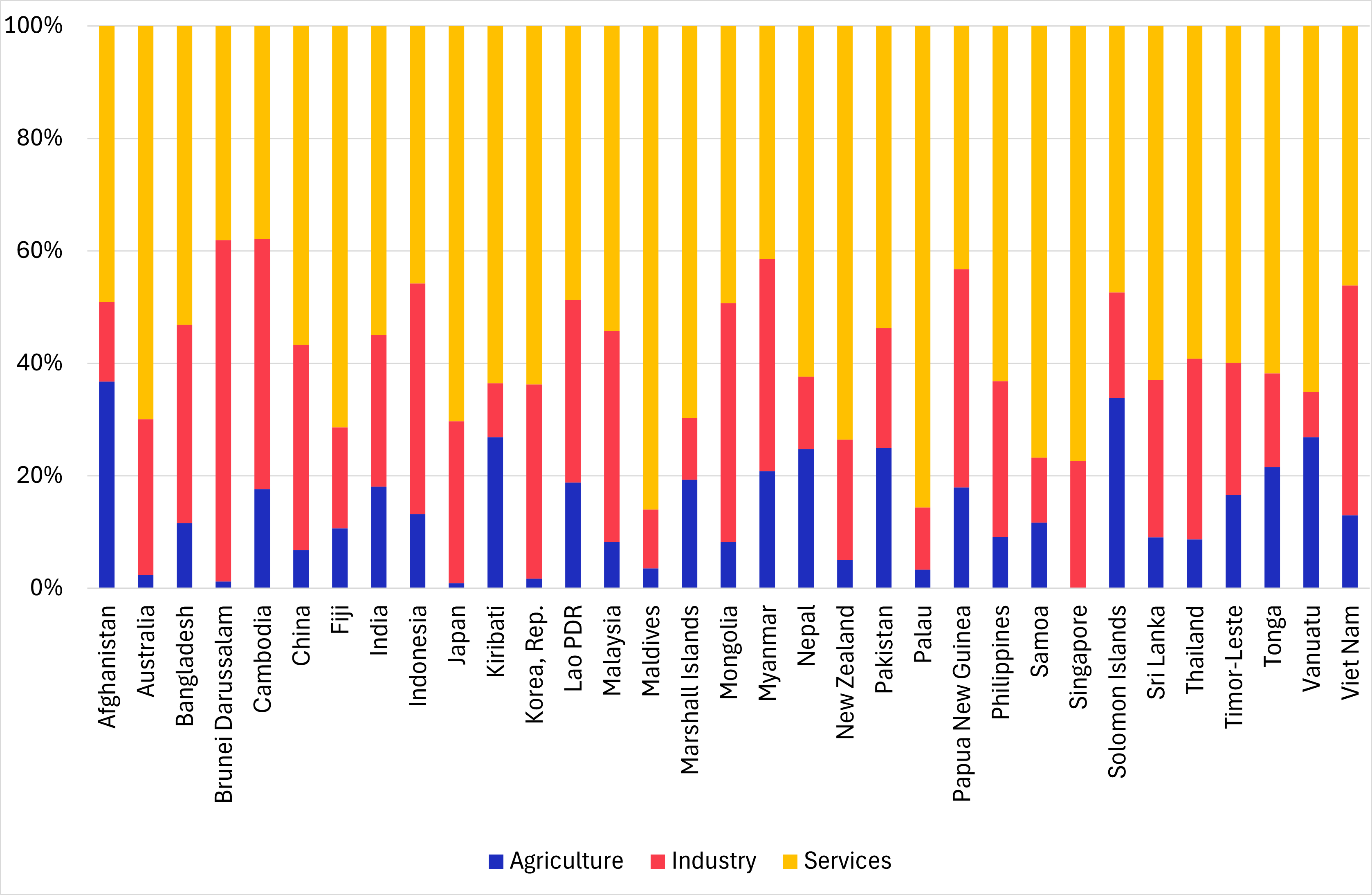
In nearly all economies in Asia and the Pacific, the contribution of the services sector to economic growth is greater than that of industry or agriculture (figure 1). Services’ value added as a share of GDP exceeds that of industry or agriculture in all Asia and the Pacific countries except Brunei Darussalam, Cambodia and Myanmar, where industry’s value added as a percentage of GDP exceeds services.21 In Brunei Darussalam, the heavy reliance on oil overshadows its dependence on services. In Indonesia, the gap in the contribution of services and industry to GDP is not pronounced: services’ value added as a percentage of GDP exceeds that of industry by only a few percentage points.22
Yet Asia and the Pacific’s experience of structural transformation has been diverse across countries in the region. When it comes to the overall sectoral distribution of employment in the region, traditional sectors, namely agriculture, forestry and fishing; manufacturing and wholesale and retail trade, still dominate.23
In this analysis, structural transformation refers to the shift of workers from low-productivity to higher levels of productivity.24 This can be across sectors or within them. In much of the developing world, agriculture continues to employ a significant portion of workers but is marked by high levels of informality and the sharing of low-productivity work.25 Decreasing agricultural employment and rising employment in manufacturing and services – sectors associated with higher levels of worker productivity and greater formalization – is therefore a marker of a structural transformation. Within sectors, moving from low- to high-value-added activities is also an indicator of a structural transformation, such as from garment manufacturing to automotive production.
Figure 1. Structure of economic output across Asia and the Pacific, 2024 or most recent year (percentage)
Source: World Bank, “World Development Indicators”.
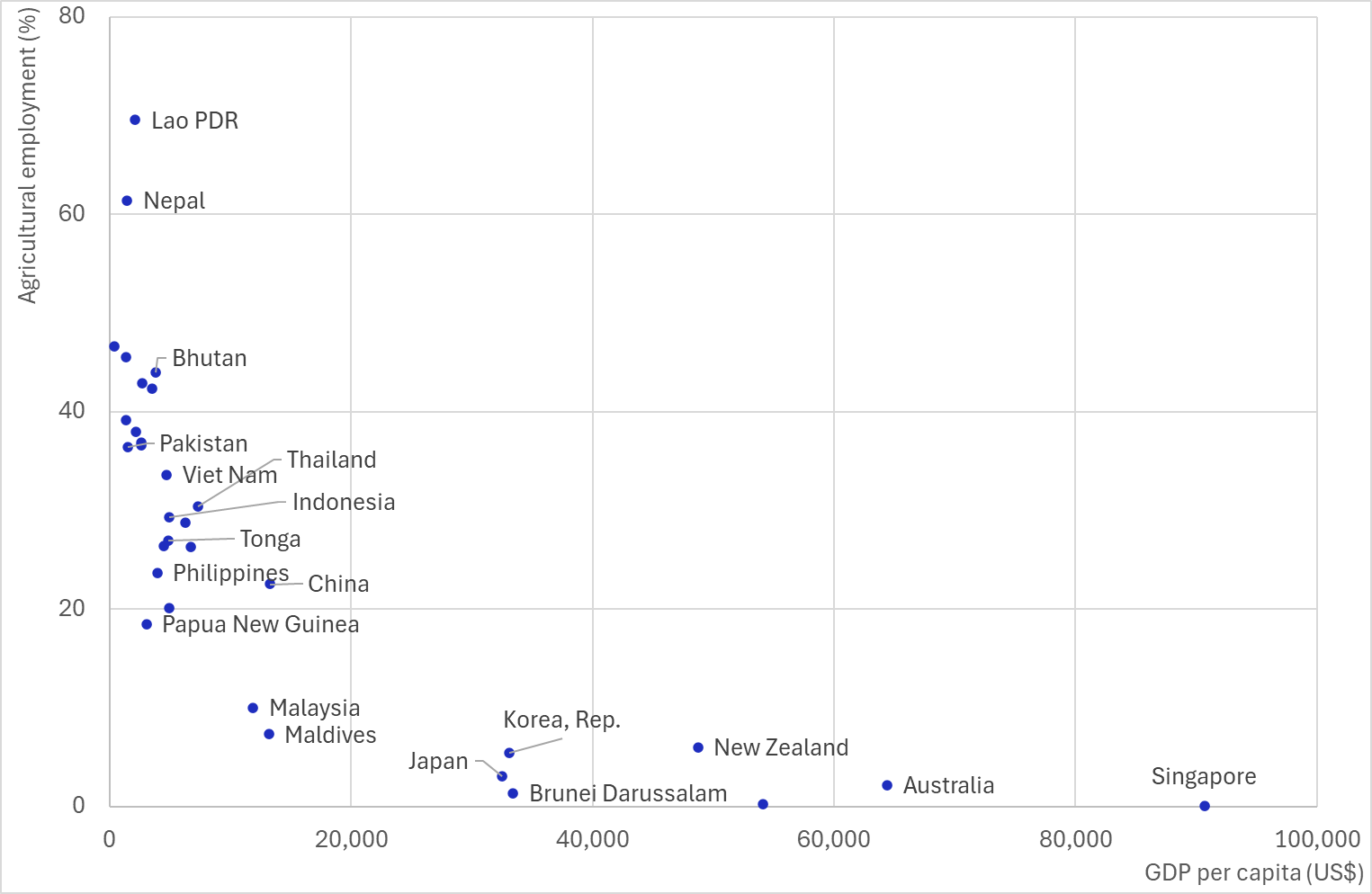
Figure 2. Share of agriculture in total employment (percentage), 2022, versus GDP per capita (US dollars), 2024 or most recent year
Source: World Bank, “World Development Indicators”, referencing ILO Modelled Estimates.
Lower levels of the agricultural share of employment, which is another marker of structural transformation, tends to correspond to a higher level of per capita GDP, and this is true for Asia and the Pacific (figure 2). The Lao People’s Democratic Republic and Nepal each have a high level of agricultural employment but a lower level of GDP. Australia and Singapore are at the other end of the spectrum, with a low level of agricultural employment and a high level of GDP.
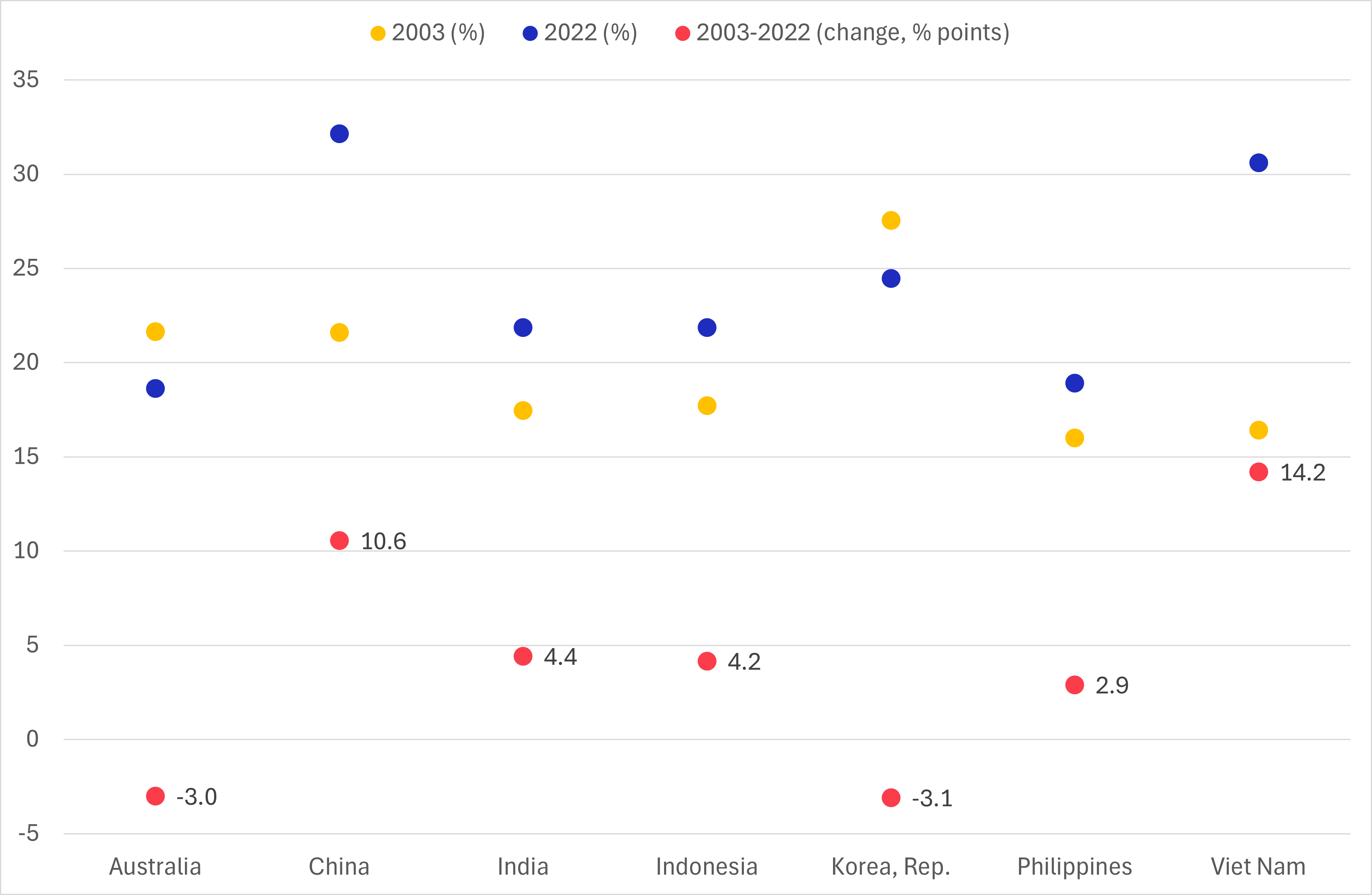
Figure 3. Share of industry in total employment of select countries in Asia and the Pacific, 2003 and 2022 (percentage)
Source: World Bank, “World Development Indicators”, referencing ILO Modelled Estimates.
Figure 3 reflects the trend in the share of industrial employment in total employment between 2003 and 2022 for a selected group of economies in Asia and the Pacific. High-income countries, such as Australia and the Republic of Korea, registered a decline in the share of industrial employment over this period. In contrast, China, India, Indonesia, Philippines and Viet Nam all experienced growth in their industrial share of employment by 2022. With a rise of 14.2 percentage points, Viet Nam registered the greatest increase.
Figure 4. Share of services in total employment of select countries in Asia and the Pacific, 2003 and 2022 (percentage)

Source: World Bank, “World Development Indicators”, referencing ILO Modelled Estimates.
Figure 4 illustrates how the services sector’s share of total employment grew for the same group of seven countries. Between the base year of 2003 and 2022, Australia, India and the Republic of Korea saw the least growth in the share of service sector employment, at 4.7 percentage points, 4.4 percentage points and 6.7 percentage points, respectively. The greatest increase in the share of service sector employment was in China, at 16 percentage points. Indonesia and Viet Nam followed, with the share of services in total employment growing 12.9 percentage points and 11.9 percentage points, respectively.
Economic activity within the services sector looks very different across Asia and the Pacific. In India, for instance, services range from low value added, services such as streetside subsistence vendors, to high-skill information technology (IT) and business services.26 This is in contrast with the services sector in a largely formal economy like Singapore, where wholesale trade, transportation, storage and information and communications were the largest subsectors based on operating revenue in 2021.27
For the region as a whole, the so-called modern sectors, such as IT and other business sector services, have added a growing share of workers. But these are higher-skilled workers, and their overall share of total employment is still small.28 Moreover, hiring in these sectors tends to favour men over women.29
In a heterogeneous region, levels of development and the expansion of the platform economy are linked
As countries in the region increasingly look to the service sector to create new opportunities for jobs and development,30 platforms and the platform economy are seen as a facet of this iteration of a service-led growth model. What the platform economy looks like across different countries and even within countries is partly a reflection of its level of development. The level of development is indicative of the fiscal resources, institutional strength, investment and technical know-how available to cultivate the digital and entrepreneurial ecosystems,31 as well as the human and physical capital that underpin the platform economy.
Given the economic heterogeneity of the region, the extent of digital platform penetration varies substantially across Asia-Pacific economies. Overall, digital platform use and activity tend to be more established in developed economies in the region. A structural assessment of the drivers of digital platform expansion reveals that certain key elements can drive penetration levels. Factors such as digital connectivity and infrastructure, urbanization, working-age population, the expansion of the services sector, and quality of governance exert a positive influence on digital platform penetration.32 Intra-regional variances in digital platform uptake also point to persistent barriers to access and a digital divide between and within countries in Asia and the Pacific.33
Demographic trends affect labour markets and platforms
Developed and developing economies not only differ with respect to the digital and entrepreneurial ecosystems that underpin the expansion of their platform economies, but their divergent demographic trends also have an impact on how the platform economy operates, including digital labour platforms.
Australia, Japan, New Zealand, Republic of Korea and Singapore have very high levels of human development and rank among the top 25 countries (of 191 countries) in the Human Development Index (see Annex Table A2).34 They also have a much higher old-age dependency ratio (see Annex Table A3).35 Other countries in the region, such as Afghanistan, Papua New Guinea and Solomon Islands, have relatively lower human development ranking. These countries also have a young population and a low old-age dependency ratio.
The low old-age dependency ratio in the younger countries of the region present opportunity. Harnessing the productive potential of youth can help propel their economies. Yet, this can only happen if labour markets have the capacity to absorb the large and growing youth segment and if there are enough opportunities for decent work. In Asia and the Pacific, around 20 per cent of all youths aged 15–24 are not in employment, education or training. This is particularly elevated for young women, at 30.4 per cent, compared to 11.3 per cent for young men.36 As well, the regional unemployment rate for youth, at 13.7 per cent, is more than three times than what it is for adults.37 Formal job creation in many developing countries has not kept pace with the rate at which youth are entering the labour market. This not only fuels informal employment but the labour surplus exerts downward pressure on wages and working conditions.
Almost 66 per cent, or 1.3 billion workers in Asia and the Pacific rely on the informal economy for their livelihood.38 Informal employment in the region’s developing and emerging economies is 71 per cent, which is three times higher than the 22 per cent average in the advanced economies.39 Informal employment is generally associated with low-levels of productivity, low wages and a lack of legal and social protections.40 In many developing countries, more women tend to be in informal than in formal work. Youth are often also disproportionately engaged in informal employment. Moreover, low-income and lower-middle-income countries in the region still have more than 60 per cent41 of their workers in vulnerable employment.42
Box 1: Policy initiatives to promote employment and income opportunities in the platform economy in China
Since 2013, the platform economy has been developing rapidly in China.a This has led to the emergence of numerous platform companies in different fields. Since 2016, the Government has considered the platform economy as a driving force for economic development, a leader in innovation, a means to promote the optimization of the structure of the services sector and an important contributor to the implementation of its strategy of giving priority to employment.b The Government encourages the integration of the internet with the services sector, production and innovation. In addition, it is strengthening the construction of network support capacity, including 5G and other new-generation information infrastructure, and encouraging the development of the platform economy.c
The Chinese Government has optimized and improved market access conditions, reduced compliance costs, innovated in relation to its regulatory philosophy and approach and optimized the environment for the development of the platform economy.d Concurrently, the Government has reformed the regulatory framework to protect the rights and interests of platforms, platform workers and consumers, thereby promoting compliance among platform enterprises. In 2021, the Ministry of Human Resources and Social Security adopted a Guiding Opinion on Safeguarding the Labour Rights and Interests of Workers in New Forms of Employment. This regulation, inter alia, supports the establishment of vocational training suitable to workers in new forms of employment to ensure that they receive equal access to training. The guidance also includes provisions on subsidies for the training of workers and references to the recognition of these workers’ skills.e
Source: a=China Sharing Economy Development Report, 2016; b=Report on the Work of the Government, 2023 and 2024; c=Guiding Opinions on Promoting the Normative and Healthy Development of the Platform Economy; d=ibid.; e=Ministry of Human Resources and Social Security (China) et al., Guiding Opinion on Safeguarding the Labour Rights and Interests of Workers in New Forms of Employment, July 2021.
Against this backdrop, digital labour platforms offer both opportunities and challenges. Digital labour platforms have created an international market for online tasks that connect different parts of the world and generate income opportunities to previously excluded segments of the workforce (box 1).
Yet, this new world of digitally mediated platform work also calls for overcoming digital divides and inculcating relevant skills that must range from the technical knowledge necessary for a platform worker to deliver an on-demand service (such as driving, beauty services or graphic design) to the digital skills necessary to access and utilize the technology and relevant applications.
While not directly targeting platform work, several countries, including Malaysia, Philippines and Singapore, have established digital literacy programmes to equip people with the skills to work in the wider information and communication technology sector. The eRezeki programme in Malaysia, for example, targets workers from low-income groups to match them with jobs on platforms. The Global Online Workforce (GLOW) programme aims to develop the skills of digital freelancers to help them secure projects on international online platforms.43 And the mid-term review of Malaysia’s MADANI 12th plan emphasizes undertaking labour market reforms, reshaping talent for the future of work and strengthening the digital economy ecosystem. Beyond these efforts, however, what kinds of skills upgrading can lead to greater career progression and economic mobility in platform work is an open question.
The emerging ecosystem of platform work is also upending traditional employment models and altering employment relationships.44 With the majority of platforms categorizing their workers as self-employed, much of the work on digital labour platforms is governed through commercial contracts for the provision of services rather than with employment contracts under labour laws. If this leads to an overall increased prevalence of self-employment, it might, under certain conditions, also have implications for informality. There is some evidence that informal employment is higher among self-employed workers than among employees. From a different perspective, it can also be argued that the traceability of activities on platforms, facilitated by digital contracts and the digitalization of transactions, offers an opportunity to formalize economic activities. The overall impact of these trends will vary depending on the labour and economic context, including the initial level of formalization.45
Over several years, the need for new instruments to govern the evolving landscape of the platform economy, and especially digital labour platforms, has become apparent. As mentioned earlier, several governments around the world and in Asia and the Pacific are taking active measures to better manage the sector. The next chapter provides an overview of where and why the need for governance of digital labour platforms has arisen.
Opportunities and challenges for work on digital labour platforms
An unresolved debate
As digital labour platforms have become more established across the globe and in Asia and the Pacific, there have been several studies that discuss the benefits and opportunities, as well as those that warn of the disruptions and challenges of work on digital labour platforms.46 There is no definitive conclusion to the debate because both exist. Some reasons are set out below.
First, there is a lack of definitive, large-scale and systematic data on the size of the platform economy, including in Asia and the Pacific. How many digital labour platforms are there? How many workers and consumers are associated with these platforms? What is the net impact of the platform economy on job creation? Of the workers associated with the platforms, how many are engaged in location-based or online work? There is also no systematic, large-scale measurement of working conditions and incomes. In the absence of this data, small-scale context-specific studies depict partial realities. As platforms become a significant part of the architecture for economic transactions, more and better systematic data collection is key to understanding the changes happening and when to act upon them.
Second, digital labour platforms offer value. For instance, they offer value to the consumer who can avail of services with greater convenience. They offer value to firms that can access a pool of geographically dispersed labour and a wider and more competitive pool of suppliers for inputs. Digital labour platforms offer value to companies that can tap into investor finances in the hopes of building a profitable business by leveraging the internet to cater to consumer demand. They offer value to the investor who hopes to gain dividends from their investment.
Finally, there is value for the workers because platform work provides an opportunity to generate an income, and it offers seemingly flexible working conditions.
Debates over the merits and limitations of digital labour platforms continue, but a key question is not whether platforms offer value but, rather, who does the value accrue to and how it is distributed? Moreover, could the absence of sufficient regulations in the platform economy be creating an uneven competitive playing field for other companies?
Regardless of the debates, digital labour platforms have become an important mode of delivering and receiving services. Service-led growth models are gaining salience relative to traditional industrialization pathways that once characterized the development trajectories of much of the developed world, including in Asia and the Pacific. Platforms today underpin the service-led model of growth.
As the platform economy gains in importance, countries, including several in Asia and the Pacific, are considering how best to regulate the emerging forms of work. The internal discussions have led to legislation in some countries, while others have tabled draft legislation. Some countries now include guidance in their law practices or deal with certain issues through case law. In a mapping of laws and practices relating to work on or through platforms, the ILO identified four approaches to regulating platform work.47 These approaches are also used in Asia and the Pacific:
Amendments to existing labour legislation to include aspects of work on digital labour platforms (Australia).
Specific stand-alone legislation on aspects of platform work (China’s Guiding Opinion on Safeguarding Labour Rights and Interests of Workers 2021 and subsequent opinions; Rajasthan’s Platform based Gig Workers (Registration and Welfare) Act, 2023; and the Singapore Platform Workers Act, 2024).
Sector-based legislation (India’s Motor Vehicle Aggregators Guidelines, 2020 and Indonesia’s Transportation Regulations of 2018 and 2019).
Specialized laws that extend existing labour and/or social protection to platform workers (Republic of Korea’s Industrial Accident and Compensation Act, 2019, Employment Insurance Act and Health and Safety Law and India’s Social Security Act, 2020).
Regulation can traverse wider areas, including consumer protection, data protection and tax and competition law. Regulating platform work through digital labour platforms, where such work spans different legal jurisdictions, whether within a country or across borders, creates more complexity. Given this context, governance must be nimble to adapt to the unprecedented developments and to address the emerging challenges so that economies and labour markets can function smoothly. Different countries have a range of ministries, regulatory bodies, and agencies engaged in various aspects of platform governance including labour ministries, but also transport, tax and business licensing agencies. Issues of concern in the governance of digital labour platforms detailed in the following sections are: definitions and classifying workers; labour protection and workers’ rights; dispute settlement; workers’ data protection and data-sharing; and workers’ voice and representation.
Developments in law and practice in Asia and the Pacific
This section provides an overview of how legislative instruments across Asia and the Pacific are regulating dimensions of platform work, all of which are relatively recent. The examples are not exhaustive, but provide insights into different country approaches to address context specific challenges. Some draft legislation under consideration is also referred to.
Definitions and decision-making
Table 1. Definition of “platform worker” and “platform work”, by country
|
Country |
Legislative instrument |
Terminology |
Definition |
|---|---|---|---|
|
China |
Workers employed in new forms |
Article 3 “Workers employed in new form” means the workers who accept delivery, travel, transportation and domestic services and other work assignments online issued by internet platforms at the request of users, provide online services on the platforms as required by the platforms and obtain remuneration for their work. |
|
|
India |
Platform worker and “platform work” |
Section 2(60) “Platform worker” means a person engaged in or undertaking platform work. “Platform work” means a work arrangement outside of a traditional employer–employee relationship in which organizations or individuals use an online platform to access other organizations or individuals to solve specific problems or to provide specific services or any such other activities which may be notified by the central Government, in exchange for payment. |
|
|
India (State of Karnataka) |
Karnataka Platform-Based Gig Workers (Social Security and Welfare) Act, 2025 |
Gig worker |
Section 2(e) “Gig worker” means a person who performs work or participates in a work arrangement that results in a given rate of payment, based on terms and conditions laid down in such contract and includes all piece-rate work, and whose work is sourced through a platform, in the services specified in the Schedule. |
|
India (State of Rajasthan)* |
Rajasthan Platform Based Gig Workers (Registration and Welfare) Act, 2023 |
Gig worker |
Section 2(e) “Gig worker” means a person who performs work or participates in a work arrangement and earns from such activities outside of traditional employer employee relationship and who works on contract that results in a given rate of payment, based on terms and conditions laid down in such contract and includes all piece-rate work. |
|
Republic of Korea |
Industrial Accident Compensation Insurance Act, 2019b |
Platform worker and labour provider |
Article 91-15(2) “Platform worker”: A labour provider who provides labour through an online platform”. “Labour provider” … refers to a person engaged in an occupation prescribed by Presidential Decree, taking into account such factors. … b. When a labour provider is requested by an employer to provide work through an electronic information processing system (hereinafter referred to as “online platform”) to mediate workers’ labour supply. |
|
Singapore |
Platform Workers Act, 2024c |
Platform worker and platform service |
Section 5(1) “Platform worker” means an individual who —
but excludes an individual who belongs to a prescribed class of individuals. (2) In subsection (1), “agreement” does not include a contract of service within the meaning given by section 2(1) of the Employment Act, 1968. Section 3 (1) In this Act, “platform service” means a service specified in the First Schedule that is provided in Singapore via a digital platform or other platform by a platform operator exercising management control in respect of the provision of that service by one or more platform workers of the platform operator. (2) A platform worker provides a platform service to a service user for a platform operator by performing one or more tasks in relation to the provision of the platform service by the platform operator to the service user. |
Note: * A similar definition and provisions are contained in other state-based legislation in the State of Jharkhand in India. See: Jharkhand Platform Based Gig Workers (Registration and Welfare) Act, 2024.
Source: a=Code on Social Security, 2020; b=Industrial Accident Compensation Insurance Act, 2019; c=Platform Workers Act, 2024.
Table 2. Definitions of digital platforms
|
Country |
Legislative Instrument |
Terminology |
Definition |
|---|---|---|---|
|
Australia |
Fair Work Legislation Amendment (Closing Loopholes No. 2) Act, 2024a |
Digital labour platform |
Section 15L
|
|
India |
Aggregator |
Section 2(2) A digital intermediary or a market place for a buyer or user of a service to connect with the seller or the service provider. |
|
|
India (State of Karnataka) |
Karnataka Platform-Based Gig Workers (Social Security and Welfare) Act, 2025 |
Platform |
Section 2(g) “Platform” means any arrangement providing a service through electronic means, at the request of a recipient of the service, involving the organization of work performed by individuals at a certain location in return for payment, and involving the use of automated monitoring and decision-making systems or human decision making that relies on data. |
|
India (State of Rajasthan) |
Rajasthan Platform Based Gig Workers (Registration and Welfare) Act, 2023 |
Platform |
Section 2(f) “Platform” means an online transaction-based arrangement of work that may involve a person or persons providing goods and services and a person or persons receiving goods and services against a specified rate of payment; |
|
Republic of Korea |
Employment Insurance Act , 2021c |
Labour platform operator |
Article 77-7 A labour platform operator establishes and operates a system that records and processes data and information related to workers and owners of labour-providing businesses by collecting and managing such data and information. |
|
Platform operator |
Article 91-15(3) A person whose business is to broker or arrange the provision of labour by platform workers using an online platform. |
||
|
Singapore |
Platform Workers Act, 2024e |
Platform operator |
Section 4(1) “Platform operator” means a person who
|
Source: a=Fair Work Legislation Amendment (Closing Loopholes No. 2) Act, 2024; b=Code on Social Security, 2020; c=Employment Insurance Act, 2021; d=Industrial Accident Compensation Insurance Act, 2019; e=Platform Workers Act, 2024.
Approaches to the classification of platform workers
One of the most debated issues in the global discussion on digital labour platforms and platform workers has been workers’ employment status. Digital labour platform workers48 are often categorized by the platforms as self-employed and consequently beyond the purview of labour laws that regulate an employment relationship. While some platform workers seek to be reclassified as employees, it is also the case that others prefer to work as self-employed workers. In any case, there are examples where legislators have moved toward clarifying the nature of the relationship between workers and platforms.
There are various approaches to the classification of workers in legal frameworks, but traditionally two approaches have prevailed. Under one approach, platform workers could be classified as employees, which would bring them within the ambit of existing regulations and most labour protections. Under the other approach, they could be classified as self-employed workers outside of the purview of labour legislation. Between these two approaches are other variations including the classification of workers in a third category who are accorded some protections or maintain the status of self-employed but are accorded some protections.
Providing legal certainty and security in labour markets and in the overall economy is contingent upon the correct classification of workers and platforms. The need for greater clarity at a national level became evident when platform workers began taking legal action to challenge their classification and the terms of their service contracts. Such situations are more prevalent in Europe, Central Asia and North America than in Africa, Asia, the Pacific and Latin America. Analysis of existing case law found a lack of consensus in relation to workers’ classification, which can be explained by the diversity of factual circumstances and regulatory frameworks.49 In some countries, legislators have amended legislation to clarify the classification of platform workers as either self-employed or employees or, in some cases, a third category of workers.
The classification of platform workers
The classification of platform workers in Asia and the Pacific reveals several differences in approach. The status of a platform worker, while not the primary focus of this report, is often contested in the region and beyond through the courts in the context of defining the scope of the employment relationship where legislation provides no specific provisions on their status. This is the situation in several countries, including China,50 Japan,51 New Zealand52 and Republic of Korea,53 where platform workers have sought to be considered employees under the relevant labour law. In Thailand, the National Human Rights Commission considered that platform workers were employees in a non-binding opinion it issued in 2024.54
Statutory presumptions sometimes have a role. For instance, Malaysia’s Employment Amendment Act, 2022 establishes a presumption as to who is an employee and employer in the absence of a written employment contract55 in any proceedings relating to an offence under the Act. In such circumstances, a person is presumed to be an employee or employer if certain criteria are met (relating to the extent of direction and control, provision of equipment and tools, etc.), and thus a reverse onus applies to disprove this presumption in any legal proceedings. Malaysia’s more recent Gig Workers Act 2025 does not apply to workers in an employment relationship but extends certain protections to workers who enter into service agreements with contracting entities that are platform providers.56
In other cases, the independent status of platform workers is preserved, but certain protections are extended to them when specific criteria are met. In Australia, for example, amendments in 2024 to the Fair Work Act, 2009 preserved the status of platform workers who are independent contractors; but if they satisfy the test for an “employee-like worker”, digital platform operators engaging such workers may be subject to minimum standards orders that would, if adopted by the Fair Work Commission, afford additional protections to these workers.
In Singapore, the Government accepted the recommendations of an Advisory Committee on Platform Workers,57 which recommended that platform workers should not be classified as employees. However, the Government also accepted the Committee’s recommendation that platform companies that exert a level of management control over platform workers should be required to provide them with certain basic protections. Subsequently, the Platform Workers Act, 2024 was adopted and allows for platform workers to establish platform work associations to represent their interests. It also recognizes that platform work associations have the right to bargain collectively. The Act established dispute resolution processes and a requirement that platform operators provide work injury compensation insurance to their platform workers.
The extension of certain protections to platform workers has also been addressed by categorizing platform workers as distinct from employees or self-employed workers. China’s Guiding Opinions on Safeguarding the Labour Rights and Interests of Workers in New Forms of Employment58 refers to the concept of “a less-than-complete employment relationship” in relation to some specified platform workers. In such circumstances, the Guiding Opinions provide for the extension of some rights to workers in this category and also allocates certain responsibilities to platforms.
In India and the Republic of Korea, platform workers have not been brought within the scope of the employment relationship, but instead, legislation in both countries has extended some specific protections to certain platform workers. In India, the Code on Social Security, 2020 explicitly defines platform work as “a work arrangement outside of a traditional employer–employee relationship”59 but provides for the extension of social security entitlements to platform workers.60 In the Republic of Korea, some occupational safety and health protections are extended to passenger transportation and delivery platform workers.61 And coverage for unemployment and maternity insurance also includes certain categories of platform workers.62
Automated systems based on algorithms and access to information
One unique aspect of platforms is their use of automated systems, based on algorithms that use data to help optimize business processes, assign specific tasks, monitor activities, supervise work and, sometimes, disconnect or suspend a worker from the platform. Digital labour platforms use different types of automated systems that help with matching clients with workers, pricing tasks or defining ratings and rankings. But the use of these automated systems is not without challenges.
Although automated systems can operate with neutral settings, their use gives rise to issues concerning discrimination. Additionally, the nature of the data used by these automated systems can exacerbate discrimination and inequality.63 The use of automated systems can also impact the transparency of information, such as how remuneration is calculated and what deductions are made; how workers’ performance is monitored and evaluated; sanctions that may be applied to workers; and the downgrading or deactivation of workers by the platform. There are also claims related to the lack of disclosure regarding the nature of data that these systems collect, how this information is used and for what purpose.64
Some legislation or guidance by Governments seeks to address concerns about the use of algorithms and their impact on working conditions. In China platform workers and worker representatives have a right to be informed and heard with respect to decisions taken by automated systems.65 Furthermore, platform enterprises are required to disclose algorithm rules and their operational mechanisms directly related to the basic rights and interests of workers, such as the allocation of orders, remuneration and payment, working hours and rest, occupational health and safety, and service specifications. Notably, this guidance also focuses on worker fatigue and includes a requirement to stop push notifications of orders when a maximum cumulated number of hours is reached.
In Malaysia, a worker covered by the Gig Workers Act 2025 must be informed of the use of automated monitoring systems and the consequences arising from it and be provided with a non-automated review mechanism.66 In the State of Karnataka in India, an aggregator or platform must inform the platform based gig worker of the procedure to seek information about the automated monitoring and decision making parameters used by the aggregator or platform, which have an impact on their working conditions, including but not limited to fares, earnings, customer feedback and allied information, as may be prescribed.67 India’s Motor Vehicle Aggregators Guidelines, 2025 call for transparency with regard to the share of the fare, incentives provided to the driver and other information as may be notified by the State Government. This must be done through up-to-date disclosures on the aggregator’s website and in its application.68 The State of Bihar in India also has provisions relating to transparency in the use of automated decision-making processes.
Labour protections
As discussed earlier, the practice of engaging platform workers under service contracts as self-employed workers means that they most often are outside the scope of existing labour protections. It is also the case that informality is more common among the self-employed compared to other workers. Increasingly, governments in Asia and the Pacific are grappling with this trend and they are exploring the role of legislation in providing protection to platform workers, as well as promoting the transition of workers to formal employment.
Remuneration
There are examples of legislation on remuneration in Australia, China and Philippines, with each taking a different approach. For instance, in Australia, the Fair Work Amendment (Closing Loopholes No. 2) Act, 2024 provides that the Fair Work Commission may make an “employee-like minimum standards order” for digital labour platforms that engage “employee-like” workers under service contracts who perform work through or by means of a digital labour platform.69 Such orders may include terms for payments and deductions but cannot include terms about overtime rates. The Guiding Opinions on Safeguarding the Labour Rights and Interests of Workers in New Forms of Employment in China provides that platform workers should receive remuneration that is no less than the minimum wage.70 In the Philippines, Labor Advisory 14-21 provides that delivery riders working for platforms must be paid fair and equitable compensation that cannot be lower than the prevailing minimum wage rate.71
In other cases, regulations can also refer to deductions and other matters. The State of Karnataka in India regulates deductions by requiring the aggregator or platform to inform the worker about the reasons for any deductions. In addition, it establishes that workers must be compensated on at least a weekly basis.72
Working time
Legislators have sought to address issues relevant to working conditions, such as working time, which can also have an impact on occupational safety and health. The appeal of platform work resides in its seemingly flexible working arrangements, which allow workers to organize their time as they see fit and may offer new opportunities for people with more care responsibilities and less availability during traditional working hours.
However, when platform work is the primary source of income, the need to take on more tasks to achieve an appropriate level of earnings, as well as some platforms’ practices that incentivize engagement with the app can result in long working hours. Moreover, it is not only the time spent on each task but also time spent waiting that contribute to the prolonged working time; for instance, in delivery or ride-share work. This waiting time may not be taken into account when payments are based solely on the performance of a task and its completion.
Another element is that some online platform work enables the flexibility to work anywhere, which naturally expands the labour market and the opportunities for workers. However, online platform workers sometimes have to adjust their schedule to accommodate different time zones. Evidence also suggests that some platforms deactivate worker accounts or limit access to more well-paid tasks when there is a prolonged period of inactivity.73 Some algorithms take working time into account when assessing workers’ performance.74 All of these practices can contribute to long and variable working hours, which may be associated with adverse health and safety outcomes. Long working hours in ride hailing, for example, can also increase the risks to public safety.
The regulation of working time for platform workers is uncommon in Asia and the Pacific, with only a small number of examples found in China, India and New Zealand. In China, guidance75 released in 2024 relating to the delivery, travel, transportation and housekeeping sectors requires platforms to improve rest measures for workers. Platforms are obliged to determine the workload and labour intensity of tasks to ensure that workers have rest time and to prevent overworking. It provides that unions or representatives of workers and enterprises can determine the maximum number of consecutive orders received and the maximum daily working hours through consultation.
New Zealand has rules that relate to workers in the passenger transport sector. The New Zealand Transport Agency applies the rules for small passenger service vehicles to regulate working hours for drivers (which also cover workers engaged on digital labour platforms).76
Equality, non-discrimination and protection against violence and harassment
As previously noted, the low barrier for entry into platform-enabled work has the potential to open up opportunities for workers who otherwise find it difficult to access work. In terms of legislative interventions relating to dimensions of discrimination, however, few governments have tackled the issue. In China, guidance issued by the Government in 2021 provides that platforms must not act in a discriminatory manner in relation to the recruitment of or setting of conditions in relation to workers based on gender, ethnicity, age and other characteristics.77 In the State of Karnataka in India, an aggregator or platform is required to take measures to prevent discrimination on the basis of religion, race, caste, gender, or place of birth or on the grounds of disability by the automated monitoring and decision making systems deployed by them.78 The State of Bihar in India also has a very similar provision it its legislation.79
Occupational safety and health
Several studies suggest that platform work can increase certain occupational risks. These can range from stress, anxiety and exhaustion to exposure to violence, harassment, road accidents beyond what is characteristic of non-platform work.80 While the risks prevalent in certain sectors or forms of work are not specific to work on digital labour platforms, there is the potential for some risks to affect platform workers more due to the impact of the use of automated systems to monitor, evaluate or to generate decisions related to work.81
In China, the guidance issued in 2021 relating to workers in “new forms of employment” provides that platforms covered by the guidance must implement safety and health procedures, provide safety equipment, and must train workers.82 It also provides for the establishment of facilities for drinking water and toilets for workers. More detailed provisions were included in subsequent guidance issued in early 2024. This guidance focuses on the connection between work intensity, working hours and occupational safety and health. When workers reach the upper limits of working hours, the guidance provides that the app should push break reminders and stop “push notifications” to take orders to ensure that workers get adequate rest.
Labor Advisory No. 14-21 issued by the Department of Labor and Employment of the Philippines provides that the terms and conditions for all delivery drivers deemed independent contractors or freelancers are governed by their respective contract, which must stipulate compliance with occupational safety and health standards, such as but not limited to the use of a standard protective helmet and personal protective equipment, as well as attendance at regular training sessions on road safety, to be arranged by the digital platform company.83
The Occupational Safety and Health Act in the Republic of Korea extends protection to passenger transportation and delivery platform workers (box 2). It notes that platforms are responsible for measures to prevent industrial accidents and that the Government may grant subsidies towards expenses incurred for instituting measures for the safety and health of workers.
In Malaysia, under the Gig Workers Act 2025, platforms must conduct risk assessments; make sure equipment and facilities are safe; provide adequate information, instruction, training and supervision of workers; and must notify the relevant authority of occupational accidents or diseases. Workers covered by the Act also have duties to comply with instructions and with procedures for dealing with emergencies.
In the State of Karnataka in India, a section entitled “Reasonable working conditions” provides that an aggregator or platform must provide and maintain, as far as is reasonably practicable, a working environment that is safe and without risk to the worker.84 “Reasonable working conditions” is explained to mean a work environment that is safe and without risk to the health of the worker and includes ensuring that the worker shall have adequate periods of rest during the work day and during the work week, access to sanitary and rest facilities, including reasonable travel time to and from such facilities. Likewise, the State of Bihar in India passed legislation dealing with occupational safety and health among other matters. It requires platforms to maintain, as far as reasonably practicable, a safe working environment that poses no risk to platform-based gig workers. In addition, if an aggregator or platform engages 100 or more workers in a district, they are required to establish designated rest points.85
Box 2. Collective agreement between the Korea Federation of Service Workers Union and Woowahan Youths (Baemin), October 2020
Collective agreements, also known as collective bargaining agreements or labour agreements, are legally binding agreements negotiated between employers and labour unions on behalf of employees. These agreements outline the terms and conditions of employment for a group of workers. The collective agreement between the Korean Federation of Service Workers Union and Woowahan Youths (Baemin) signed in October 2020 includes occupational risk prevention measures, such as road safety training and the suspension of order deliveries when there is inclement weather.
Source: Chea Sarah, “Baemin Riders Operator Agrees to Improve Working Conditions”, Korea Joongang Daily, 22 October 2022.
In 2023, the Singapore Government established a Platform Workers Work Injury Compensation Network to develop operational policies and implementation details for a work injury compensation regime.86 The Network comprises companies, insurers and tripartite partners. The Platform Workers Act, 2024 recently amended the Work Injury Compensation Act to provide that platform operators are required to cover delivery and passenger transport platform workers with work injury compensation at a comparable level to employees. This applies to both accidents and occupational diseases.
Social security
Platform workers are typically engaged under contracts for services by platforms and therefore are classified by the platforms as self-employed. In practice, these contracts fall outside the purview of labour legislation and its attendant protections. Workers who are self-employed, usually – but not always – have low levels of social security protection and often assume the full cost of such protection. Where workers are not covered by public social security schemes, they are generally responsible for acquiring their own coverage, typically in the private market. However, a notable development in some countries in Asia and Pacific is the extension of social security coverage to platform workers without reclassifying them as employees.
China’s Guiding Opinions on Safeguarding the Labour Rights and Interests of Workers in New Forms of Employment establishes, as the name makes clear, a category of workers who are “in new employment forms” and thereby acquire some labour protection. The guidance requires platforms to contribute to a new public occupational injury insurance pilot. The guidance also encourages platform companies to improve social protection for workers through the provision of commercial insurance for personal accident and employer liability.87
In 2022, the Republic of Korea established mandatory coverage for unemployment and maternity insurance to delivery workers and “designated drivers” working on platforms. In 2023, employment injury insurance also became mandatory. The costs are shared between workers and the platforms in both insurance schemes. In this arrangement, the platforms are responsible for sharing information on earnings with the authorities, withholding workers’ contributions and submitting the contributions from both parties.
India’s Code on Social Security Act, 2020 provides for the establishment of a social security fund88 for platform workers that is capitalized through combined contributions from the central Government, state governments, platforms or aggregators and other sources.89 This fund is intended to pay for or subsidize the extension of entitlements to platform workers through welfare schemes designed by the central Government or state governments. The schemes cover health and maternity benefits, old age protection, education, accident benefits and others. The Code requires that unorganized workers and platform workers be registered to gain access to social security entitlements.90 At the state level, the State of Rajasthan in India passed the Rajasthan Platform-Based Gig Workers (Registration and Welfare) Act, 2023 to establish a state fund for platform-based gig workers and the levy of a welfare fee to finance the fund and welfare programmes.91 Similarly, the State of Karnataka in India also established the Karnataka Gig Worker’s Social Security and Welfare Fund for the benefit of registered platform based Gig workers. Other state-based legislation providing for social security welfare funds is also in place in the Indian States of Jharkhand92 and Bihar.93
In Singapore, the Platform Workers Act established a mandatory requirement that platform operators deduct Central Provident Fund contributions from delivery and ride share workers’ earnings each month – rather than such contributions being managed and submitted by the workers.
Malaysia’s Self-Employment Social Security Act, 2017 created a series of benefits that can be claimed by workers. It also created a social security fund.94 A notable aspect of this law is that a license to provide transportation services to passengers, including when done through digital platforms, is contingent on mandatory registration under the law.95 The more recent Gig Workers Act 2025 requires platforms to register workers covered by it under the Self-Employment Social Security Act 2017 and make deductions from a workers’ earnings on their behalf.
The Republic of Korea’s Employment Insurance Act (as amended in 2021) also extends employment insurance to platform workers.96 In Japan, food delivery businesses97 have been included in workers’ accident special insurance coverage since 2021, in response to the expansion of freelance work.98
Dispute resolution
When it comes to dispute resolution, there are two issues of concern. First, the extent to which contracts include mechanisms for redressal where contract violations occur. This is complicated when workers, customers and platforms are located in different legal jurisdictions. Platform contracts often include arbitration clauses that make private dispute settlement mechanisms available in a different country from where a worker resides or performs work for the platform. Barriers -- financial or otherwise -- sometimes prevent workers from using such arbitration mechanisms. The second issue arises in relation to automated decisions through the use algorithms and the extent to which workers are able to challenge decisions when there is no human interlocutor or access to reasons for decisions. In some situations, platforms have established dispute resolution processes that provide greater transparency or solutions have been negotiated with workers to address these concerns.
In Singapore, the Government accepted99 recommendations of the Tripartite Workgroup on Representation for Platform Workers (formed in August 2022), which led to the Platform Workers Act, 2024. The Act includes provisions for conciliation assistance from the Ministry of Manpower to resolve disputes when parties are unable to reach a collective agreement or in an industrial dispute. Such disputes are also referrable to the Industrial Arbitration Court if conciliation fails. The Platform Workers Act also provides that a member of a platform workers’ association may make an appeal to the Ministry of Manpower if their agreement with a platform is terminated without just cause.
Australia’s Fair Work Legislation Amendment (Closing Loopholes No. 2) Act, 2024 sets out remedies for when a worker has been unfairly deactivated from a digital labour platform, contrary to the Digital Labour Platform Deactivation Code. The Fair Work Commission is empowered to order the reactivation of a worker’s account and restore lost pay.
The State of Karnataka in India also regulates grievances. A worker, in relation to any violation regarding pay, deductions or termination may file a grievance with an internal dispute resolution committee that must be constituted by the registered aggregator or platform.100 A worker can also make a petition through a web portal available on the platform application of every registered aggregator or platform. Should a grievance not be resolved on time or a worker is dissatisfied with a decision, they can appeal to the Welfare Board constituted under the Act. Grievances arising out of entitlements, social security payments and other benefits provided by the Board, can be raised with an officer as notified by the State Government. The officer’s decisions may be appealed to an appellate authority, as notified by the State Government.101
Workers’ personal data collection and use
In addition to addressing concerns around the conditions of work for platform workers, another issue has been the collection and use of workers’ personal data by platforms. That is, the extent to which platforms collect data about platform workers and how they use this data. This may include data on a worker’s location through location-based tracking on apps, information on a worker’s health, and conversations between workers on platforms. Many countries around the world have data protection laws of broad scope, which in practice may provide some protection, but the extent to which these laws apply and are enforced on platforms still remains to be seen.
India’s Motor Vehicle Aggregators Guidelines, 2025 provides that to be licenced, aggregators and platforms should comply with the Digital Personal Data Protection Act, 2023. In applying for a licence, they should provide the of location of servers where data is proposed to be stored.102 The State of Bihar in India has detailed provisions relating to the protection of personal data in the Bihar Platform Based Gig Workers (Registration, Safety and Welfare) Act, 2025.103 It provides that no personal data can be collected or processed without the prior, informed, and explicit consent of the worker, unless otherwise required under law. Further, every registered worker has the right to access their personal data; request a correction or update inaccurate data; and withdraw consent, subject to applicable law. The State Government is also obliged to designate a Data Protection Officer within the Welfare Board to monitor compliance and address grievances.
Data-sharing
Another issue relates to data-sharing between platforms and public authorities to enable more evidence-based governance of the platform economy and regulation of work on digital labour platforms. This takes on particular importance in developing countries in Asia and the Pacific, which are marked by high levels of informality. Workers in informal employment are often “invisible” to the State, which also makes it hard to extend entitlements and protections to them. If public authorities were able to utilize the data that digital labour platforms collect, it would make workers, who may otherwise remain unregistered and thus invisible, more visible to the State.
In the Republic of Korea, the Employment Insurance Act empowers the Minister of Employment and Labour to use data or information furnished by owners of labour-providing businesses to confirm the use of the relevant labour platform and insurance relationships. Under the Employment Insurance Act (as amended in 2021), a labour platform operator can file a report on a worker’s acquisition of insured status under article 15 (1), as prescribed by a presidential decree. The Minister of Employment and Labour may request any labour platform to provide specified data or information necessary for confirming the use of the relevant labour platform and insurance relationships to efficiently handle insurance affairs regarding workers. In such a situation, a labour platform operator in receipt of a request must comply with the request unless there is a compelling reason not to do so.104
To implement these provisions, the Korea Workers' Compensation and Welfare Service, the implementing agency, signed memoranda of understanding with digital labour platforms to facilitate the real-time exchange of data. To incentivize reporting, subsidies are provided to platform operators based on the number of reports they submit.105 In addition, the National Tax Service shares platform operators' income data with the Workers' Compensation and Welfare Service. For this purpose, an application programming interface with a direct network connection to platform operators is used. This way, social insurance institutions can directly monitor the service orders that platform workers receive on their phones through multiple platforms and calculate their total gross income.106
In India, the Rajasthan Platform-Based Gig Workers (Registration and Welfare) Act, 2023 requires that all payments generated on platforms are mapped to the Central Transaction Information and Management System. Every payment, including the breakup of a payment made to a worker, commission, taxes and levies, is to be recorded and available for inspection through the Central Transaction Information and Management System.107 The Act also mandates that platforms share their database of all registered platform workers with their State Government.108 In the State of Karnataka in India, a centralized system, (the “Payment and Welfare Fee Verification System”) was established to keep records of every payment made to a worker and the welfare fees that are deducted.109
Organization of platform workers
Platform work is diverse with workers delivering different services at different times in different locations. The characteristics of platform workers and the environment in which they work call for the rapid establishment of new modes of engagement through organizing and bargaining that responds to the new business models. The trade union movement has broadened the scope of their representation to include platform workers; various new grass-roots platform workers’ organizations have formed.110 The environment in which collective organization can flourish is challenged by the relative isolation of workers, especially online workers who span geographies.111 The absence of established regulatory frameworks in which to operate poses challenges to organizing and bargaining on issues of concern.
In Asia and the Pacific, there are instances where laws have specifically dealt with freedom of association and the right to bargain collectively (box 3). In Australia, as previously noted, the Fair Work Legislation Amendment (Closing Loopholes No. 2) Act, 2024 allows for collective bargaining and collective agreements to be established between a digital labour platform operator and an organization representing the interests of regulated workers who are “employee-like” workers engaged by platforms.112 The Act also authorizes certain conduct in relation to a minimum standards order or a collective agreement for the purposes of the Competition and Consumer Act, 2010, which is intended to address the potential conflict that may otherwise arise with competition law.113
China amended its Trade Union Law in 2021, noting that workers in new forms of work, such as platform work, are entitled to participate in and organize trade unions within a framework that accepts the organization as an affiliate of the All-China Federation of Trade Unions. In the Philippines, the draft POWERR Act of 2022114 and the draft Senate Bill No. 136115 propose certain protections relating to the right to freedom of association and the right to bargain collectively.
In Singapore, the Platform Workers Act, 2024 provides for the establishment of platform work associations (being either an association of platform workers or an association of platform operators).116 The rights of platform workers to join a registered platform work association, participate in their activities and associate for the purposes of organizing a platform work association are protected.117 The Act provides that platform work associations that are recognized by platform operators can negotiate with platform operators to further the interests of platform workers, including negotiating collective agreements118 and representing platform workers in work disputes.119
Box 3. Representation and collective agreements
In some countries, despite a lack of clarity on whether the law permits freedom of association and collective bargaining for platform workers, independent platform workers’ organizations are emerging. Workers also use a variety of methods, including informal groups on social media for the purpose of organizing and advocating for improvements in working conditions. Research suggests that organizing by platform workers is most prevalent in the passenger transport and delivery sectors. For instance, in India, the Indian Federation of App-based Transport Workers has smaller unions registered in different states of the country as its members.
Consultative mechanisms
Some governments have established consultative mechanisms relating to platform work, either in law or in practice. In Australia, the Fair Work Legislation Amendment (Closing Loopholes No. 2) Act, 2024 established the Digital Labour Platform Consultative Committee to engage in workplace relations matters on platform work.120 The Economic, Social and Labour Council in the Republic of Korea also established a committee between 2018 and 2020 that focused on digital platform work and generated three tripartite agreements.121
In 2021, the Government of Singapore set up an Advisory Committee on Platform Workers to explore strengthening protection for delivery workers, private-hire car drivers, taxi drivers and non-employees who use online platforms. The Committee convened a Tripartite Workgroup on Representation for Platform Workers to “propose a framework for a representative body to seek mandate to represent platform workers collectively”.122 This culminated in the enactment the Platform Workers Act, 2024.
In Malaysia, the Gig Workers Act 2025 provides for the establishment of a Consultative Council that includes public officials, contracting entities (including platforms), gig workers and other members. The Council is established for the purpose of advising the Government on earnings issues, work standards and other matters.
Consultative mechanisms are also in place in relation to worker’s welfare boards in the States of Rajasthan and Karnataka in India. Both boards are required to engage with registered unions working with platform-based gig workers and to hold regular open consultations with them.123
Conclusion
Propelled by the current wave of technological advancement, countries in Asia and the Pacific are charting new growth trajectories that increasingly rely on services. The platform economy is growing in importance as one of the pillars for these modern service-led economies. The potential is significant, but it is not without its own challenges. Policymakers, workers and platforms worldwide and in Asia and the Pacific are all trying to navigate the way that platforms, especially digital labour platforms, are disrupting traditional patterns of employment between and within countries. Varying levels of development and demographic profiles interact with how digital labour platforms operate. In this new context, digital labour platforms are evolving faster than governance.124
The following conclusions emerge from this study:
-
Despite challenges in obtaining accurate and comparable data, it is evident that the number of workers engaging with digital labour platforms has been growing consistently in Asia and the Pacific, giving rise to significant opportunities and growth potential. To harness this potential, governments must ensure that comprehensive policy and legal frameworks are in place, including measures to reduce the digital divide, provide a fair competition framework. Digital labour platforms also have a particularly important role in providing income-generation opportunities for the large and growing youth populations in many countries in the region, and this dimension requires specific attention.
-
The services that many major global platforms provide in response to consumer preferences are similar between the developed and developing countries. But the impacts on the quantity and quality of work as well as on workers varies significantly between the two.
-
Clear governance frameworks are necessary to provide greater certainty for business and workers alike.
-
A deeper consideration of the nature of the platform workforce requires specific attention to gender differences in platform work. Online spaces can replicate the offline biases that have constrained women’s economic engagement and the visibility of their contributions. Work to address these structural constraints must continue whether women are working online or offline.
-
Up-to-date and reliable information through surveys and administrative data are essential for informing policy, not only with respect to regulatory settings but for identifying future growth opportunities, jobs and skills needs in a sector. The collection and analysis of disaggregated data also help ensure that the nature of platform work and workforce diversity are well understood and accounted for in policy and regulatory design.
-
The extent to which platforms provide a pathway to formality depends on the extent to which a range of administrative and other data are collected and shared with the relevant authorities. Digital labour platforms offer the potential for workers, who may otherwise be dispersed and informal, to be “visible” through initiatives to take advantage of traceability, including measures associated with licencing and registration.
-
A combination of government regulation and incentives that are clearly communicated and promote responsible business practices among platform companies, including reaching consensus on reasonable parameters for data-sharing, privacy and security, are critical. This underscores the importance of social dialogue to develop and implement solutions that meet the expectations and needs of workers and businesses.
-
Given that much of the impact that digital labour platforms are having on the world of work is unprecedented, many of the terms of this new landscape must be negotiated. This emphasizes the importance of social dialogue. National and decentralized mechanisms that promote freedom of association, collective bargaining and social dialogue are essential to enable the sustained and stable governance of the labour platform economy.
Annex
Figure A1. Typology of platforms
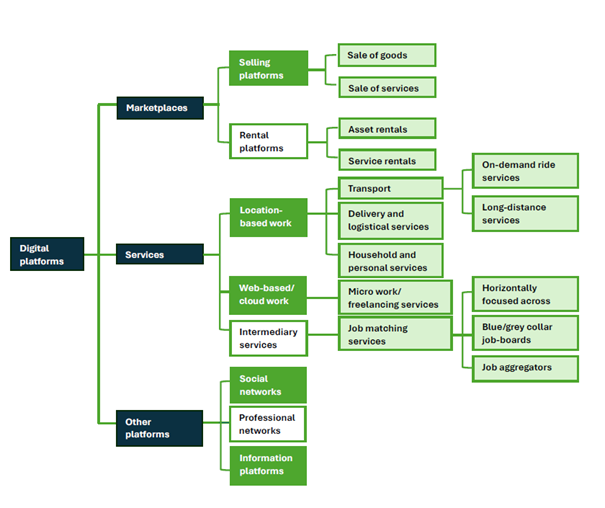
Source: Sabina Dewan and Kaushiki Sanyal (eds), Empowerment or Exploitation: Global Perspectives on Women’s Work in the Platform Economy (New Delhi: JustJobs Network, 2023).
Table A1. Digital Platform Economy Index
|
Digital Platform Economy |
Sub-indices |
Pillars |
Variables (entrepreneurship/digital) |
|
Digital Technology Infrastructure |
Digital access |
Digital access institutions |
|
|
Digital access institutions |
|||
|
Digital freedom |
Digital freedom institutions |
||
|
Digital freedom |
|||
|
Digital protection |
Digital protection institutions |
||
|
Digital protection |
|||
|
Digital User Citizenship |
Digital literacy |
Digital literacy institutions |
|
|
Digital literacy users |
|||
|
Digital openness |
Digital openness institutions |
||
|
Digital openness |
|||
|
Digital rights |
Digital rights institutions |
||
|
Digital rights |
|||
|
Digital Multi-Sided Platform |
Networking |
Networking agents |
|
|
Networking users |
|||
|
Matchmaking |
Matchmaking agents |
||
|
Matchmaking users |
|||
|
Financial facilitation |
Financial facilitation agents |
||
|
Financial facilitation users |
|||
|
Digital Technology Entrepreneurship |
Digital Adoption |
Digital adoption agents |
|
|
Digital adoption |
|||
|
Technology absorption |
Technology absorption agents |
||
|
Technology absorption |
|||
|
Technology transfer |
Technology transfer agents |
||
|
Technology transfer |
|||
Source: Abraham K. Song et al., The Digital Platform Economy Index 2020 (Geneva: Springer, 2022).
Table A2. Human Development Index country ranking and value, Asia and Pacific, 2023
|
HDI rank |
Country |
HDI Value |
|---|---|---|
|
Very high human development |
|
|
|
7 |
Australia |
0.958 |
|
8 |
Hong Kong, China |
0.955 |
|
13 |
Singapore |
0.946 |
|
17 |
New Zealand |
0.938 |
|
20 |
Korea, Rep. |
0.937 |
|
23 |
Japan |
0.925 |
|
60 |
Brunei Darussalam |
0.837 |
|
67 |
Malaysia |
0.819 |
|
High human development |
|
|
|
76 |
Thailand |
0.798 |
|
78 |
China |
0.797 |
|
84 |
Palau |
0.786 |
|
89 |
Sri Lanka |
0.776 |
|
92 |
Tonga |
0.769 |
|
93 |
Maldives |
0.766 |
|
93 |
Viet Nam |
0.766 |
|
104 |
Mongolia |
0.747 |
|
108 |
Marshall Islands |
0.733 |
|
111 |
Fiji |
0.731 |
|
113 |
Indonesia |
0.728 |
|
117 |
Philippines |
0.720 |
|
122 |
Samoa |
0.708 |
|
Medium human development |
|
|
|
129 |
Tuvalu |
0.689 |
|
130 |
Bangladesh |
0.685 |
|
130 |
India |
0.685 |
|
140 |
Kiribati |
0.644 |
|
142 |
Timor-Leste |
0.634 |
|
145 |
Nepal |
0.622 |
|
146 |
Vanuatu |
0.621 |
|
147 |
Lao People's Democratic Republic |
0.617 |
|
150 |
Myanmar |
0.609 |
|
151 |
Cambodia |
0.606 |
|
156 |
Solomon Islands |
0.584 |
|
160 |
Papua New Guinea |
0.576 |
|
Low human development |
|
|
|
168 |
Pakistan |
0.544 |
|
181 |
Afghanistan |
0.496 |
Source: UNDP, Human Development Index.
Table A3. Old-age dependency ratios in Asia and the Pacific, 2024
|
Japan |
50.7 |
|
Hong Kong, China |
33.9 |
|
Australia |
27.5 |
|
Korea, Rep. |
27.5 |
|
Thailand |
22.0 |
|
China |
21.2 |
|
Sri Lanka |
18.4 |
|
Singapore |
18.3 |
|
Palau |
16.1 |
|
Viet Nam |
13.4 |
|
Tonga |
11.6 |
|
Tuvalu |
11.0 |
|
Malaysia |
11.0 |
|
Indonesia |
10.7 |
|
Myanmar |
10.7 |
|
Samoa |
10.6 |
|
India |
10.5 |
|
Nepal |
10.0 |
|
Bangladesh |
9.9 |
|
Fiji |
9.8 |
|
Cambodia |
9.6 |
|
Brunei Darussalam |
9.5 |
|
Bhutan |
8.9 |
|
Timor-Leste |
8.6 |
|
Philippines |
8.2 |
|
Mongolia |
8.2 |
|
Marshall Islands |
7.6 |
|
Vanuatu |
7.5 |
|
Pakistan |
7.3 |
|
Lao PDR |
7.2 |
|
Kiribati |
6.9 |
|
Solomon Islands |
6.1 |
|
Maldives |
6.1 |
|
Papua New Guinea |
5.5 |
|
Afghanistan |
4.4 |
Note: Defined as population aged 65 and above as a percentage of the working-age population aged 15-64.
Source: World Bank, “World Development Indicators”.
References
Advisory Committee on Platform Workers (Singapore). 2022. Strengthening Protections for Platform Workers.
ASEAN Secretariat. 2023. ASEAN Employment Outlook: The Quest for Decent Work in the Platform Economy: Issues, Opportunities and Ways Forward.
Asian Development Bank. 2020. “ADB Calculations Using Data from Statista”.
———. 2021. Asian Economic Integration Report 2021: Making Digital Platforms Work for Asia and the Pacific.
———. 2023. E-Commerce Evolution in Asia and the Pacific: Opportunities and Challenges.
Baiocco, Sara and Enrique Fernandez. 2022. The Algorithmic Management of Work: A Basic Compass. ILO and European Commission.
Blackman, Valerie Mercer and Christine Ablaza. 2018. The Servicification of Manufacturing in Asia: Redefining the Sources of Labor Productivity. Manila: Asian Development Bank Institute.
Chambers and Partners. 2025. Employment 2025 – Thailand, Trends and Developments.
Chea, Sarah. 2022. “Baemin Riders Operator Agrees to Improve Working Conditions”. Korea Joongang Daily, 22 October 2022.
Choudary, Sangeet Paul. 2018. “The Architecture of Digital Labour Platforms: Policy Recommendations on Platform Design for Worker Well-being”, ILO Future of Work Research Paper No. 3.
Christie, Nicola and Heather Ward. 2019. “The Health and Safety Risks for People Who Drive for Work in the Gig Economy”. In Journal of Transport & Health 13: 115–127.
Department of Statistics (Singapore). 2021. “Singapore’s Services Sector”.
Dewan, Sabina. 2020a. “Harnessing the Potential of ASEAN’s Digital Transformation Through Regional Cooperation”. In The Fourth Industrial Revolution and the Future of Work: Implications for Asian Development Cooperation, edited by Anthea Mulakala, 30–54. Seoul: KDI School of Public Policy and Management and The Asia Foundation.
———. 2020b. Managing Technology’s Implications for Work, Workers, and Employment Relationships in ASEAN Jakarta: ASEAN Secretariat.
Dewan, Sabina, Mathangi Krishnamurthy and Devesh Taneja. 2022. Digitalisation and the Indian Labour Market, Trends, Challenges and Opportunities. Delhi: GIZ.
Dewan, Sabina and Peter Peek. 2007. “Beyond the Employment/Unemployment Dichotomy: Measuring the Quality of Employment in Low-Income Countries”, ILO Policy Integration and Statistics Department Working Paper No. 83.
Dewan, Sabina and Kaushiki Sanyal, eds. 2023. Empowerment or Exploitation: Global Perspectives on Women’s Work in the Platform Economy. New Delhi: JustJobs Network.
European Agency for Safety and Health at Work. 2017. Protecting Workers in the Online Platform Economy: An Overview of Regulatory and Policy Developments in the EU.
European Union Agency for Fundamental Rights. 2022. Bias in Algorithms – Artificial Intelligence and Discrimination.
Government of New Zealand. 2021. “Land Transport Rule: Work Time and Logbooks 2007 (Rule No. 62001/2007)”.
Hadwiger, Felix. 2022. “Realizing the Opportunities of the Platform Economy Through Freedom of Association and Collective Bargaining”, ILO Working Paper No. 80.
International Labour Organization (ILO). 2021. World Employment and Social Outlook 2021: The Role of Digital Labour Platforms in Transforming the World of Work.
———. 2022. Asia–Pacific Employment and Social Outlook 2022: Rethinking Sectoral Strategies for a Human-centred Future of Work.
———. 2023. Women and Men in the Informal Economy: A Statistical Update.
———. 2024a. Asia-Pacific Employment and Social Outlook 2024: Promoting decent work and social justice to manage ageing societies.
———. 2024b. “The Republic of Korea: Extending Social Insurance to Digital Platform Workers”.
———. 2025a. World Employment and Social Outlook, Trends 2025.
———. 2025b. Realizing Decent Work in the Platform Economy. ILC.113/Report V(1).
IT for Change. 2018. “Policies for the Platform Economy: Current Trends and Future Directions”.
Kenney, Martin and John Zysman. 2016. “The Rise of the Platform Economy”, Issues in Science and Technology 32 (3): 61–69.
Kim, Jong-jin. 2021. Digital Platform Work in South Korea. Bangkok: Friedrich Ebert Stiftung.
Ministry of Human Resources and Social Security (China) et al. 2021. Guiding Opinion on Safeguarding the Labour Rights and Interests of Workers in New Forms of Employment.
Ministry of Human Resources and Social Security (China). 2024. Guidelines on the Protection of Rights and Interests of Workers in New Employment Forms of Rest and Labor Remuneration.
Ministry of Human Resources and Social Security (China) and Supreme People's Court. 2023. “Typical Cases of Labour and Personnel Disputes (the third batch)”.
Ministry of Manpower (Singapore). 2023a. “Formation of Platform Workers Work Injury Compensation Implementation Network”.
———. 2023b. “Government Accepts Recommendations by Tripartite Workgroup to Enhance Representation for Platform Workers”.
Ministry of Manpower (Singapore), NTUC and SNEF. 2023. Enhancing Representation for Platform Workers: Tripartite Workgroup on Representation for Platform Workers Report.
NITI Aayog. 2022. India’s Booming Gig and Platform Economy: Perspectives and Recommendations on the Future of Work.
Organisation for Economic Co-operation and Development (OECD), ILO and Eurostat. 2023. Handbook on Measuring Digital Platform Employment and Work.
Sen, Kunal. 2016. The Determinants of Structural Transformation in Asia: A Review of the Literature. Manila: Asian Development Bank).
Song, Abraham K., László Szerb, Eva Somogyine Komlosi, Zoltan J. Acs and Esteban Lafuente. 2022. The Digital Platform Economy Index 2020. Geneva: Springer.
State Information Center (China). Various years. China Sharing Economy Development Report.
Taylor, Kelvin, Pieter Van Dijk, Sharon Newnam and Dianne Sheppard. 2023. “Physical and Psychological Hazards in the Gig Economy System: A Systematic Review”. In Safety Science 166 (106234).
Tokyo Labor Relations Commission. 2024. “Worker Status of Platform Workers Under the Labor Union Act”. In Japan Labor Issues 8 (46).
United Nations, 2019. Digital Economy Report 2019: Value Creation and Capture: Implications for Developing Countries.
United Nations Development Programme. 2024. Human Development Index.
World Bank. 2023a. “Services for Development: East Asia and Pacific Economic Update.”
———. 2023b. Working Without Borders: The Promise and Peril of Online Gig Work.
———. 2024. “World Development Indicators”.
World Statistics Congress. 2023. “Initiatives to Measure the Size of Gig Workers and Online-related Occupations in the Philippines Using the Labor Force Survey”.
Zulkifly, Syah. 2024. “Work-related Safety and Health Issues Among Food and Parcel Delivery Riders”. In Business, Management and Economics.