


Financing occupational safety and health prevention:
A comparative analysis of six case studies
Abstract
At its 349th Session, the ILO Governing Body endorsed the Global Strategy on Occupational Safety and Health (OSH), recognizing sustainable financing as a key condition for the development of effective, resilient and sustainable national OSH systems. This working paper examines and compares six approaches to financing OSH prevention in Germany, Japan, Quebec (Canada), Peru, the Philippines and Tunisia. Drawing on these case studies, it analyses the institutional arrangements, financing modalities and incentive structures supporting prevention activities. The analysis indicates that institutionally mature systems rely predominantly on employer-financed models, combining enterprise-level investment with contributory social insurance mechanisms that integrate prevention and compensation functions. By contrast, systems undergoing institutional development tend to depend more heavily on public financing and complementary external support, often within fragmented governance frameworks.
Across the case studies, the paper identifies a number of common challenges, including limited earmarking of resources for prevention, constraints linked to labour informality, and weak monitoring and tracking of OSH-related expenditure. It also highlights policy options to strengthen the sustainability and effectiveness of prevention financing, including dedicated financing arrangements, incentive-based contribution systems and improved mechanisms for monitoring prevention investments.
Executive Summary
At its 349th Session, the Governing Body of the International Labour Organization (ILO) endorsed the Global Strategy on Occupational Safety and Health and Plan of Action (ILO, 2023), recognizing sustainable financing as a key prerequisite for effective, resilient and sustainable national occupational safety and health (OSH) systems. This study contributes to that objective by examining six approaches to financing OSH prevention in Germany, Japan, Quebec (Canada), Peru, the Philippines and Tunisia. It analyses and compares these systems to identify practical mechanisms for financing OSH prevention and to draw lessons that may support Member States in developing sustainable OSH financing arrangements.
The modalities for financing OSH prevention across the six case studies are shaped by the degree of institutional maturity, level of economic formalization, and the historical evolution of social protection systems. In Germany, Japan and Quebec, OSH prevention financing is supported by well-established institutional frameworks and dedicated funding arrangements. In these systems, employer expenditure on OSH prevention constitutes a central component of financing, although its share in total OSH expenditure varies considerably across countries. In several cases employers’ own spending is complemented by autonomous social security funds. These include Quebec’s CNESST, which is funded fully through employer contributions and finances prevention, inspection and compensation; Japan’s Workers’ Accident Compensation Insurance (WACI) fund, which allocates approximately 2.15 per cent of total premium income to prevention activities (FY2024 budget), including training and workplace improvements; and Germany’s statutory accident insurance (UV), which contributes about 3.1 per cent of total OSH prevention financing. Government spending other than social security also plays an important, though more limited, role in OSH prevention financing.
In contrast, systems in transition tend to rely more heavily on public financing. However, this funding is often insufficient, reflecting broader fiscal limitations, particularly in economies with high informality, where narrow tax bases may reduce revenue available for OSH prevention. In addition, expenditure on OSH prevention is frequently embedded within broader budgets – such as those of labour and health ministries – without specific budget allocations. As a result, OSH prevention programmes are vulnerable to fiscal cuts and delays. Funding is also often divided across multiple government bodies. Although this can allow systems to draw on a range of capacities and resources, fragmentation can also foster duplication of efforts and reduce visibility, coordination and prioritization of OSH prevention.
Other financing arrangements include international cooperation and private insurance mechanisms. International cooperation has supported OSH financing in Peru, the Philippines and Tunisia through funding for pilot programmes, institutional capacity building and technical cooperation, often serving as a catalyst for institutional development and system design. Private insurance also serves as a complementary financing mechanism in some jurisdictions, with insurers offering small-scale prevention initiatives to clients, funded through employer premiums. However, these are voluntary schemes and remain limited in scope.
The comparison between the six systems for financing OSH prevention can be summarized in ten key findings:
-
Regulatory frameworks and policy instruments, in the absence of clearly defined and adequately resourced financing arrangements, are insufficient to ensure the effectiveness, continuity and long-term sustainability of OSH prevention systems.
-
Many national OSH systems remain in transition, characterized by limited institutional maturity and the absence of stable and predictable financing structures.
-
Dependence on non-earmarked public budgets exposes OSH financing to political cycles, fiscal volatility and recurrent budgetary constraints, while high levels of labour informality may undermine the sustainability of employer-contribution-based financing models.
-
Dedicated financing mechanisms strengthen the stability, coverage and strategic orientation of prevention efforts, whereas fragmented and ad hoc budgetary allocations tend to weaken policy coherence, continuity and overall impact.
-
Autonomous OSH institutions can facilitate the pooling of resources from multiple funding streams and support more predictable, efficient and strategically targeted allocation of OSH financing.
-
Robust monitoring and evaluation frameworks for OSH expenditure are essential to demonstrate both the economic returns and the wider social benefits associated with investment in prevention.
-
Employers’ organizations can play an important strategic role in supporting OSH financing and implementation; however, the extent and effectiveness of their engagement depend largely on the prevailing institutional and governance framework.
-
Financial incentives constitute a potentially important instrument for sustainable OSH financing, yet they remain underutilized, particularly in systems undergoing institutional transition, despite their capacity to promote compliance, prevention and innovation.
-
Revenues derived from penalties for labour infractions may provide a supplementary source of financing, alongside other earmarked fiscal instruments where applicable, provided that appropriate legal and governance mechanisms ensure transparency, accountability and reinvestment in prevention activities.
-
External financial assistance, including regional and international cooperation, can play a complementary and catalytic role, but it cannot substitute for sustained domestic investment and nationally anchored financing strategies for OSH prevention.
Overall, the evidence from the case studies suggests that a modern and comprehensive legal framework for OSH constitutes a necessary precondition for effective prevention systems, but is insufficient to ensure implementation in the absence of clear, stable and adequately resourced financing arrangements. The transition towards more sustainable financing models and stronger institutional frameworks is typically gradual and often constrained by structural economic and institutional factors. These challenges are particularly pronounced in contexts characterized by high levels of informality, low productivity and limited enforcement capacity, all of which restrict the ability to mobilize employer-based contributions. Nevertheless, irrespective of the financing model adopted, the availability of dedicated and earmarked resources for OSH prevention emerges as a critical determinant of sustained institutional development and policy effectiveness.
While the study combines qualitative and quantitative evidence, limitations in the availability and consistency of financial reporting across the case studies constrain the precision and comparability of expenditure estimates. Furthermore, the analysis focuses primarily on financing arrangements and does not assess the broader effectiveness of OSH systems in terms of coverage, outcomes or interactions with wider public health financing mechanisms.
The study identifies a number of cross-cutting opportunities to strengthen OSH prevention financing across different national contexts. These include reinforcing monitoring and evaluation systems to better demonstrate the economic and social returns of prevention investments; expanding the use of targeted financial incentives to encourage employer investment in OSH; and exploring earmarked funding mechanisms, including the allocation of a share of labour penalties to prevention activities under appropriate governance safeguards. In addition, the study highlights the potential for a more systematic involvement of employers’ organizations in the delivery and financing of prevention services, as well as the benefits of greater institutional autonomy to support more stable and longer-term OSH financing arrangements.
Introduction
Occupational Safety and Health (OSH) encompasses a broad set of functions aimed at preventing work-related injuries, diseases and fatalities, as well as promoting safe and healthy working environments. While core public OSH functions, including the development and enforcement of regulatory frameworks are, in most cases, financed through national budgets,1 there is no common approach to financing broader prevention activities. This reflects a broader pattern in health financing, where prevention often lacks clearly defined and stable funding arrangements. Strengthening financing for prevention therefore emerges as a priority area for policy attention. This focus aligns with the ILO Global Strategy on Occupational Safety and Health and Plan of Action (ILO 2023), which highlights sustainable financing as a precondition for strengthening national OSH systems.
In support of this objective, the ILO conducted analyses in Germany, Japan, Quebec (Canada), Peru, the Philippines and Tunisia. The six case studies were selected based on consultations with ILO specialists across regions, who were invited to propose countries with relevant experience and diversity in OSH prevention financing arrangements. Each analysis was prepared by national experts based on available documentation and, in some cases, additional inputs from national and regional institutions.
This comparative report explores how the six case studies finance prevention activities within their OSH systems, focusing on resources allocated to preventive functions such as advisory services, training, occupational health services, research and related prevention support activities. It also examines the roles of varied stakeholders in OSH financing and identifies systemic constraints and strengths across the jurisdictions studied. Based on this analysis, the report provides insights and identifies opportunities which can support ILO constituents in improving financing for OSH prevention. The analysis is primarily qualitative, drawing on national case studies and secondary data, and does not attempt to produce standardized cost estimates.
Overview of financing mechanisms and actors in OSH prevention financing
1.1 OSH financing mechanisms
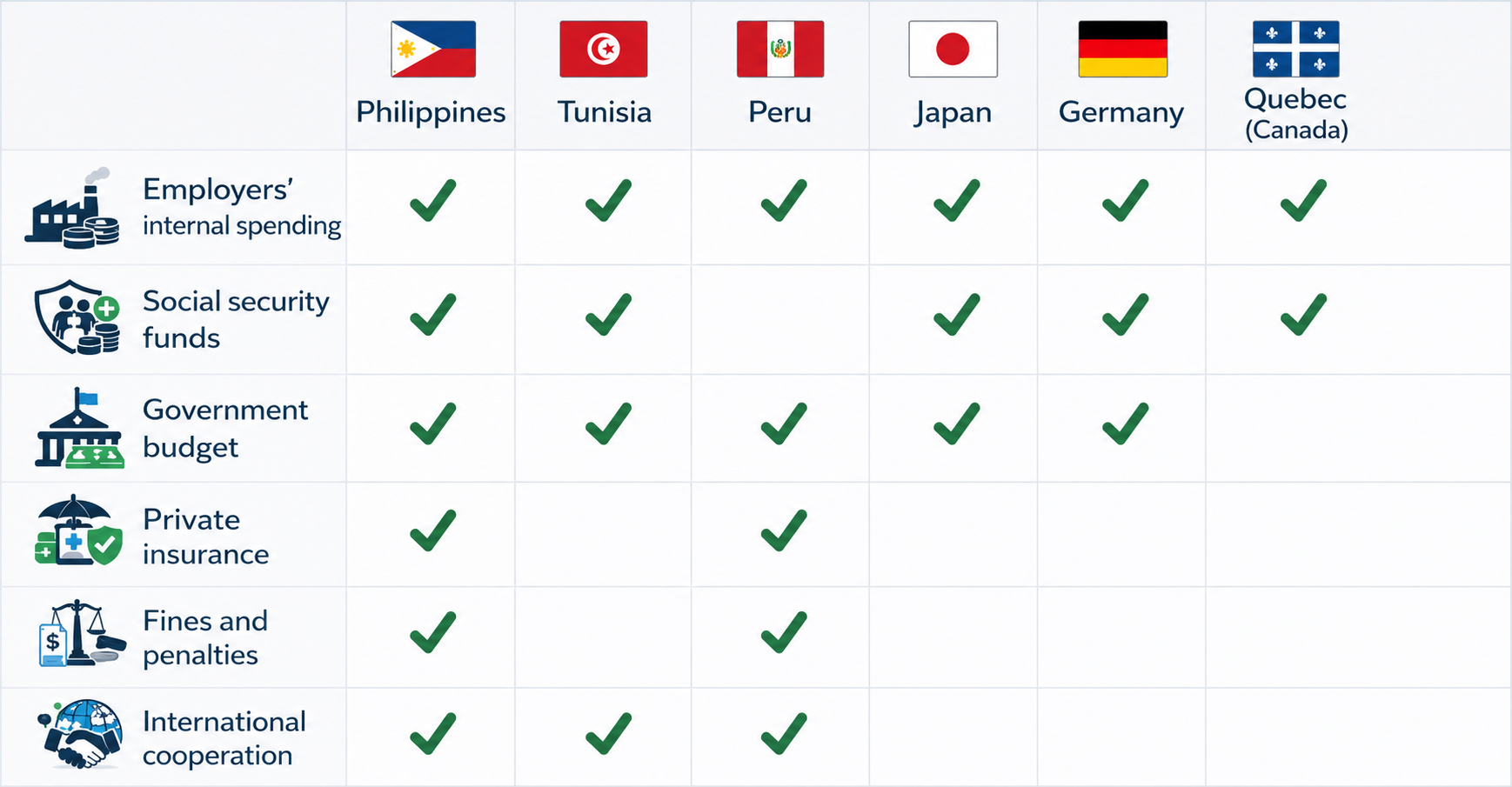
OSH systems are financed through a diverse range of mechanisms that reflect national legal frameworks, institutional capacities and levels of economic development and informality. While each case study presents a unique configuration of funding arrangements, six common sources of financing were identified across the case studies: employers’ internal spending, government budgets, social security funds, revenues from fines for labour infractions, private insurance and international cooperation (Figure 1).
Figure 1. Typology of financing mechanisms across the six case studies
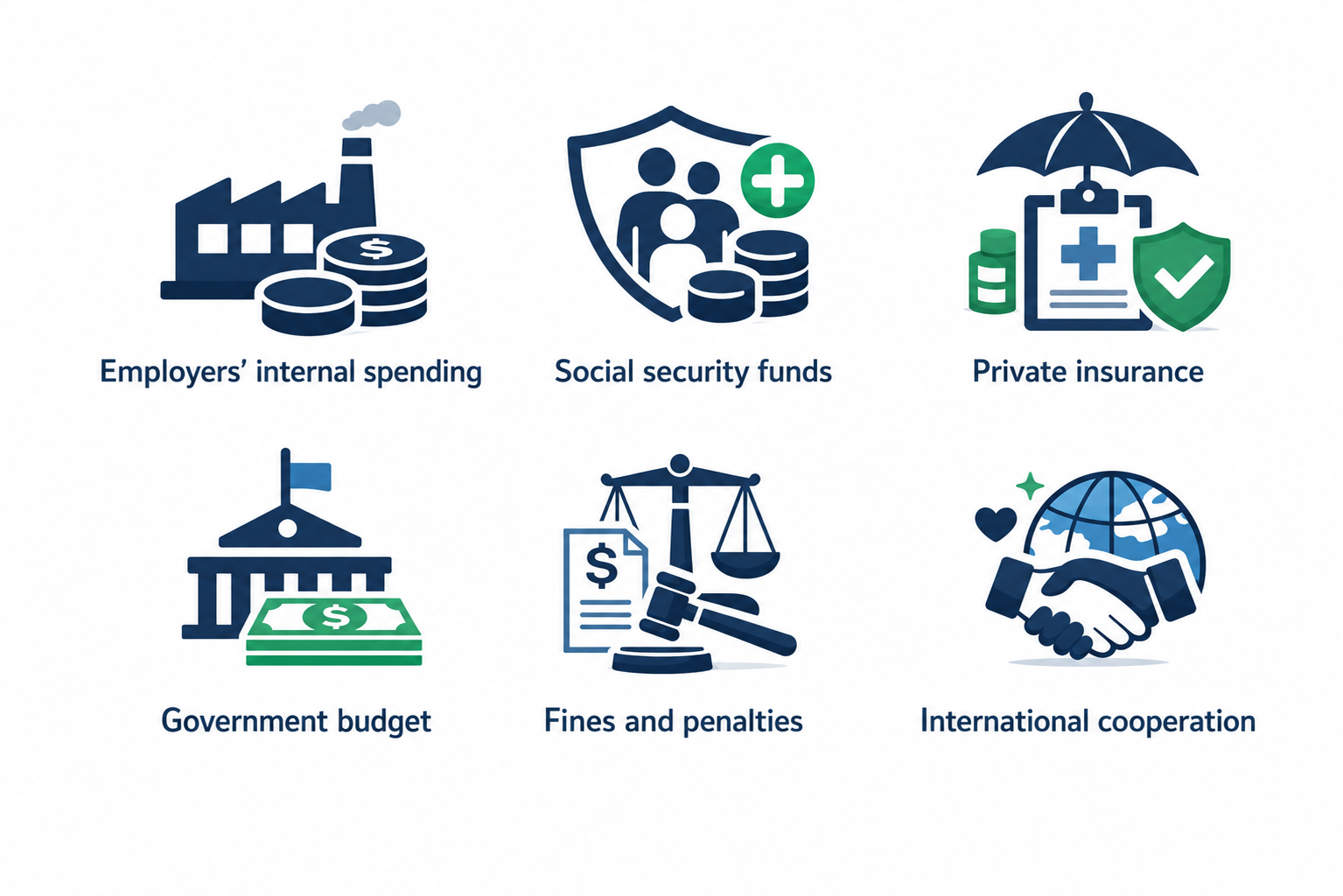 Across all six case studies examined, employers play a central role in financing prevention activities. Their expenditures typically cover firm-level investments including personal protective equipment (PPE), risk assessments, worker training, occupational health services, specialized personnel, internal health and safety management systems and measures to meet sector-specific requirements. These expenditures, often mandated by legislation, function as the first layer of protection against workplace hazards. However, the scale of employer investment varies substantially by enterprise size and sector, with small and medium-sized enterprises (SMEs) often facing tighter financial constraints.
Government budgets represent another critical source of financing, particularly in contexts where employer contribution systems are underdeveloped because informality is widespread. Public expenditure typically covers core OSH functions such as labour inspection and regulatory development. In addition, governments frequently allocate resources to prevention activities, including public campaigns and training and, in some cases, direct subsidies or support mechanisms for employers. In several countries, OSH budgets are embedded within broader programmes, such as those of labour and health ministries.
Social security funds constitute a core pillar of OSH financing in institutionally mature systems. They are primarily financed through mandatory employer contributions, supplemented in some cases by worker payments, and are predominantly directed towards compensation and rehabilitation of injured workers. In some systems, such as Japan and Germany, a defined portion of these contributions is earmarked for prevention activities, creating a self-sustaining financing loop that links compensation and prevention.
Sanctions for labour infractions can represent another source of financing for OSH prevention. Revenues generated from fines can be channelled into preventive activities, including training and public awareness campaigns. Where a statutory earmarking mechanism ensures that a defined share of collected penalties is reinvested into OSH prevention, punitive measures can be transformed into a more sustainable funding stream for prevention. However, this mechanism is effective only where clear legal provisions ensure allocation, transparency and monitoring of such funds.
Private insurance companies also contribute to the financing of prevention, particularly in systems where employers are mandated or choose voluntarily to purchase coverage for occupational accidents and diseases or life or disability insurance. Part of the premium revenues is often reinvested into prevention activities for insured firms, including information campaigns, educational materials and training workshops on OSH prevention. These initiatives reflect both employers’ approaches and insurers’ incentives to lower future claims costs by mitigating risk ex ante. However, such efforts remain voluntary and are rarely integrated into broader national OSH financing or strategy frameworks.
Finally, international cooperation constitutes a supplementary source of OSH prevention financing, particularly in countries with systems in transition. External actors, such as bilateral or multilateral donors, development banks and international organizations, provide resources for pilot projects, training and system modernization, typically through grants or loans. In several countries, international cooperation has played a catalytic role by supporting the design of institutional mechanisms or pilot financial instruments that may later be institutionalized domestically, demonstrating added value beyond temporary support. Such support complements, rather than replaces, sustained national investment in OSH prevention.
1.2 Institutional roles and responsibilities
Multiple public and private actors play key roles in national OSH prevention financing systems:
Government ministries and agencies have the primary duty of OSH governance in all six case studies examined. Typically, the ministry of labour or an equivalent government body is charged with drafting and updating OSH regulations. Enforcement is usually carried out by specialized inspectorates that provide technical advice, conduct workplace inspections, issue penalties for non-compliance and collect associated fines. In Germany (Berufsgenossenschaften and Unfallkassen) and Quebec, social security institutions are also responsible for inspection. In some jurisdictions, a separate public health agency may complement this role by developing guidelines on workplace hazards and overseeing environmental monitoring. Beyond regulation and enforcement, other government institutions with OSH-related mandates also act as direct financiers and implementers of prevention activities, positioning the state as both a rule-setter and an active participant in OSH provision.
Social security institutions, including workers’ compensation, health insurance and pension funds, play a key role, particularly in institutionally mature systems. Financed through mandatory employer contributions and, in some cases, supplementary employee contributions, these institutions administer compensation, coordinate medical rehabilitation, deliver health and pension benefits and frequently allocate resources to prevention, including education campaigns. In such systems, social security entities often maintain dedicated budget lines for preventive research, training and technical assistance, embedding prevention within long-term financial planning. By contrast, in systems in transition, prevention spending is typically less institutionalized and more project-based, reflecting fiscal constraints and narrower contribution bases. These differences reflect both fiscal capacity and the degree of integration between compensation and prevention functions.
Employers and workers occupy a central place on the frontline of OSH prevention but also have a consultative role at the regional and national level. In the six case studies, national legislation places legal obligations on employers to protect workers’ safety and health. Employers are responsible for conducting risk assessments, providing training and supplying personal protective equipment as necessary. Trade unions, employer federations and other workplace bodies function as intermediaries in this process, transmitting worker preferences and negotiating collective agreements that incorporate safety provisions. Their engagement is reinforced through tripartite mechanisms that provide a forum for consultation and policy input.
Representatives of employers’ and workers’ organizations have a role in national, regional and sectoral decision-making on OSH policy and financing through tripartite councils. Although they vary in structure, these councils typically serve as consultative platforms for drafting regulations, monitoring implementation and, in some cases, advising on the allocation of OSH resources.
In certain systems, employers’ and workers’ representatives participate directly in governance structures that influence or decide on the allocation of resources for OSH financing. In Germany, for instance, accident insurance institutions (Berufsgenossenschaften and Unfallkassen) operate under a self-governance model in which employers and workers jointly sit on decision-making boards that set contribution rates and determine the allocation of funds between prevention and compensation. In Tunisia, the Caisse Nationale d’Assurance Maladie (CNAM) is overseen by a tripartite board that deliberates on the deployment of social security contributions for OSH. In the Philippines, the Employees’ Compensation Commission, which is the policy-making body for employees’ compensation, includes employers’ and workers’ representatives on its board and provides policy issuances on compensation as well as OSH matters. This tripartite governance model can reinforce accountability and transparency in financial management. In other contexts, however, the role of employers’ and workers’ representatives remains primarily advisory.
Private insurers play a role in prevention financing, particularly in countries where private occupational risk insurance is compulsory. Insurance companies underwrite workplace accident coverage and may provide clients with risk mitigation services, including on-site audits or safety training programmes. However, across the six case studies examined, their contribution remains peripheral, reflecting weak regulatory incentives or a lack of robust reporting mechanisms.
International organisations, multilateral development banks and bilateral donors play a key but complementary financing role in certain countries. These institutions offer technical assistance and grants for pilot projects and training support, especially in systems in transition. These external actors help introduce best practices and new technologies, typically complementing rather than substituting domestic responsibilities.
The relative weight and interaction of these financing mechanisms vary widely across countries, as explored in the following national case studies.
National models for OSH prevention financing
2.1 Germany
Germany represents an institutionally mature OSH financing model operating within a highly formalized labour market in which prevention is primarily financed through employer expenditures and statutory accident insurance contributions. The combination of employer-based financing and autonomous institutions provides a stable and predictable foundation for long-term prevention investment.
Institutional and legal framework
The legal basis of Germany’s OSH system is established by the Labour Protection Act (ArbSchG, §§ 3–14)2 and the Labour Safety Act (ASiG)3, which require employers to conduct risk assessments, implement preventive measures and continuously improve workplace safety, and also regulate the deployment of occupational physicians and safety professionals.
At the federal level, two ministries share responsibilities: the Federal Ministry of Labour and Social Affairs (BMAS), which steers labour policy and oversees OSH standards, and the Federal Ministry of Health (BMG), which integrates occupational health into broader public health strategies. Under BMAS, the Federal Institute for Occupational Safety and Health (BAuA) provides research, technical guidance and support for workplace prevention. Under BMG, the Federal Institute for Public Health (BIÖG) contributes by embedding occupational health in national prevention initiatives.
Strategic alignment is ensured through two key coordination mechanisms: the Joint German Occupational Safety and Health Strategy (GDA), coordinated through the National Conference on Occupational Safety and Health (NAK), and the National Prevention Conference (NPK). The GDA brings together the federal government, the Länder (Germany’s 16 federal states) and the statutory accident insurance institutions to define common goals and programmes. The NPK, established by the 2015 Prevention Act, unites statutory health, accident, pension and social care insurance institutions. It is responsible for adopting and updating the national safety and health strategy, developing federal framework recommendations, and publishing a periodic prevention report. Together, these bodies provide complementary coordination mechanisms. While GDA focuses on OSH-specific coordination and implementation, NPK ensures alignment with broader national prevention and health promotion strategies.
Financing sources for OSH prevention in Germany
Figure
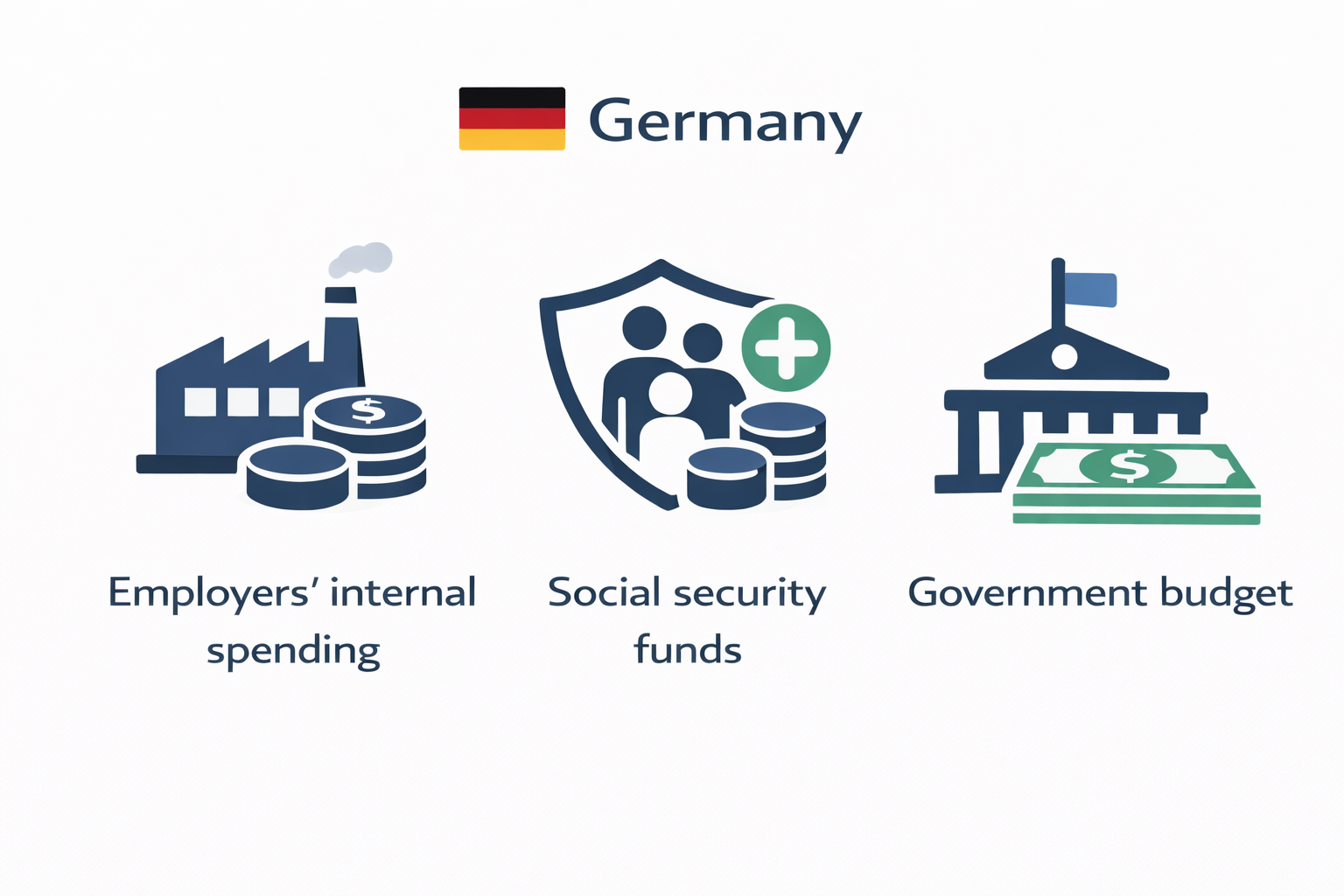
OSH prevention in Germany is financed through three main channels: employer-level prevention expenditures, social insurance contributions and public budgets (Figure 2).
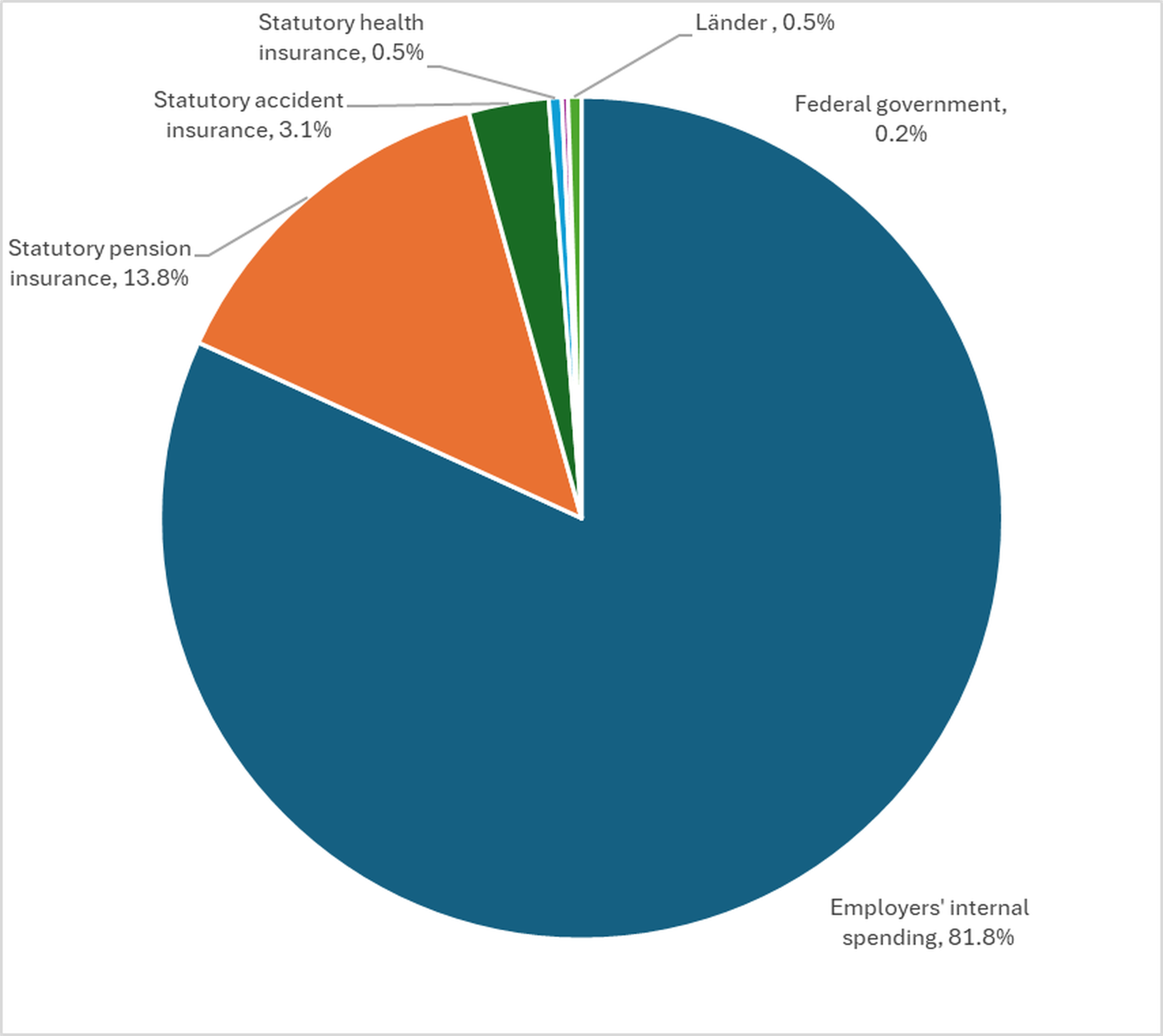
In 2023, an estimated total of €53,955 million was invested in OSH prevention across the country (Figure 3). This total reflects the sum of the following components:
-
Employers contributed the largest share of resources, investing an estimated €44,160 million4 in internal OSH prevention measures, representing approximately 82 per cent of total OSH investment. These expenditures encompass risk assessments, preventive and control measures including PPE, training programmes and workplace management systems. The investment represents roughly 2.4 per cent of the total wage bill, in line with levels observed in other institutionally mature systems such as Canada (IWH 2022).
-
The statutory pension insurance fund (RV) allocated €7,464 million to OSH-related activities, accounting for 13.8 per cent of total OSH funding. These resources support rehabilitation services and preventive outreach to employees at risk of losing their capacity to work (BMAS 2024a). The fund is largely financed through equal employer and worker contributions, with public funding comprising around 22 per cent of its revenues in 2023 (BMAS 2023; Deutsche Rentenversicherung 2024).
-
A total of €1,657 million was allocated to OSH prevention programmes by Germany’s statutory accident insurance fund (UV), accounting for 3.1 per cent of total OSH prevention funding in the country. This includes funding for technical advice to employers, sectoral prevention campaigns, financial and non-financial incentives, training, research and the development of rules and regulations. The fund is financed entirely by employer contributions and its risk-based premium system creates a direct financial incentive for prevention, as discussed further below. 5
-
The statutory health insurance fund (GKV) invested €269 million in workplace health promotion (Betriebliche Gesundheitsförderung, BGF) in 2023, representing 0.5 per cent of total national OSH prevention funding. These resources supported health promotion initiatives in nearly 30,000 workplaces, reaching over two million employees (GKV-Spitzenverband 2024, 142). While the amounts are relatively modest, these investments still play an important role in addressing work-related health risks, particularly stress and mental health.
-
Public budgets contributed a smaller but essential portion of the total. At the federal level, the government invested an estimated €126 million6 primarily through the budgets of BMAS and BMG and their affiliated agencies, notably BAuA and BIÖG, in regulatory functions, core staff, research programmes and advisory services, including initiatives such as the New Quality of Work programme (INQA).7 This represents 0.2 per cent of total OSH prevention funding in the country.
-
The Länder (Germany’s 16 federal states) also contribute to OSH funding, primarily for supervisory and inspection activities. Collective investment by the states is estimated at approximately €279 million, representing 0.5 per cent of total OSH prevention funding in the country.8 While some targeted regional prevention projects are funded, these account for a small share of overall state OSH expenditure and could not be separately quantified.
Figure
Incentives for employer investment in prevention
Germany provides robust financial and institutional incentives to encourage employer investment in prevention. Statutory accident insurance (UV) is financed exclusively by employers, with contribution rates differentiated according to the sector and the individual employer’s accident record. This creates a direct financial incentive for prevention, since firms with lower accident rates and effective preventive measures benefit from reduced contributions.
Sectoral accident insurance institutions (Berufsgenossenschaften (BG) and Unfallkassen) provide extensive support services funded by employer contributions, including free technical advice, training modules and assistance in implementing OSH management systems, lowering the cost of prevention for employers. Several BGs also offer awards and recognition for outstanding preventive practices, providing reputational as well as financial incentives. These incentives create a culture of prevention that extends beyond compliance.
Main characteristics of the system
-
OSH prevention is supported by multiple funding sources, including statutory pension insurance (€7,464 million) and statutory health insurance (€269 million) for preventive and rehabilitative services, as well as federal budgets (€126 million) for targeted activities. Employers account for the majority of OSH prevention funding (82 per cent), covering expenditures on risk assessments, protective equipment, training and workplace management systems.
-
Despite the multiplicity of funding sources, the system benefits from strong governance. The GDA, coordinated by the NAK, aligns the federal government, the Länder and statutory accident insurance institutions on common objectives, work programmes and supervisory practices. The NPK, established under the 2015 Prevention Act, brings statutory health, accident, pension and social care insurance institutions together under the leadership of BMAS and BMG to define national prevention strategies and publish prevention reports.
-
In addition, over 200 regional and sectoral networks are active, creating a dense prevention framework supporting both employees and employers.
-
Germany’s statutory accident insurance organizations (Berufsgenossenschaften and Unfallkassen) operate as autonomous bodies governed by employers’ and workers’ representatives. Their unified mandate covering both compensation and prevention creates a vertically integrated financing model in which expenditures can be strategically allocated to maximize long-term value. This allows them to prioritize prevention as a core element of their mandate, target resources according to industry-specific needs and reinvest in prevention measures that reduce long-term costs and improve workplace safety.
-
Employers’ and workers’ organizations play an active role in OSH governance through tripartite structures, participating in decision-making bodies within the statutory accident insurance system and in national coordination mechanisms.
2.2 Japan
Like Germany, Japan reflects an institutionally mature OSH financing system within a highly formalized labour market. It combines public budget funding for regulatory functions with employer-financed social insurance for prevention and compensation. The Workers’ Accident Compensation Insurance system plays a central role in sustaining prevention activities through stable employer contributions.
Institutional and legal framework
Institutional responsibility for national OSH measures in Japan lies with the Ministry of Health, Labour and Welfare (MHLW). The ministry formulates policy, drafts legislation, oversees inspections, administers OSH programmes, coordinates performance evaluation processes and directly operates workers’ compensation insurance. Deliberations on the enactment and revision of major OSH legislation and programme evaluations are conducted through a tripartite mechanism involving government, workers and employers.
This comprehensive mandate reflects the constitutional framework governing safety and health at work. The system operates under a constitutional mandate, namely Article 27 of the Constitution of Japan9, which recognizes both the right to work and requires that working conditions be defined by law. Based on this provision, the Labour Standards Act (1947)10 and the Occupational Safety and Health Act (1972)11 serve as the primary legal instruments for OSH, supported by more than twenty ministerial ordinances.
OSH activities are carried out by civil servants under the MHLW, including labour inspectors (3,112 in 2023) and technical OSH officials operating across 47 local labour bureaus and 321 labour standards inspection offices (MHLW 2023a). These officials supervise compliance, provide technical guidance and issue administrative enforcement orders where necessary. The OSH Department within the MHLW also oversees the development of five-year national OSH programmes. The most recent programme covers the period 2023–2027 and informs budget allocations, planning and strategic priorities.12
In addition to public authorities, the Japanese system is supported by independent research and service organizations that operate autonomously but under the supervision of the MHLW. These include the Japan National Institute of Occupational Safety and Health (JNIOSH), which provides scientific research on OSH; the Japan Organization of Occupational Health and Safety (JOHAS), which delivers nationwide occupational health services through Rosai hospitals;13 and the University of Occupational and Environmental Health, Japan (UOEH), which promotes occupational health activities, occupational hygiene, OSH management and training. Voluntary OSH activities are coordinated through employer-based cooperative bodies such as the Japan Industrial Safety and Health Association (JISHA) and four industry-specific prevention associations.
Financing sources for OSH prevention in Japan
Figure
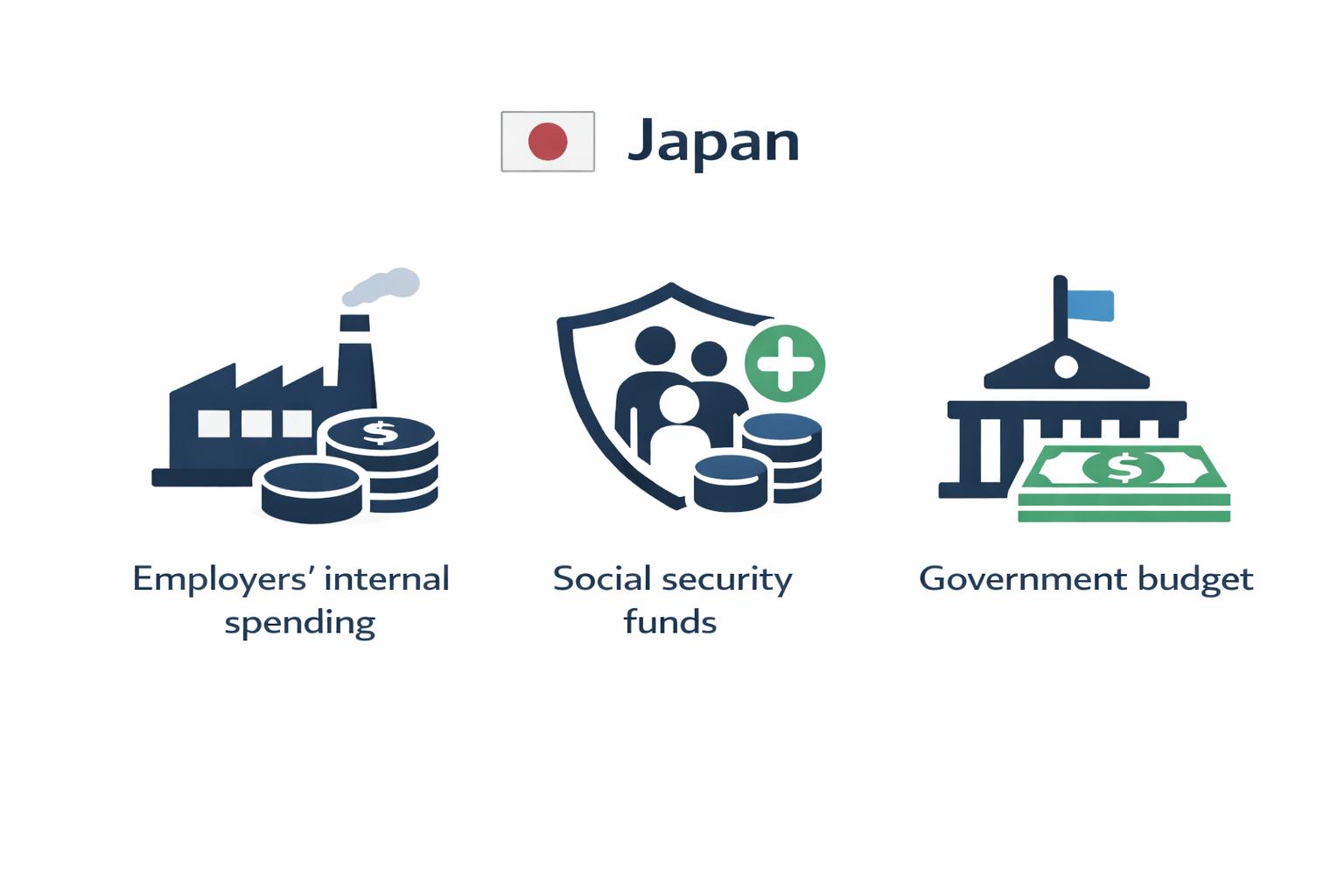 While employers in Japan incur direct costs for implementing OSH measures at enterprise level, such expenditures are not systematically captured in national financing data. Accordingly, although employers incur substantial prevention costs within enterprises, nationally reported OSH financing is primarily reflected through public budgetary funding and employer-financed social insurance (Figure 4).
The national budget (General Account) finances the administration of OSH policies, including legislative drafting, labour inspection and technical enforcement. It also supports competitive OSH research grants through the MHLW Science Research Grant programme. Funded through general tax revenues, including income, corporate and consumption taxes, these allocations ensure fairness, neutrality and legal compliance across industries. Because enforcement may involve administrative penalties or judicial procedures, it is considered inappropriate for these functions to be financed by groups with vested interests such as employers.
For fiscal year 2024, estimated personnel and administrative costs for civil servants engaged in OSH activities at central and regional levels amounted to approximately 11.7 billion Japanese yen (approximately US$78 million).14 An additional 122 million yen (approximately US$0.8 million) was allocated through the Science Research Grant programme for competitive research projects addressing issues such as fall prevention, occupational stress among the self-employed and chemical exposure risk management (MHLW n.d.).
In addition to public funding, Japan operates a dedicated social security fund, the Workers’ Accident Compensation Insurance (WACI) Special Account, financed through mandatory employer insurance premiums across all sectors. WACI is legally mandated by the Industrial Accident Compensation Insurance Act (1947), which establishes both compensation obligations and the use of part of the fund’s premium income for preventive activities. Employer contributions to WACI are calculated on the basis of total wages and assessed risk rates. For example, metal mining carries the highest rate (88 yen per 1,000 yen of wages), while finance and communications sectors carry the lowest (2.5 yen per 1,000 yen of wages). The average contribution across all industries is 4.5 yen per 1,000 yen of wages, combined with a bonus–malus mechanism reflecting accident rates at individual workplaces (MHLW 2024a).
While WACI contributions primarily fund compensation for work-related injuries and illnesses, a portion is earmarked for prevention and reintegration programmes. In 2024, approximately 2.15 per cent of total WACI premium income (24.6 billion yen, or roughly US$164 million) was allocated to 23 OSH prevention programmes.15 These programmes cover subsidies to employers’ organisations such as JISHA, occupational health services provided by JOHAS and UOEH, campaigns to reduce deaths related to overwork, mental health support portals, construction safety training and initiatives supporting the integration of medical treatment and work. These programmes are implemented either directly by MHLW, outsourced through competitive bidding to private or academic institutions, or delivered by OSH service organisations in line with national policy. Programme design, budgeting and performance evaluation are reviewed through a tripartite process involving government, employers and workers, ensuring accountability and alignment with national OSH priorities (MHLW 2024c; 2024d).
Main characteristics
-
Clear legal and institutional foundations, with constitutional and legislative provisions defining financial responsibilities between the General Account and the WACI Special Account.
-
Labour inspection and enforcement are publicly funded to ensure impartiality, while most prevention programmes are financed by employers, who benefit from reduced workplace risks.
-
Stable and sustained financing for prevention activities, funded through employer contributions to the mandatory public workers’ compensation insurance system, including established mechanisms for contribution assessment, collection and disbursement.
-
Well-established institutions (MHLW, JNIOSH, JOHAS, UOEH and JISHA) with clearly defined mandates for research, service delivery and oversight.
-
Five-year national OSH programmes guide strategic planning and are linked to budget requests, ensuring alignment of resources with policy priorities.
-
Tripartite budget review and performance evaluation system with output and outcome indicators, ensuring accountability and transparency.
2.3 Quebec, Canada
In contrast to Germany and Japan, Quebec operates a centralized and fully employer-financed OSH system within a highly formalized and regulated labour market. Its integrated financing model consolidates prevention, inspection and compensation within a single autonomous institution, supporting financial stability and multi-year planning.
Institutional and legal framework
In Quebec, OSH governance is centralized under a single public authority: the Commission des normes, de l’équité, de la santé et de la sécurité du travail (CNESST).16 The CNESST operates within a dual legislative framework: the Act respecting industrial accidents and occupational diseases (AIAOD)17, which governs compensation and rehabilitation, and the Occupational Health and Safety Act (OHSA)18, which establishes the legal framework for hazard elimination, risk prevention and workplace safety.
Within this mandate, the CNESST is responsible for compensating and rehabilitating injured workers, formulating and implementing prevention policies, inspecting workplaces, supporting health and safety committees, coordinating and funding research, maintaining a toxicological inventory and providing technical and financial assistance to joint sectoral associations (bipartite bodies of employers and workers that promote prevention within specific industries). It also promotes OSH awareness, designs training programmes and collaborates with the Ministry of Education and the Ministry of Health to integrate OSH into education and occupational health services.
Financing sources for OSH prevention in Quebec
Figure
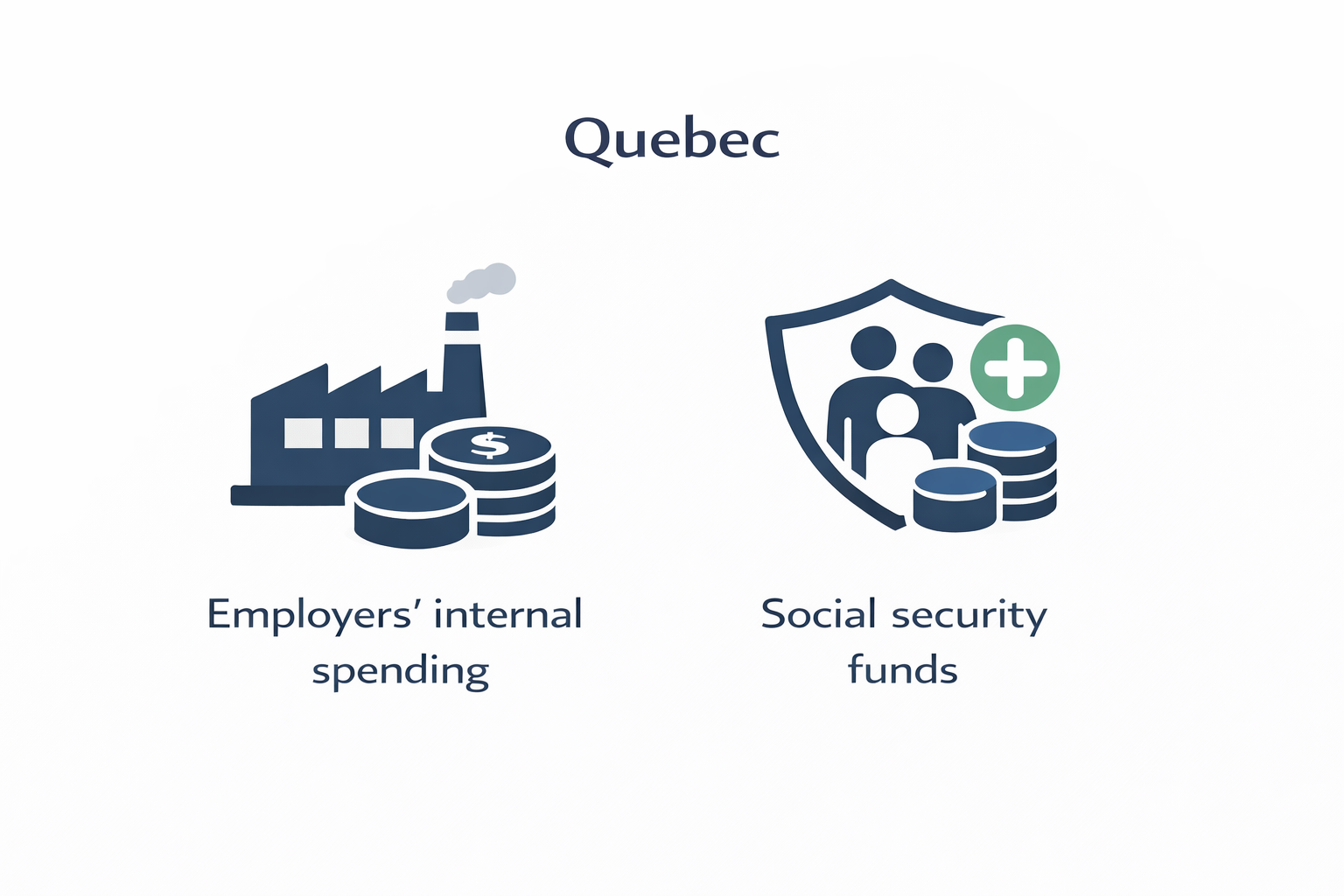
All OSH measures in Quebec are financed exclusively by employers, with no financial contribution from provincial or federal government budgets (Figure 5). Employers contribute to OSH financing in the following ways:
-
The CNESST is financed through compulsory employer contributions covering the full cost of administering the OSH system, including inspection, training, research, prevention and occupational health services. These contributions are legally mandated under the OHSA.
-
In addition to centralized contributions, employers bear responsibility for direct operating expenditures related to OSH prevention within their own organizations. These typically include hazard identification and control, implementation of internal prevention programmes, acquisition of protective equipment, workplace adaptation, employee training and the functioning of health and safety committees. There are no public subsidy programmes to offset these costs. This structure underscores Quebec’s fully self-financed OSH model, which is distinctive among the six case studies examined.
Main characteristics
-
OSH functions in Quebec are consolidated under a single autonomous entity, CNESST. This centralized model integrates compensation, prevention, inspection and research activities, ensuring systemic coordination and stable financing.
-
The CNESST operates as a fully integrated and autonomous institution overseeing the entire OSH system. Its autonomy provides direct control over the allocation of financial resources, ensuring alignment between funding decisions and institutional priorities.
-
The institutional structure, together with its funding base through employer contributions, allows the CNESST to allocate prevention resources strategically. By leveraging inspection data and sectoral risk analyses, it can channel expenditures toward areas with the highest expected impact, thereby enhancing efficiency and return on investment in risk reduction and enabling multi-year prevention strategies without dependence on annual political or fiscal cycles.
-
Employers with an establishment in Quebec are generally required to contribute to the CNESST and participate in its protection regime, although specific rules apply to independent operators, self-employed persons and certain special categories.
-
Differentiated contribution rates create financial incentives for prevention. Contribution levels are calculated differently for employers of different sizes:
-
Unit rates are applied to small employers, calculated on the basis of risk class, independent of individual performance.
-
Variable rates are applied to medium and large employers, adjusted according to the employer’s accident and compensation history.
-
Retrospective pricing is applied to very large employers, where contributions are settled ex post based on actual costs incurred from workplace accidents and occupational diseases.
-
-
Voluntary prevention mutuals19 allow small firms to pool resources, share expertise and collectively implement prevention measures more efficiently.
2.4 Peru
Peru illustrates an OSH financing architecture in which prevention is largely embedded within public budgets and dispersed across multiple institutions, reflecting fiscal constraints and high levels of labour market informality. While the legal framework is comprehensive, dedicated and earmarked financing mechanisms remain limited.
Institutional and legal framework
Peru’s national OSH framework is established under Law No. 29783, the Law on Safety and Health at Work, enacted in 201120, and regulated by Supreme Decree No. 005-2012-TR21. The legislation applies across all sectors, with complementary provisions for specific industries such as mining and dock work, as well as regulations addressing sexual harassment and labour inspection.
The system is coordinated by the National Council for Safety and Health at Work, operating under the Ministry of Labour and Employment Promotion (MTPE) and including representatives from government bodies, employers and workers. At the decentralized level, Regional Councils for Safety and Health at Work oversee implementation. Oversight and enforcement are the responsibility of the National Superintendency of Labor Inspection (SUNAFIL), which exercises both promotional and supervisory functions.
Research and technical capacity in OSH are anchored in the National Centre for Occupational Health and Environmental Protection for Health (CENSOPAS), a specialized body of the National Institute of Health (INS), under the Ministry of Health (MINSA). CENSOPAS develops research, technologies and services aimed at prevention and risk control.
Strategic direction is provided by the National Policy for Safety and Health at Work to 2030, approved by Supreme Decree No. 018-2021-TR.22 This policy assigns responsibilities for OSH to a broad range of public institutions, including MTPE, MINSA, INS, SUNAFIL, the social health insurance body (EsSalud), the National Civil Service Authority (SERVIR), the Ministry of Education (MINEDU), the National Council for Science, Technology and Technological Innovation (CONCYTEC), the National Institute of Statistics and Informatics (INEI) and regional governments. Each entity is expected to implement OSH-related actions through its regular budgetary allocations, without additional earmarked funds. Coordination across these institutions is supported through the National Council for Safety and Health at Work, which serves as a tripartite platform for consultation and policy alignment.
Financing sources for OSH prevention in Peru
Figure
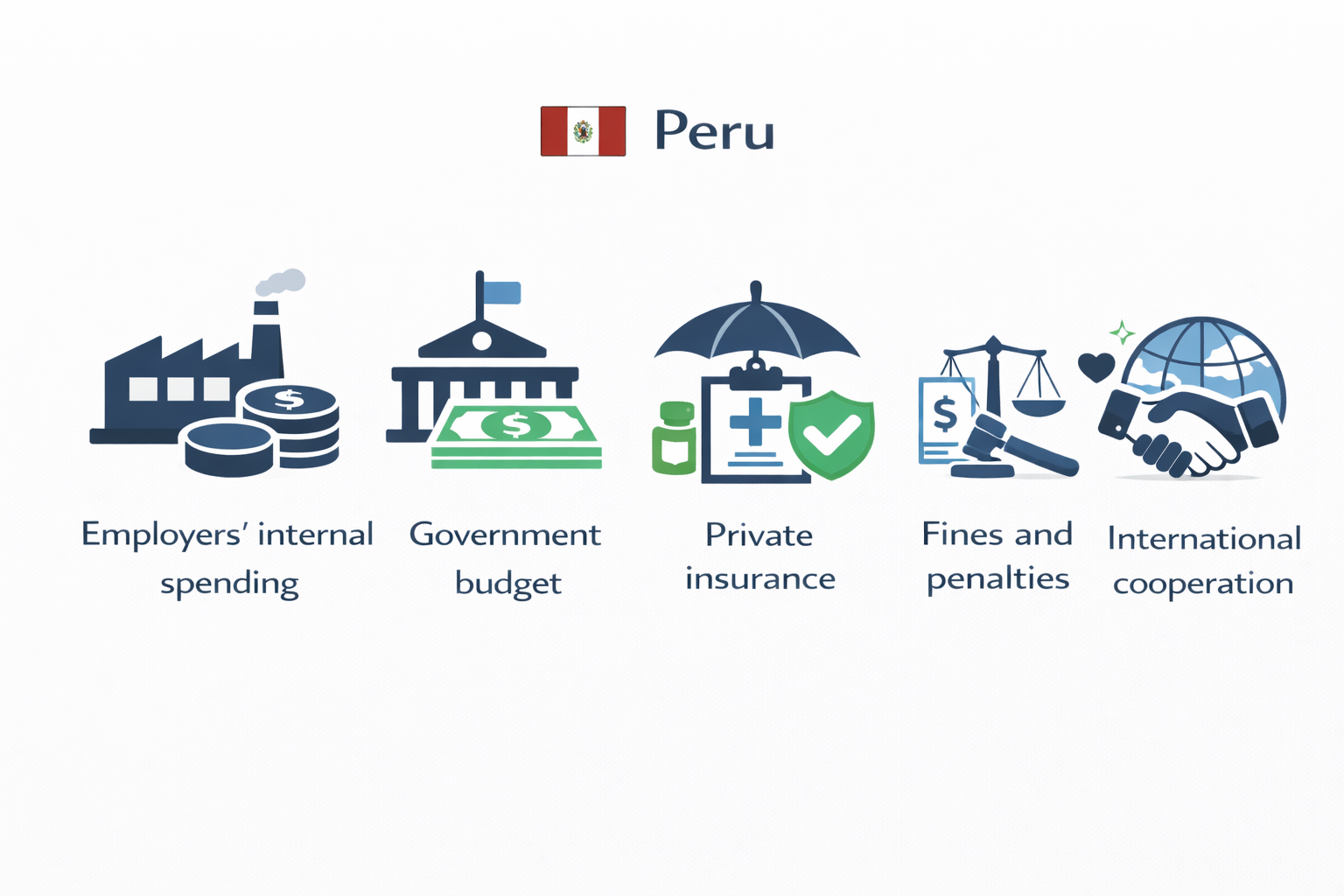
OSH prevention in Peru is financed through a combination of public budget allocations, employer expenditures and complementary sources (Figure 6).
Public financing is channelled through the ordinary operating budgets of ministries and government bodies. Within the MTPE, allocations are directed to OSH-related units, including the National Council for Safety and Health at Work and various directorates. In 2025, these units received a combined budget of over 3 million Peruvian soles (approximately US$0.84 million), representing 0.4 per cent of the Ministry’s total budget (MTPE 2025a). These resources finance both OSH prevention activities and broader labour rights activities. CENSOPAS, on the other hand, received an allocation of 6.1 million soles (approximately US$1.7 million) in 2025, financed through the budget of the INS (INS 2024). The INS’s overall funding structure is composed predominantly of government appropriations, supplemented by external sources including donations, loans and cooperation agreements. For 2025, the INS reported a total budget of 266 million soles (approximately US$74.5 million), of which 180 million soles (approximately US$50.4 million) — or 68 per cent — came from government funds (INS 2025).
Other public institutions with responsibilities under the National Policy for Safety and Health at Work to 2030, such as MINSA, SERVIR, MINEDU, CONCYTEC, INEI and regional governments, finance OSH-related activities through their regular operating budgets. However, specific line-item allocations for OSH within these entities are not clearly identifiable in public documentation.
SUNAFIL generates additional resources through the collection of fines for labour infractions, a majority of which are retained by SUNAFIL and reinvested to strengthen its institutional capacity, including promotion, training and infrastructure. SUNAFIL also redistributes at least 30 per cent of collected fines to regional governments, while a designated share is allocated to the MTPE. In January 2025, 2.4 million soles (approximately US$0.67 million) were transferred to the MTPE (MTPE 2025b).23 While these transfers aim to reinforce labour inspection capacity, they may also indirectly support other elements of OSH prevention, although public information on the allocation of these funds remains limited.
In addition to public financing, employers are directly responsible for funding OSH prevention within their own organizations. These expenditures include worker training, implementation of safety measures, acquisition of protective equipment and compliance with statutory obligations. The absence of comprehensive data constrains full assessment of the relative weight of private versus public expenditure in the national OSH system.
Insurance companies also contribute indirectly to OSH prevention. Under Peruvian law, employers are required to provide mandatory public health insurance through EsSalud, as well as mandatory life insurance and Complementary Insurance for High-Risk Work (Seguro Complementario de Trabajo de Riesgo, SCTR).24 EsSalud provides coverage for dependent workers and their beneficiaries, financing medical care, recovery, rehabilitation and related benefits, including services relevant to occupational injuries and diseases. Mandatory life insurance and SCTR are typically contracted through private insurers. These insurers often offer OSH-related training, awareness campaigns and technical resources to their clients. While these prevention activities are voluntary, they are funded through employer-paid premiums and align with insurers’ financial incentives, as reducing workplace incidents lowers risk exposure and associated payouts. Consequently, these interventions represent an indirect channel of employer-financed OSH investment.
Employers’ organizations, such as the National Confederation of Private Business Institutions (CONFIEP) and the National Society of Industries (SNI), provide legal advice, training and events related to OSH for their members. Their funding comes primarily from membership fees and through fees for specific services.
Main characteristics
-
OSH prevention in Peru is financed mainly through government budgets and employer-funded measures. Employers are legally responsible for financing OSH within their enterprises and likely account for a substantial share of total OSH spending, although the absence of comprehensive data limits assessment of the relative weight of public and private expenditure.
-
Public OSH financing is characterized by a multi-source structure, reflecting the requirements of the National Policy for Safety and Health at Work to 2030, which mandates engagement from a broad range of public institutions. This framework allows OSH prevention to be incorporated into the strategic objectives and budgetary planning of ministries, regional governments and specialized agencies, leveraging resources across the public sector.
-
Dedicated institutions such as CENSOPAS illustrate the capacity to mobilize targeted funding for OSH. In 2025, its budget was approximately double that of OSH-related units within the MTPE, highlighting the fiscal impact of institutional specialization.
-
Additional funding is provided through other channels, including premiums for mandatory private workplace insurance, contributions from employers’ organizations and support from international cooperation. These mechanisms supplement both public and employer-level expenditures, diversifying the overall financing base for OSH activities in Peru.
-
Revenues from labour fines provide an auxiliary source of financing, but the proportion of these funds directed specifically towards OSH prevention remains unclear.
2.5 Philippines
Similar to Peru, the Philippines operates within a system in transition characterized by a hybrid financing structure combining public budget allocations, employer-financed social insurance and enterprise-level preventive investment. Despite a robust legal framework, prevention financing remains partly embedded within broader institutional budgets.
Institutional and legal framework
OSH governance in the Philippines is structured within a multisectoral institutional framework, underpinned by key legal instruments. The Department of Labour and Employment (DOLE) serves as the primary regulator, setting national OSH policy and overseeing compliance. Its technical arm, the Occupational Safety and Health Center (OSHC), provides specialized support for implementation and capacity building. The Employees’ Compensation Commission (ECC), also under DOLE, administers the Employees’ Compensation Program (ECP) and oversees the State Insurance Fund (SIF), which functions as the primary financial vehicle for funding ECP benefit disbursements as well as the operational budgets of the ECC and OSHC, including allocations for OSH preventive programmes and strategic initiatives.
Key legal provisions that underpin the system include Republic Act No. 11058 (OSH Law of 2018)25, which mandates employer compliance with OSH standards and assigns financial responsibilities for implementation. Its implementing rules and regulations were issued through DOLE Department Order No. 198-1826 and were revised under DOLE Department Order No. 252 (2025)27. Presidential Decree No. 626 (Employees’ Compensation and State Insurance Fund)28, as subsequently amended, provides the legal basis for the ECP and the SIF and establishes the framework for compensation benefits, employer contributions and fund management. Executive Order No. 307 (1987)29 established the OSHC within the ECC, granting it authority to conduct training, research, monitoring and technical services using SIF allocations.
In addition, the Civil Service Commission (CSC), DOLE and the Department of Health (DOH) jointly issued Memorandum Circular No. 001-202030 and Administrative Order 2023-000131, establishing a compliance mandate for government institutions to implement OSH programmes and promote healthy workplace conditions. These directives function as regulatory instruments that ensure institutional accountability, mitigate operational and workforce-related risks and optimize human capital productivity across the public sector.
Several sectoral agencies, including the Department of Environment and Natural Resources (DENR), the Department of Energy (DOE), the Department of Trade and Industry (DTI) and the Department of Public Works and Highways (DPWH), enforce OSH-related requirements through industry-specific regulations. Local Government Units (LGUs), the Philippine Economic Zone Authority (PEZA), the Maritime Industry Authority (MARINA) and other bodies also contribute to OSH implementation through licensing, permits and inspections.
Financing sources for OSH prevention in the Philippines
Figure
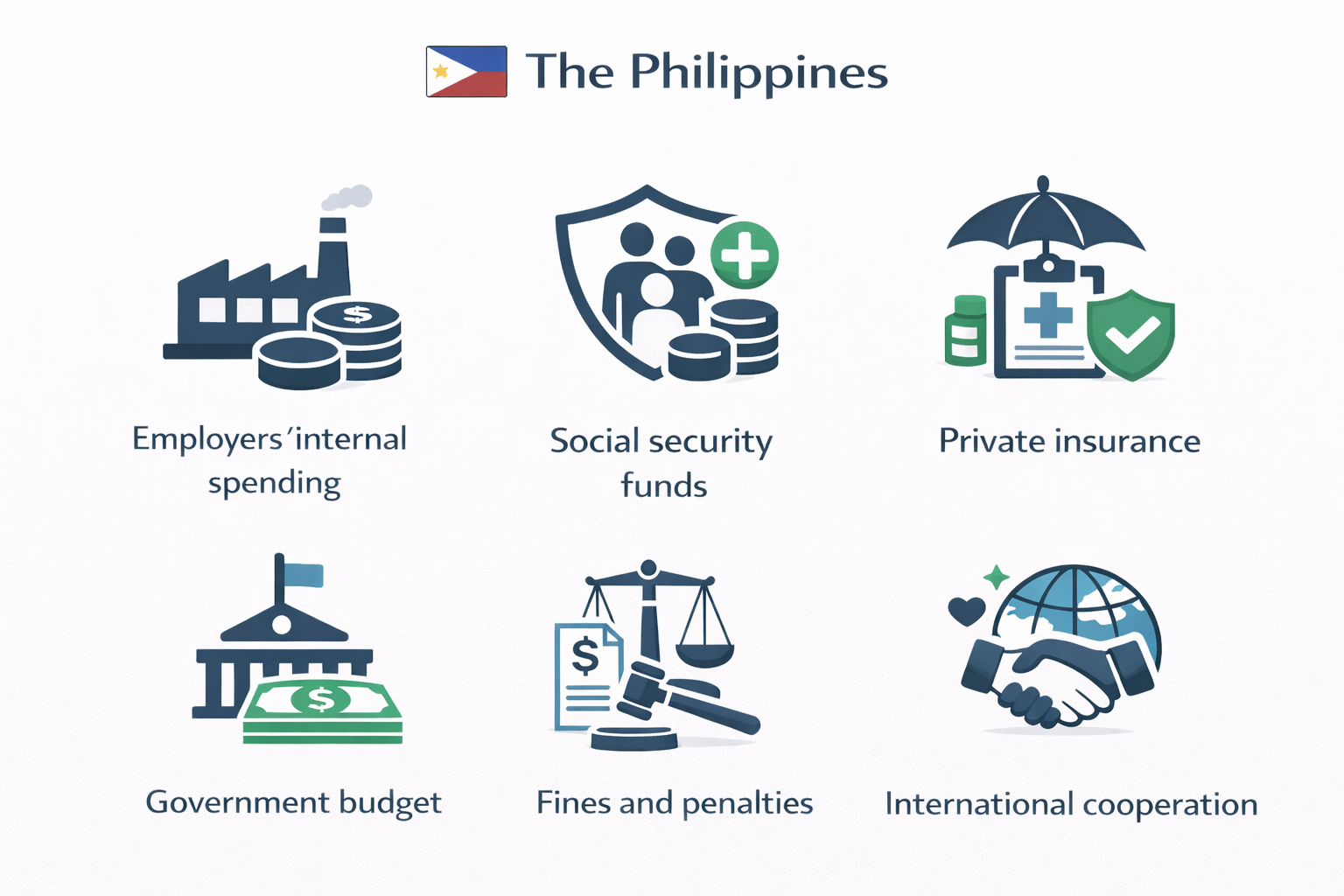 The Philippine OSH system relies on a combination of public budget allocations, employer-funded programmes, social insurance schemes and international technical assistance. (Figure 7):
Public budget allocations play a pivotal role in financing OSH prevention. In 2024, DOLE earmarked approximately 772 million Philippine pesos (approximately US$13.5 million) for OSH-related programmes, representing roughly 3 per cent of its total budget (DBM 2024). While other government agencies also contribute to OSH financing, their specific allocations are not readily identifiable. The General Appropriations Act (GAA) serves as the primary fiscal instrument for government spending, with OSH-related expenditures embedded within broader agency budgets. These allocations are often categorized under general administrative or health-related line items, which obscures the precise tracking and financial reporting of OSH investments.
Social insurance contributions constitute another significant funding stream for OSH programmes. The State Insurance Fund (SIF) operates as a dedicated financial vehicle for work-related accidents and occupational diseases, financed entirely through employer contributions. It provides compensation in the form of cash benefits, such as income replacement for temporary or permanent incapacity and survivors’ benefits, as well as medical care and rehabilitation services. The ECC manages the SIF, with benefit payments processed through the Social Security System (SSS) for private sector workers and the Government Service Insurance System (GSIS) for public sector employees.
For the first nine months of 2024, the Employees’ Compensation Commission (ECC) reported total State Insurance Fund (SIF) revenues of 9.0 billion pesos (approximately US$156.5 million), with 965.5 million pesos (approximately US$16.8 million) allocated to the “loading fund”—the earmarked portion of the SIF designated to finance the operational budgets of the ECC, OSHC and the administrative costs of SSS and GSIS. Of this amount, ECC received 393.9 million pesos (approximately US$6.9 million) and OSHC received 328.9 million pesos (approximately US$5.7 million) for their corporate operating budgets (ECC 2024). Additionally, OSHC retains internally generated revenues from laboratory services, training fees and technical support activities, which are reinvested to expand preventive functions, including workplace assessments, PPE testing and health monitoring programmes.
Revenues from labour infractions also represent a potential supplementary source of OSH financing. Under Republic Act No. 11058 and DOLE Department Order No. 252 (2025), fines collected for violations of OSH standards may be allocated to support OSH initiatives, including training, education and related programmes. However, at present, operational mechanisms for earmarking and deploying these funds specifically for prevention remain under development.
Employers are legally mandated under the OSH Law and DOLE guidelines to invest in OSH prevention. Required investments include expenditures on PPE, workplace inspections, medical surveillance and employee training programmes. A 2025 survey by the Employers’ Confederation of the Philippines highlighted significant variation in budgeting practices, with larger firms in high-risk sectors maintaining fixed OSH budgets, whereas smaller enterprises and service-oriented companies often rely on ad hoc allocations,32 reflecting differing risk exposures and internal financial planning capacities.
Additional funding support comes from international sources, including the International Labour Organization, the World Health Organization, the Asian Development Bank, the United States Agency for International Development and the Japan International Cooperation Agency. These actors fund capacity-building projects, infrastructure development and technical assistance.
Employers’ organisations, labour unions and professional organisations also fund training programmes and advocacy activities related to OSH for their members.
Main characteristics
-
OSH financing in the Philippines relies on a diversified portfolio of funding streams, including allocations from the national budget, social insurance contributions, employer-driven investments in preventive measures and targeted international assistance. This multi-source structure provides a financial base for both operational and preventive OSH initiatives.
-
OSH financing and institutional responsibilities are firmly underpinned by robust legal mandates, including Republic Act No. 11058, Presidential Decree No. 626 and Executive Order No. 307, which establish a clear regulatory framework.
-
Enforcement and preventive services are delivered through specialized agencies, notably the OSHC and ECC, which function as dedicated operational and technical units to manage compliance, fund allocation and risk mitigation across both public and private sectors. In addition, the OSHC is authorized to generate and retain income from training, laboratory testing and technical services, including PPE testing, industrial hygiene assessments and medical surveillance.
-
OSH financing, enforcement and technical service delivery are institutionally organized within a DOLE-led framework, primarily through the ECC and OSHC, bringing together compensation, prevention, inspection and technical support functions within a single governance structure, thereby providing an institutional basis for coordination.
2.6 Tunisia
Like Peru and the Philippines, Tunisia represents a system in transition in which employer-funded compensation mechanisms coexist with constrained public financing for prevention, shaped by fiscal limitations and labour market informality. Prevention allocations remain modest relative to compensation spending.
Institutional and legal framework
The Ministry of Social Affairs (MAS) holds primary responsibility for OSH governance, operating through specialized departments including the Directorate General of Medical and Occupational Safety Inspection (DGIMST), the Occupational Safety and Health Institute (ISST) and the National Health Insurance Fund (CNAM). The CNAM manages compensation and supports prevention under the occupational injury and disease regime.
Beyond the MAS, several other government entities contribute to the national OSH system. These include the National Council for the Prevention of Occupational Risks (CNPRP) and regulatory bodies across multiple ministries. The Ministry of Health, the Ministry of Industry, the Ministry of Agriculture and the Ministry of the Interior each contribute to the national OSH system through sectoral enforcement and technical support.
The legal foundation of Tunisia’s OSH system is anchored in the 2022 Constitution33, which enshrines the right to health and safe working conditions, and the Labour Code (Law No. 66-27 of 1966)34, as amended, which mandates both preventive and compensatory OSH measures at enterprise level. Complementary regulatory instruments address sector-specific risks, employer obligations, medical surveillance requirements, workplace inspections and institutional roles.
Enterprises are legally required to establish autonomous occupational medical services (SMA) or to participate in Groupings of Occupational Medicine (GMT), depending on workforce size. In addition, internal OSH structures such as Health and Safety Committees (CSST) and designated Safety Officers (RS) are mandatory once enterprises exceed specified employee thresholds or are subject to sector-specific OSH requirements based on occupational risk exposure, in accordance with the Labour Code and its implementing decrees.35
Financing sources for OSH prevention in Tunisia
Figure
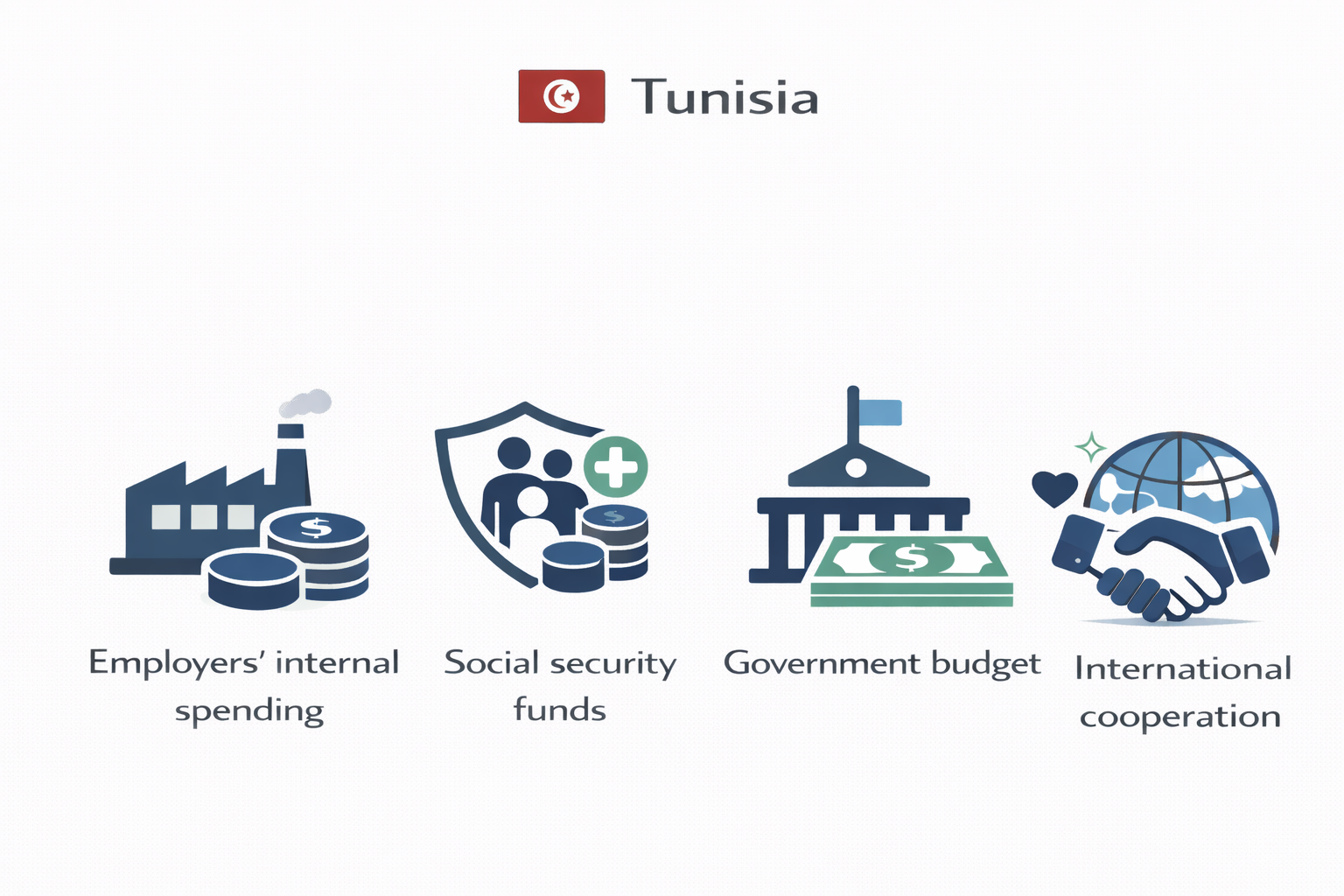
OSH financing in Tunisia is sustained primarily by public budget allocations and employer contributions (Figure 8), although preventive activities remain comparatively underfunded.
The MAS receives funding from the national budget and channels resources to OSH activities, particularly through its “Labour and Professional Relations” programme. In 2025, this programme accounted for 0.89 per cent of the MAS budget, with approximately 90 per cent of funds allocated to personnel costs (Ministry of Finance 2025). As a result, preventive activities, including awareness campaigns, training programmes and equipment procurement, remain limited in scope, constraining the impact of OSH interventions.
The Accidents du Travail et Maladies Professionnelles (ATMP) regime, managed by the CNAM, is funded entirely through employer contributions. Contribution levels are calibrated by sector-specific risk and vary across risk classes. Under Decree No. 95-538 of 1 April 1995, as amended, rates for private-sector enterprises affiliated with the National Social Security Fund (CNSS) range from 0.4 per cent to 4 per cent of the wage bill, while certain public-sector entities are subject to rates of up to 6 per cent in the highest-risk sectors. These contributions fund rehabilitation and compensation for workplace accidents and diseases, including medical care, daily allowances in cases of temporary incapacity and disability pensions. Within the ATMP regime, the CNAM is legally authorized to support OSH prevention through targeted subsidies, investment loans, and incentive mechanisms for enterprises, particularly small firms. However, utilization remains constrained by administrative barriers and limited employer awareness, resulting in prevention expenditures that remain modest relative to compensation spending.
Enterprises directly finance mandatory internal OSH services. Groupings of Occupational Medicine (GMT) are financed through a 0.5 per cent payroll levy on affiliated enterprises or fixed per-capita fees, as provided under Article 27 of Decree No. 2000-1986 of 12 September 2000. SMA units cover their own operational costs. Despite these arrangements, coverage remains incomplete, with a substantial proportion of salaried employees not covered by GMT or SMA services and therefore lacking systematic occupational health oversight.
International cooperation serves as a supplementary source of funding. Between 2016 and 2025, Tunisia received US$73.5 million in international cooperation for social protection and health programmes from donors including the European Union, the ILO, Switzerland and the Republic of Korea (Ministry of International Cooperation n.d.). While this figure refers to overall social protection and health support, a portion of these resources was allocated to OSH-related technical assistance and system strengthening.
Sector-specific funding mechanisms include the Social Protection Fund for Agricultural Women Workers, established under the Finance Law to extend social protection coverage to a previously under-covered population. The fund is financed through mixed revenue streams, including state budget allocations, insurance-related levies, and a designated share of road fines and vehicle technical inspection fees. It is designed to strengthen social protection, including health coverage and work injury (ATMP) protections, for women employed in the agricultural sector.
Main characteristics
-
A robust regulatory and institutional foundation ensures clear mandates and accountability across public and private sectors.
-
The use of a performance-based budgeting model enhances financial transparency and accountability.
-
Tripartite coordination mechanisms facilitate inclusive decision-making and broad stakeholder engagement.
-
Dedicated structures such as CNAM, ISST and DGIMST contribute to oversight, inspection and capacity building.
-
Integration of prevention financing within the CNAM-managed ATMP regime provides a structured, though limited, source of preventive funds. However, the scale of allocations for prevention remains modest relative to compensation expenditures.
A comparison of the financing models used across the six case studies
The six case studies illustrate that OSH prevention is financed through varying combinations of employer expenditures, public budget allocations, contributory financing mechanisms, international cooperation and revenues derived from labour penalties (Figure 9). The composition and relative importance of these funding sources differ substantially across the case studies, reflecting variations in institutional development, economic structure, and the degree of labour market formalization. Beyond differences in relative weight, the case studies suggest identifiable patterns in the types of prevention activities they tend to finance. Employer expenditures are primarily directed towards firm-level preventive measures such as PPE provision, training and internal safety and health management systems. Social insurance mechanisms often combine compensation with prevention services, technical advice and targeted incentives. Public budgets predominantly finance regulatory functions, including labour inspection and institutional administration. International cooperation, by contrast, is typically focused on pilot initiatives, capacity building and system strengthening.
The financing architecture of OSH prevention diverges significantly across the case studies covered by the study. In institutionally mature systems, including Germany, Japan and Quebec, the cost burden is concentrated within the private sector, with employers underwriting prevention primarily through direct expenditures and contributions to social security funds. As these funds are largely financed by employer payments, the effective responsibility for prevention financing remains employer-driven, with state budget allocations playing a comparatively limited role. In systems in transition, including Peru, the Philippines and Tunisia, the financing mix is broader and more externally dependent, with public expenditure constituting a central pillar, supplemented by employers’ internal spending and, in some cases, international cooperation and other complementary sources. This broader financing structure reflects constraints on employer contribution capacity and the structural role of public budgets in sustaining prevention activities.
This pattern is closely linked to the degree of enterprise formality and overall financial capacity within each economy. In highly formalized markets such as Canada, Germany and Japan, the prevalence of registered enterprises with sufficient liquidity and capital reserves enables systematic investment in internal prevention measures as well as consistent contributions to social security funds. This structural capacity supports the viability of financing models that rely predominantly on employer contributions as the primary revenue stream for OSH prevention. In countries with lower levels of enterprise formality, as well as a high proportion of small businesses with more limited capacity to invest in OSH, financing tends to depend more heavily on government budgets. This has important implications for OSH prevention financing, as explored in the key findings below. Enterprise formalization strengthens the financing base for OSH prevention by expanding both the employer contribution pool and the predictability of cash flows into prevention systems. Formalization also enhances enterprises’ access to credit and insurance markets, improving their liquidity and capacity to allocate resources towards prevention investments.
Employer financing is central across all countries. In all six case studies, employers face a statutory obligation to invest in internal prevention measures. Quebec stands out as a model fully financed by employers, both centrally via CNESST contributions and directly at enterprise level. In Germany, Japan and the Philippines, employer expenditures represent the primary funding stream. For the remaining jurisdictions, the extent of employer financing could not be fully determined, though in all cases it represents a material share of national OSH expenditure. Employer outlays are comparatively higher in advanced economies, where enterprises may have greater liquidity and investment capacity to sustain these obligations.
Public budget allocations are critical to OSH prevention financing in systems in transition, although their relative weight diminishes in institutionally mature systems where private financing dominates. State budgets support OSH prevention in five countries (Germany, Japan, the Philippines, Peru and Tunisia), with government expenditure assuming a comparatively larger share in systems in transition.
Social security contributions are key to prevention financing in institutionally mature systems but play a much more limited role in systems in transition, particularly where high levels of labour market informality constrain contribution coverage and revenue collection. Japan, Germany, Quebec and the Philippines leverage their social insurance mechanisms, funded through employer contributions, to finance prevention activities, training and research, thereby internalizing long-term cost savings.
Fines for labour infractions have a limited role in prevention financing. Two countries (Peru and the Philippines) have made some progress towards allocating revenues from such fines for reinvestment in prevention. Increased use of this mechanism may represent an opportunity to enhance the sustainability of national OSH financing frameworks, if accompanied by transparent rules, robust monitoring mechanisms and safeguards to ensure that labour inspectors continue to provide and balance their advisory and technical support roles with the duty to enforce.
International cooperation plays a modest yet strategically valuable role in systems in transition. Peru, Tunisia and the Philippines have received international technical and financial support in recent years, but this source of funding is typically time-bound and cannot replace sustained domestic financing.
Private insurance plays a limited role in financing prevention activities, with its impact most visible in markets where coverage is mandatory (for example Peru) or broadly adopted.
Table
|
Financing Mechanism |
Germany |
Japan |
Quebec |
Peru |
Philippines |
Tunisia |
|---|---|---|---|---|---|---|
|
Employer internal expenditure |
Dominant source (≈82% of total OSH prevention spending) |
Significant at enterprise level (not nationally quantified) |
Fully employer-financed (enterprise + CNESST) |
Legally mandated; magnitude not quantified |
Legally mandated; varies by firm size |
Mandatory occupational medicine (≥500 internal; otherwise GMT) |
|
Social security / insurance funds |
Statutory accident insurance (UV) allocates dedicated prevention funds |
WACI Special Account allocates ≈2.15% of contributions to prevention |
CNESST integrates prevention, inspection & compensation |
No dedicated prevention earmarking within social insurance |
State Insurance Fund (SIF) funds compensation; limited prevention allocation |
ATMP regime funds compensation; limited prevention use |
|
Public budget allocations |
Limited (federal + Länder; small share of total) |
General Account funds inspection & research |
None (no government financing) |
Core funding source; embedded in ministry budgets |
Significant share via DOLE; embedded in GAA |
Public funding modest |
|
Fines for labour infractions |
Not earmarked for prevention |
Not used as prevention funding |
Not used as prevention funding |
Collected by SUNAFIL; partial transfer to regions; no dedicated OSH earmark |
Legally designated for OSH, not yet operationalized |
Limited role |
|
Private insurance mechanisms |
Marginal role |
Limited role |
Not central |
Mandatory SCTR; insurers provide voluntary prevention support |
Limited; some employer insurance-based training |
Limited |
|
International cooperation |
Minimal |
Minimal |
None |
Project-based support for capacity-building |
Project-based technical assistance |
Supplementary support within broader social protection programmes |
Figure
Common challenges faced
A number of challenges were frequently identified across the countries studied. These include:
-
Institutional complexity. All six systems involve multiple actors, including ministries, social insurance institutions, decentralized units and private sector stakeholders. This multi-actor engagement supports broad coverage but generates significant administrative complexity, particularly for smaller firms and local offices with limited capacity. Coordination challenges arise from legacy occupational risk classification schemes, limited interoperability between institutions and dispersed responsibilities, which can reduce efficiency and data accuracy. The effectiveness of tripartite bodies and joint sectoral associations is contingent on voluntary participation, active coordination and sustained stakeholder engagement. This complexity underscores the importance of coordination platforms and interoperable information systems.
-
Difficulties identifying investments in prevention. Public financing of OSH across these systems is often fragmented and embedded within broader administrative or health allocations, making precise tracking difficult. Civil servants frequently perform mixed duties and infrastructure or operational costs are rarely disaggregated by function, resulting in expenditure estimates rather than clearly defined OSH-specific line items. Performance-based budgeting exists in some cases but is limited by transparency constraints and a lack of cost–benefit evaluation. Local government and smaller agencies often face irregular or inconsistent funding, exacerbated by insufficient staff capacity.
-
Liquidity and compliance challenges for smaller firms. Employer-financed OSH mechanisms are central across all six systems, including mandatory internal medical services, sectoral levies and enterprise-level preventive budgets. While this internalization promotes accountability, it creates liquidity and compliance challenges for smaller firms. Uptake of financial incentives (for example subsidies, loans and bonuses) is often low and preventive activities are frequently underfunded compared with compensation obligations. Funding is vulnerable to fluctuations in premium collection and employer compliance.
-
High labour market informality. In countries such as Peru, the Philippines and Tunisia, high labour market informality (exceeding 70 per cent in Peru) limits both worker coverage and tax revenues for government OSH programmes. In addition, public sector employees and self-employed workers frequently fall outside mandatory schemes. Enterprise-level coverage through autonomous medical services or groupings is incomplete, with salaried employees often only partially reached. Underreporting of occupational injuries and diseases, particularly in informal and high-risk sectors, further undermines effective planning, risk assessment and resource allocation.
-
Constraints to institutional capacity. Dedicated institutions provide oversight, technical expertise and enforcement functions in all systems, yet their capacity in some cases is constrained by limited budgets, uneven regional deployment and administrative complexity. Coordination between actors is often limited by fragmented systems and technical constraints, affecting contribution tracking, compliance monitoring and resource allocation.
Key findings
a) Regulatory frameworks and policy instruments, when not accompanied by clearly defined and adequately resourced financing mechanisms, are insufficient to ensure the effectiveness and sustainability of OSH prevention programmes.
Across all six case studies examined, the presence of OSH legislation, national strategies and policy instruments has not automatically translated into guaranteed or sustainable financing streams for prevention. In several cases, the regulatory architecture is robust and, in some instances, relatively advanced, but the underlying funding mechanisms remain inadequate to operationalize these mandates. For example, in the Philippines and Peru, comprehensive legal frameworks coexist with non-earmarked or insufficiently resourced financing arrangements, while in Tunisia, preventive activities remain underfunded despite a robust regulatory foundation.
Regulatory and policy instruments can establish legal obligations; however, without transparent and dedicated financing channels, OSH prevention remains structurally underfunded and functions more as a policy aspiration than a fully capitalized system.
b) Several national OSH systems remain in transition, lacking institutional maturity and stable funding mechanisms.
In this context, “systems in transition” refers to OSH frameworks where institutional coordination and financing structures remain evolving rather than fully consolidated. In these systems, financing responsibilities are often distributed across multiple institutions without a unified governance structure or clearly defined coordination mechanisms. While legal mandates may be established, the absence of consolidated institutional authority and predictable financing architecture limits strategic planning, resource pooling and long-term prevention investment.
This pattern is visible in several case studies. In Peru, OSH financing responsibilities are dispersed across ministries and public agencies, with prevention activities embedded within general operating budgets rather than consolidated under a dedicated financing framework. Similarly, in the Philippines and Tunisia, multiple government bodies play roles in prevention and enforcement, yet financing streams remain institutionally segmented. Together, these arrangements reflect evolving institutional maturity and the absence of stable, consolidated financing mechanisms for coordinated prevention planning.
c) Reliance on non-earmarked public budgets exposes OSH financing to political cycles, fiscal volatility and budgetary shortfalls, while high informality can limit the viability of employer-based contribution models.
In many systems in transition, prevention expenditures depend heavily on annual public allocations, making them vulnerable to shifts in government priorities and broader fiscal constraints. These vulnerabilities are amplified in countries with large informal sectors, where narrow tax and contribution bases constrain public revenue capacity to sustain prevention financing.
This dynamic is evident in Peru, the Philippines and Tunisia, where OSH prevention financing relies primarily on public budgets and is therefore sensitive to changing expenditure priorities. Across these contexts, high levels of labour market informality further restrict public revenue collection and limit the feasibility of broad-based employer contribution models.
d) Dedicated OSH financing mechanisms enhance the stability and scope of prevention efforts, whereas fragmented budgetary allocations constrain impact and continuity.
Effective financing is not only a question of where funding comes from, but whether it is specifically earmarked for OSH prevention. Systems with dedicated OSH funding mechanisms are better positioned to sustain prevention activities and align them with strategic objectives. Many countries lack such mechanisms and instead rely on fragmented pockets of funding across multiple institutions.
e) Autonomous OSH institutions can pool resources from different sources and ensure more predictable and strategic allocation of OSH financing.
A key finding across the six case studies analysed is the close link between the institutional maturity of the OSH system and the effectiveness, stability and traceability of its financing architecture. Jurisdictions with clearly defined, autonomous and technically capable institutions tend to exhibit more coherent and sustainable financing models for OSH prevention. By contrast, countries characterized by fragmented mandates or inactive governance structures typically face constrained and volatile funding flows for prevention activities.
The choice of institutional model for OSH financing is an important determinant of financial performance. Autonomous OSH institutions, in particular, tend to deliver stronger results by virtue of their legal and operational independence from general government frameworks, allowing them to set their own priorities, allocate resources strategically and ensure continuity in their programmes, thereby reducing reliance on political cycles. As examples, both Quebec and Germany benefit from autonomous institutions responsible for all, or a large proportion, of national OSH financing.
f) Systematic monitoring and evaluation of OSH investments are critical to demonstrating both the financial and the broader social benefits of investing in prevention.
In institutionally mature OSH financing systems, the allocation of resources to prevention is supported by systematic monitoring and evaluation mechanisms that demonstrate both economic and social returns. Valuable monitoring and evaluation tools identified in the case studies include:
-
Performance indicators: Performance indicators for OSH prevention are integrated into many national OSH systems. In Japan, for example, prevention activities financed by WACI are monitored and assessed against strategic objectives. This evidence is then used to ensure accountability in the use of funds and to refine and adapt prevention strategies.
-
Cost–benefit assessment based on data on workplace accidents and diseases: Where institutions have robust data on occupational accidents and diseases and their related costs, they can assess the effectiveness of prevention mechanisms in relation to these costs. In Germany, for example, statutory accident insurance institutions collect detailed data on occupational accidents, diseases and related costs. This information is used to assess the effectiveness of prevention programmes and to demonstrate cost savings achieved when workplace risks are reduced. By linking prevention outcomes to financial performance, these institutions can justify ongoing or increased investment in preventive measures.
These kinds of ongoing cost–benefit assessments are particularly applicable where one institution manages both the payment of benefits related to workplace accidents and diseases and investments in prevention. These institutions have access to data on both and can act directly on the results of findings. Where financing for prevention and compensation is managed separately, data sharing efforts are important to allow for this kind of ongoing analysis.
-
Applied research: In addition to the two mechanisms explored previously, the impact and cost–benefit of prevention programmes can be examined in greater depth through applied research. In Quebec, CNESST monitors the impact of prevention and inspection activities through performance indicators and research partnerships, including grants to the Quebec Occupational Health and Safety Research Institute (IRSST). The IRSST conducts applied research that evaluates prevention interventions and quantifies their benefits for employers, workers and the compensation system.
Systems such as those in Germany, Japan and Quebec embed systematic monitoring and evaluation within their OSH governance and financing frameworks. Beyond reinforcing accountability, these mechanisms generate financial evidence that prevention reduces compensation liabilities, improves productivity and contributes to workers’ well-being. By quantifying returns on prevention investment, they strengthen the case for sustained funding and serve as a critical instrument for securing both political commitment and financial support for OSH prevention strategies. These monitoring mechanisms also enhance transparency and accountability in OSH spending.
g) Employers’ organizations can play a strategic role; their engagement, however, is contingent on the prevailing institutional framework.
Employer organisations play two complementary roles in OSH prevention financing:
-
Employers’ organisations can deliver key services that contribute to prevention. They provide services such as OSH training, awareness campaigns and practical tools for their members. They frequently collect, analyse and disseminate industry data on OSH risks. By pooling resources through employers’ organizations, firms can access specialized expertise that they might not be able to finance individually. In some countries, these organizations also co-invest in prevention projects in partnership with government bodies or external donors. Such projects often include technical assistance and sustained support to employers and workers.
-
In some countries, employers’ organizations have a formal governance role in OSH systems . They may sit on tripartite boards that determine OSH strategies and budgets and play a consultative role in designing national OSH policies, legislation, technical standards and safety guidelines. As representative organisations of the private sector, they help ensure that OSH policies are tailored to the needs and realities of their members across sectors, including small and medium-sized enterprises.
The governance role of employers’ organizations, as well as the extent to which their activities are integrated into national OSH systems, varies significantly across the case studies. In some jurisdictions, they are formal partners in prevention strategies supported by legal mandates and financing arrangements.
In others, their contributions are delivered primarily through consultation processes, voluntary initiatives, training and awareness-raising. While valuable, these activities may have limited scale and long-term impact without formal integration into national OSH frameworks. Better leveraging the role of employers’ organisations and more closely aligning them with national systems represent a significant opportunity to enhance outcomes in systems in transition.
h) Financial incentives are a pathway to sustainable financing, but they remain underutilized, particularly in systems in transition , despite their potential to drive compliance and innovation.
Across the six case studies, financial incentives and market-based instruments — such as premium discounts for good safety performance, tax credits for preventive investments or subsidies for risk-reduction measures — tend to be well established in institutionally mature OSH systems, where they are embedded within contributory financing arrangements.
In Germany, risk-based contribution rates under the statutory accident insurance system link employer premiums directly to sectoral risk profiles and accident performance, creating strong financial incentives for preventive investment. Similarly, in Japan, the Workers’ Accident Compensation Insurance system incorporates differentiated contribution rates and bonus–malus mechanisms that reward improved safety outcomes and internalize long-term cost savings. Quebec provides a further example of the systematic use of financial incentives through differentiated employer contribution rates and retrospective pricing mechanisms that adjust premiums based on individual employers’ accident and compensation histories, alongside voluntary prevention mutuals that enable smaller firms to pool resources and reduce prevention costs.
In systems in transition, differentiated contribution rates may also exist. For example, Tunisia’s ATMP regime applies sector-based risk rates financed by employer contributions. However, the linkage between contribution levels and firm-level prevention performance is generally less systematically embedded and the use of contribution systems as active incentive instruments for prevention remains more limited.
i) Revenues from existing penalties for labour infractions may represent a potential supplementary financing source alongside other earmarked fiscal instruments where applicable, provided that legal provisions ensure allocation, transparency and reinvestment in prevention.
A portion of revenues generated from fines for labour infractions can be earmarked for financing OSH prevention. This creates a reinforcing cycle in which penalties collected from non-compliant duty holders are reinvested into measures that improve workplace safety and support employers in fulfilling regulatory obligations.
In the Philippines and Peru, labour fines have been identified as a potential supplementary source of OSH financing, primarily supporting inspection capacity and, in some cases, designated OSH-related activities.
These examples point to an important opportunity for OSH financing: if revenues from fines were legally dedicated to prevention, or if at least a defined portion were earmarked, they could provide an additional source of financing. At the same time, reliance on fines alone is not a sustainable long-term strategy: as compliance improves, the volume of sanctions—and therefore available funds—may decline. Overemphasis on fines could also risk turning national authorities, including labour inspectorates, into revenue-collecting bodies, potentially diverting them from their advisory and technical support roles. Countries where OSH violations are treated primarily as criminal offences may also be less suited to this type of funding mechanism.
To operationalize this approach, a clear legal framework is needed to allocate a dedicated portion of fine revenues to OSH prevention. This should be accompanied by transparent rules governing the transfer, tracking and expenditure of these funds, as well as robust monitoring and evaluation mechanisms to ensure that the resources produce measurable improvements in workplace safety. Regular consultation with social partners is also recommended to ensure that these funds support preventive outcomes without distorting national compliance strategies or affecting the balanced use of advisory and enforcement functions by labour inspectorates.
j) External financial assistance, including regional and international cooperation, can play a complementary role but cannot replace sustained domestic investment in OSH prevention.
Regional and international cooperation can play a useful supplementary role in strengthening OSH systems. In several countries, such support has helped to fund innovations, upgrade equipment, provide specialized training and build institutional capacity. However, these funds are generally short-term and cannot substitute for the stable, long-term investment required to maintain and develop OSH prevention activities. The catalytic effect of external cooperation is maximized when it supports the design of sustainable national financing mechanisms.
For example, international cooperation has supported OSH prevention in several of the countries examined. In Peru and the Philippines, external assistance has financed pilot programmes, training activities and institutional capacity-building related to OSH prevention. In Tunisia, international cooperation has contributed to OSH-related technical assistance and system strengthening within broader social protection and health programmes. Across these cases, external support has played a catalytic and complementary role but has remained project-based and time-bound, reinforcing the importance of sustained domestic financing for long-term impact.
This distinction is illustrated in Figure 10, which presents the types of OSH prevention activities typically supported by external financial assistance compared with core prevention activities that require national financing.
Figure 10. Activities typically funded by external financial assistance compared to national financing
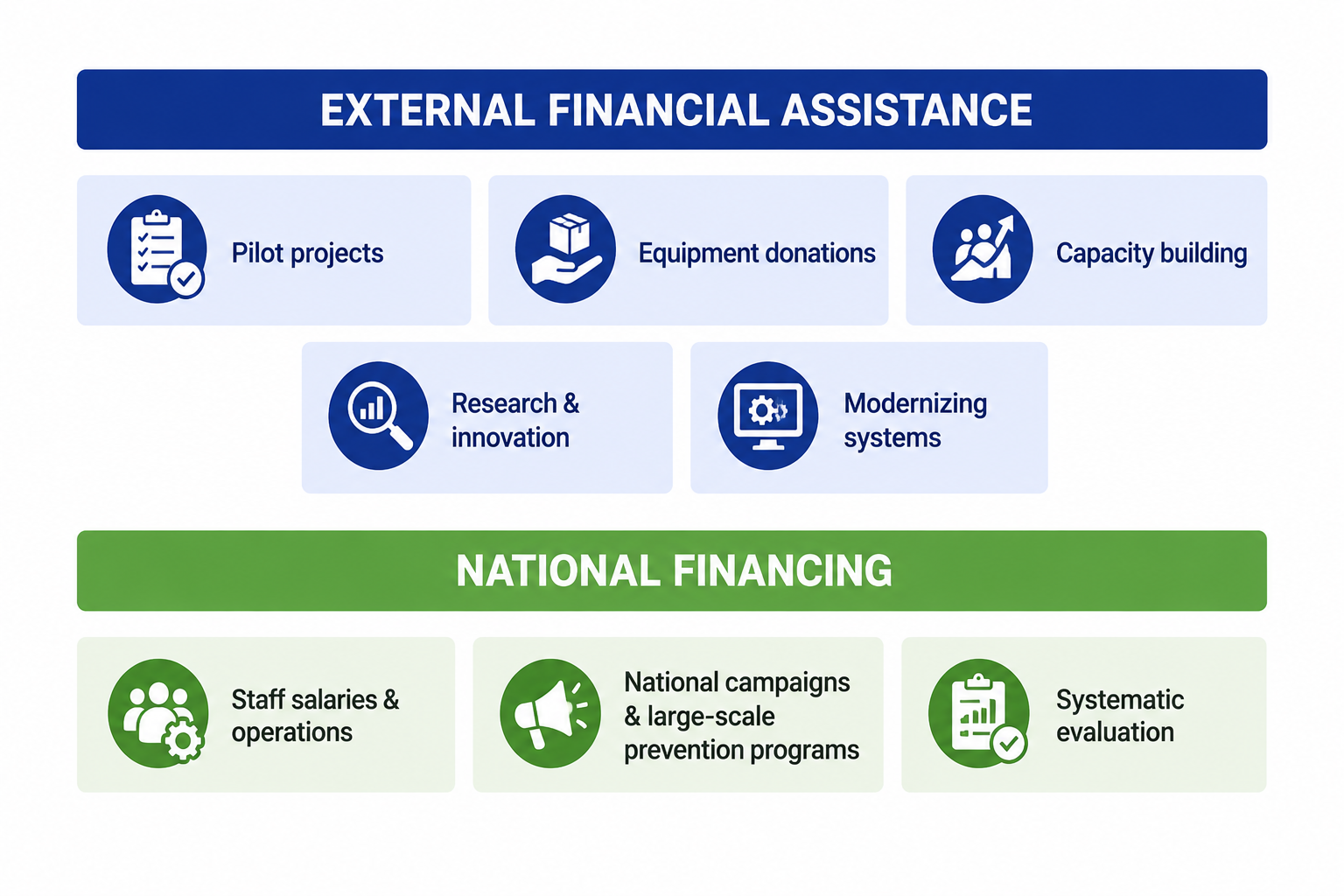
Conclusion
The six case studies demonstrate that modern OSH legislation alone, while necessary, is insufficient to ensure effective and sustainable prevention outcomes. Dedicated and efficient financing mechanisms, supported by strong institutions, are essential to translate national commitments into sustained practice.
The analysis presented in this study focused on the institutional and financial arrangements underpinning OSH prevention across six case studies. It did not include quantitative analysis of OSH outcomes, as the purpose of the research was to describe and compare financing models. In addition, the study did not examine broader public health financing systems, which in some countries may contribute indirectly to OSH prevention through investments in occupational health services or workplace health promotion. This possible linkage between public health expenditure and OSH prevention merits further analysis, particularly in systems with integrated occupational health services.
While the study draws on qualitative and quantitative data, the absence of consistent and disaggregated financial reporting across countries limits precise cross-country comparability of expenditure estimates. In many cases, prevention expenditures are embedded within broader administrative or health budgets, making OSH-specific allocations difficult to identify. The analysis therefore focuses on financing arrangements and institutional models rather than standardized cost estimates and does not assess OSH coverage or prevention outcomes.
Although the comparative analysis identifies consistent patterns in financing architecture across the six case studies, it does not attempt to establish causal relationships between specific financing mechanisms and measurable prevention outcomes. Further empirical research linking financing structures to OSH performance indicators would strengthen the evidence base for policy design. Future studies could also explore the feasibility of alternative earmarked fiscal instruments — such as sector-specific levies or dedicated taxes on high-risk industries or goods — as potential complementary sources of prevention financing. In addition, further analysis is warranted on how labour market informality, self-employment and non-standard forms of work affect the sustainability and inclusiveness of employer-based financing models for OSH prevention, as this study does not differentiate financing arrangements by employment category.
Looking forward, several opportunities emerge to strengthen OSH prevention financing. These include consolidating and earmarking resources to enhance stability, improving monitoring and evaluation to demonstrate the benefits of prevention and engaging employers’ and workers’ organizations more systematically in mobilizing and managing resources, as well as in broader OSH policymaking. Advancing these areas would help Member States build more coherent and resilient financing systems capable of sustaining prevention over the long-term. In doing so, such systems would not only enhance workplace safety but also yield measurable social and economic returns.
Figure 11. Opportunities for strengthening OSH prevention financing
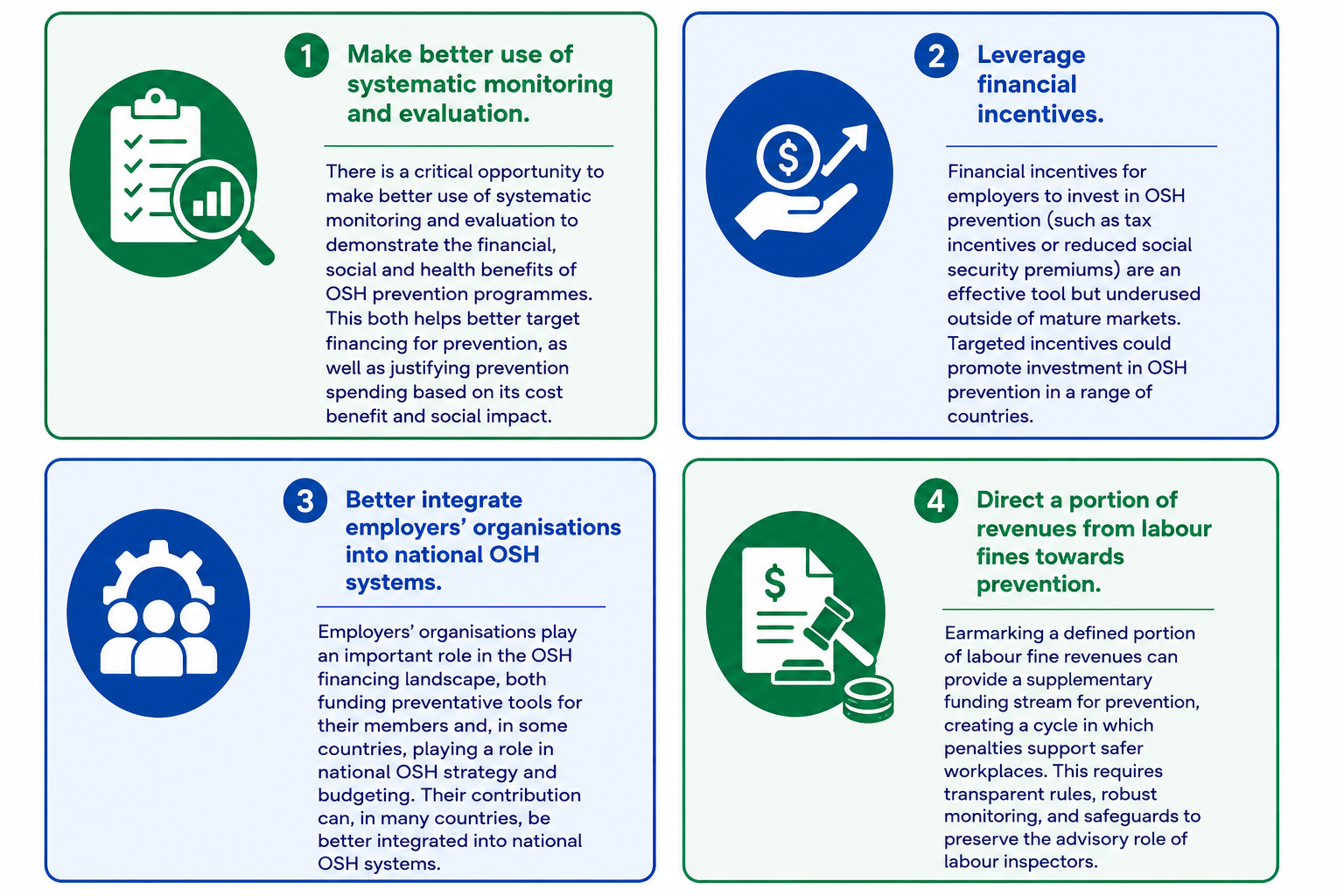
References
BAuA (Federal Institute for Occupational Safety and Health). 2024. BAuA Figures – Data and Facts. https://www.baua.de/EN/About-BAuA/BAuA-figures-data-facts
BMAS (Federal Ministry of Labour and Social Affairs). 2023. Old-Age Security in Germany. https://www.bmas.de/EN/Social-Affairs/Old-age-security-in-Germany/old-age-security-in-germany-art.html
BMAS (Federal Ministry of Labour and Social Affairs). 2024a. Rentenversicherungsbericht 2024. Berlin: Federal Ministry of Labour and Social Affairs. https://www.bmas.de/SharedDocs/Downloads/DE/Rente/rentenversicherungsbericht-2024.pdf
BMAS (Federal Ministry of Labour and Social Affairs). 2024b. New Quality of Work Initiative (INQA). https://www.bmas.de/EN/Labour/Occupational-Safety-and-Health/occupational-safety-and-health-art.html
BMAS/BAuA. 2024. Sicherheit und Gesundheit bei der Arbeit – Berichtsjahr 2023. Dortmund: BAuA. https://www.baua.de/DE/Angebote/Publikationen/Berichte/Suga-2023
BMF (Federal Ministry of Finance). 2024. Bundeshaushalt Digital. https://www.bundeshaushalt.de/DE/Bundeshaushalt-digital/bundeshaushalt-digital.html
BMG (Federal Ministry of Health). n.d. Financing of the Statutory Health Insurance (GKV). https://www.bundesgesundheitsministerium.de/finanzierung-gkv
CNESST (Commission des normes, de l’équité, de la santé et de la sécurité du travail). n.d. “Mutuelles de prévention.” https://www.cnesst.gouv.qc.ca/fr/demarches-formulaires/employeurs/assurance-sante-securite-travail/tarification/reduire-prime-dassurance/mutuelles-prevention
DBM (Department of Budget and Management). 2024. General Appropriations Act FY2024. https://www.dbm.gov.ph/index.php/2024/general-appropriations-act-gaa-fy-2024
Deutsche Rentenversicherung. 2024. “Bundesmittel und Bundeszuschuss 2024.” https://www.deutsche-rentenversicherung.de/DRV/DE/Ueber-uns-und-Presse/Presse/Meldungen/2024/240719-bundesmittel-bundeszuschuss.html
DGUV (German Social Accident Insurance). 2023. Prevention Report. Berlin: Deutsche Gesetzliche Unfallversicherung. https://publikationen.dguv.de/widgets/pdf/download/article/5016
ECC (Employees’ Compensation Commission). 2024. Financial Status: State Insurance Fund; Corporate Operating Budget. https://www.ecc.gov.ph
ECOP (Employers Confederation of the Philippines). 2025. Survey on Occupational Safety and Health Financing in the Private Sector.
GKV-Spitzenverband. 2024. Präventionsbericht 2024: Leistungen der gesetzlichen Krankenversicherung – Primärprävention und Gesundheitsförderung. Berlin: GKV-Spitzenverband. https://www.gkv-spitzenverband.de/media/dokumente/krankenversicherung_1/praevention__selbsthilfe__beratung/praevention/praeventionsbericht/2024_GKV_MD_Praventionsbericht_barrierefrei.pdf
ILO (International Labour Organization). 2022. Supporting Companies’ Occupational Safety and Health Performance: A Guide for Employers and Business Membership Organizations on OSH Advocacy and Services. https://www.ilo.org/publications/supporting-companies-occupational-safety-and-health-performance-guide
ILO (International Labour Organization). 2023. Global Strategy on Occupational Safety and Health and Plan of Action (2024–2030). GB.349/INS/8. https://www.ilo.org/resource/conference-paper/gb/349/global-strategy-occupational-safety-and-health-2024%E2%80%9330-and-plan-action-its
INS (Instituto Nacional de Salud). 2024. Resolución de Presidencia Ejecutiva No. 258-2024-PE/INS. https://www.gob.pe/institucion/ins/normas-legales/6338088-258-2024-pe-ins
INS (Instituto Nacional de Salud). 2025. Presupuesto Institucional 2025. Portal de Transparencia Económica. https://transparencia.gob.pe/reportes_directos/pte_transparencia_info_finan.aspx?id_entidad=10032&id_tema=19&ver=
IWH (Institute for Work & Health). 2022. Estimating the Financial Return on Employers’ Investments in the Prevention of Work Injuries in Ontario. Issue Briefing. https://www.iwh.on.ca/sites/iwh/files/iwh/reports/iwh_issue_briefing_financial_return_employer_ohs_investments_2022.pdf
MHLW (Ministry of Health, Labour and Welfare). 2010. Labour Standards Inspection Services. https://www.mhlw.go.jp/jigyo_shiwake/dl/15-2a.pdf
MHLW (Ministry of Health, Labour and Welfare). 2023a. Annual Labour Standards Inspection Report 2023. Vol. 76. https://www.mhlw.go.jp/bunya/roudoukijun/kantoku01/dl/r05.pdf
MHLW (Ministry of Health, Labour and Welfare). 2023b. Budget Request for FY2023. https://www.mhlw.go.jp/wp/yosan/yosan/23syokan/dl/05-1b-01.pdf
MHLW (Ministry of Health, Labour and Welfare). 2024a. Workers’ Accident Compensation Insurance Premium Rate Table. https://www.mhlw.go.jp/content/11201000/000328655.pdf
MHLW (Ministry of Health, Labour and Welfare). 2024b. FY2024 Budget (Labour Insurance Special Account – Workers’ Accident Account). https://www.mhlw.go.jp/wp/yosan/kaiji/roudou56.html
MHLW (Ministry of Health, Labour and Welfare). 2024c. First Social Reintegration Promotion Programme Review Meeting for FY2024. https://www.mhlw.go.jp/content/11601000/001271311.pdf
MHLW (Ministry of Health, Labour and Welfare). 2024d. Second Social Reintegration Promotion Programme Review Meeting for FY2024. https://www.mhlw.go.jp/content/11601000/001337513.pdf
MHLW (Ministry of Health, Labour and Welfare). n.d. Science Research Grant Programme. https://www.mhlw.go.jp/stf/seisakunitsuite/bunya/hokabunya/kenkyujigyou/index.html
Ministry of Finance (Tunisia). 2025. Loi de Finances pour l’Année 2025. https://www.finances.gov.tn/fr/document/loi-des-finances-pour-lannee-2025ar
Ministry of International Cooperation (Tunisia). n.d. Rapport sur l’Appui des Partenaires au Secteur Social et de la Santé 2016–2025.
Ministry of Social Affairs (Tunisia). 2024. Annual Report 2023 of the Occupational Medicine Inspection.
MTPE (Ministry of Labour and Employment Promotion). 2025a. Plan Operativo Institucional Anual 2024 Actualizado Versión 4. https://cdn.www.gob.pe/uploads/document/file/7630513/6470218-documento-tecnico-poi-2024-actualizado-v4-1452-f.pdf
MTPE (Ministry of Labour and Employment Promotion). 2025b. Boletín No. 01-2025: Presupuesto del Sector Trabajo y Promoción del Empleo y su Ejecución al 31 de Enero de 2025. https://cdn.www.gob.pe/uploads/document/file/7630438/6470183-boletin-01-2025-1.pdf
Acknowledgements
This comparative report on occupational safety and health (OSH) prevention financing systems is based on six national case studies prepared by independent national experts and developed through a process of technical consultation and peer review.
The report was developed under the technical guidance of Joaquim Pintado Nunes, whose strategic direction and expertise helped shape its analytical framework and overall coherence.
The six case studies were prepared by Alice Merry (Peru), Anne St-Martin (Quebec), Monia Trabelsi (Tunisia), Teresita S. Cucueco (Philippines), Walter Eichendorf (Germany), and Yuki Shimazaki (Japan). Their detailed analyses provided the foundation for this comparative work.
The consolidation and comparative analysis were carried out by Alice Merry and Grace Gothuey, who synthesized the country findings and developed the comparative framework presented in this report. Francisco Santos O'Connor provided substantial analytical and editorial contributions that helped strengthen the quality, coherence and clarity of the final manuscript.
Valuable technical feedback and contextual insights were provided by field specialists Yuka Ujita, Aida Lamloum and Tzvetomira Radoslavova, whose contributions strengthened both the factual accuracy and contextual grounding of the study.
The report also benefited from thoughtful peer review and constructive comments from Lou Tessier, Matias Espinosa, Bernd Treichel, Maren Hopfe and Ana Catalina Ramirez. Their perspectives helped sharpen the analysis and enhance the clarity of the findings.
We would also like to thank Lucia Navarro Risueno for her careful reading of the manuscript and insightful suggestions, which contributed to improving the final version. Special thanks are also due to Catherine Weber Soto for reviewing legislative references and supporting the verification and inclusion of links to legal sources where publicly available.